
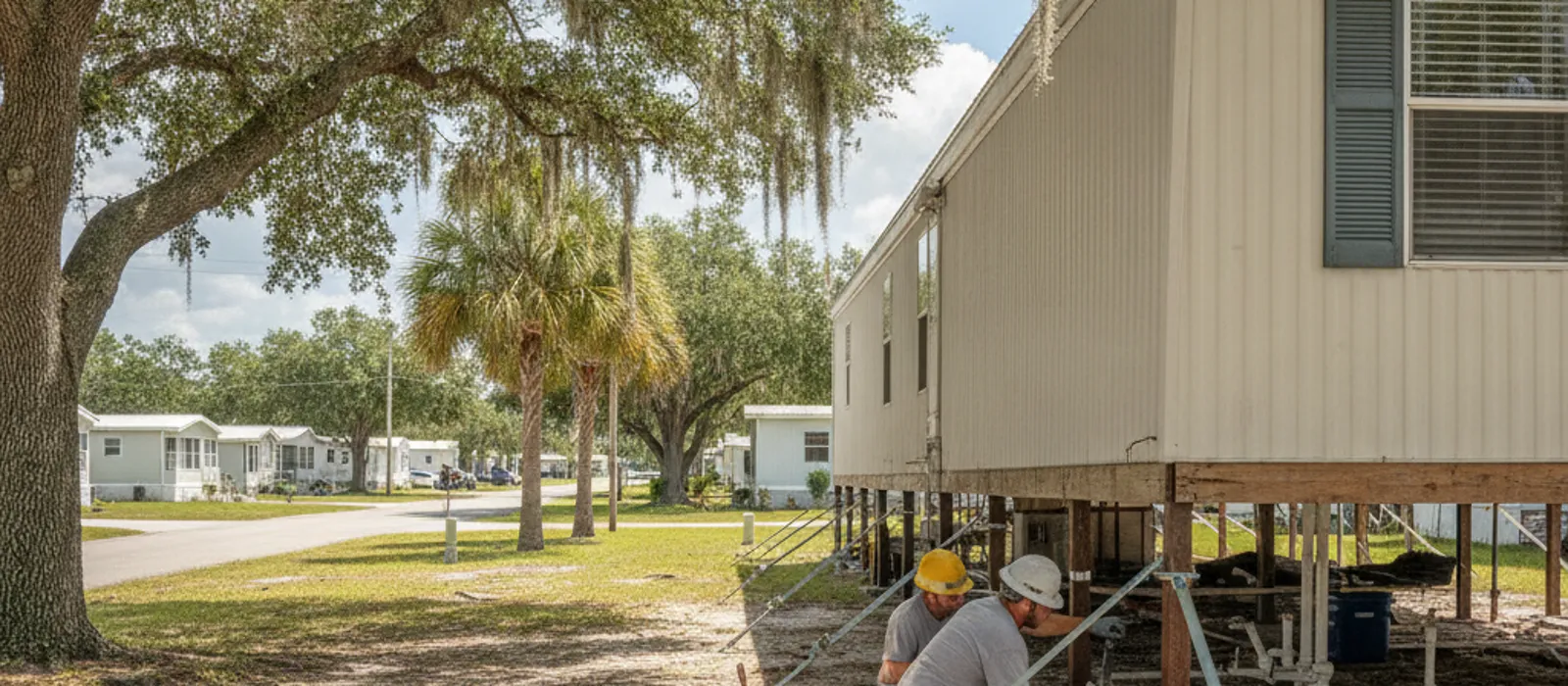
About one out of every three releveling calls we run in Marion County ends with the same hard conversation. We crawl under the home, shine a light on the piers, and have to tell the owner that shims alone won’t fix this one.
Knowing when to replace mobile home piers instead of just releveling can save you thousands of dollars, and not always in the direction you’d expect. Sometimes replacement now prevents a much bigger repair later. Sometimes an honest contractor should tell you a $700 relevel is all you need, even when a pushier company quoted you $5,000 in new piers.
This guide walks through both sides. You’ll learn what piers actually do, which problems shims can solve, which ones they can’t, and what real numbers look like here in Ocala and the surrounding towns.
What Mobile Home Piers Do, and Why Florida Wears Them Out
Your mobile home sits on a steel frame, and that frame rests on a grid of piers. Most homes around Ocala sit on stacked concrete blocks with a poured pad or ABS plastic pad underneath, capped with wood or plastic shims that fine-tune the height. A typical single-wide has 12 to 20 piers. A double-wide can have 30 or more, including piers along the marriage line where the two halves join.
Each pier carries somewhere between 2,000 and 6,000 pounds. That’s a lot to ask of stacked blocks sitting on Central Florida sand.
Our soil is the real enemy. Marion County sits on sandy soil over limestone, and that sand shifts when it gets soaked and dries out again. Summer thunderstorms dump water under homes with damaged skirting or no vapor barrier, the sand compacts unevenly, and piers start to sink, lean, or crack. We wrote more about that cycle in why mobile homes settle in Florida.
Age matters too. Concrete blocks are rated for decades of service, but constant moisture, soil movement, and point loading crack them early. A pier that went in when the home was set in 1985 has been through 40 years of wet seasons.
Here’s the good news: most pier problems we see are still fixable with a standard relevel. If you’re not sure which camp you’re in, call us at (352) 820-4441 and we’ll take a look. The inspection and written estimate are free, and we’ll tell you plainly if shims will do the job.
When Releveling Is Still the Right Call
Don’t let anyone talk you into full pier replacement before you understand what releveling can fix. A proper relevel involves jacking the frame, adjusting or replacing shims, and sometimes re-stacking a pier or two. It handles a surprising amount.
Releveling usually solves the problem when:
- Piers have settled but the blocks are intact. Sinking is a soil problem, not a pier problem. Jacking and reshimming restores the height.
- Shims are crushed, split, or missing. Wood shims compress over the years. Replacing them is routine work.
- Only a few piers are slightly out of plumb. A pier leaning a degree or two can often be re-stacked square during the relevel.
- Your symptoms are doors sticking, minor floor slopes, or small drywall cracks. These usually trace back to settling, not structural pier failure. Our post on the signs your mobile home needs leveling covers the full list.
Marcus in Summerfield is a good example. He called us convinced he needed all new piers because a door-to-door outfit had quoted him $4,800 after a five-minute look. His 2004 double-wide had settled at the north end after a wet summer, and three doors wouldn’t latch. Under the home, every block was sound. He needed a relevel with new shims and two re-stacked piers. Total: $850. The doors worked that afternoon.
That’s the relevel side. Now for the piers that are genuinely past saving.
When to Replace Mobile Home Piers: 7 Signs They’re Done
Some pier conditions can’t be shimmed away. When we see these under a home, replacement goes in the estimate, because jacking a home onto a failing pier just transfers thousands of pounds onto a component that’s already losing the fight.
1. Cracked or split blocks. Hairline surface cracks are common and usually cosmetic. Cracks that run through the block, spall off chunks, or let the block shift under hand pressure mean the pier has lost load capacity. Replace it.
2. Piers leaning more than about 1 inch out of plumb. A badly leaning pier isn’t carrying load straight down anymore. It’s on its way to kicking out entirely, and re-stacking the same crumbling blocks doesn’t fix why it leaned.
3. Crushed or rotted caps and shims that keep failing. If a pier eats a new set of shims every year or two, the pier or the pad under it is the problem, not the shims.
4. Sunken or broken pads. The pad spreads the load into the soil. A cracked pad, or one that’s punched down into the sand, lets the whole stack settle no matter how many times you relevel. This shows up a lot after tropical systems, which is why settling after heavy rain is worth watching.
5. Piers separated from the frame. If you can slide a hand between the pier cap and the steel beam, that pier is carrying nothing. Its share of the load moved to its neighbors, which are now overloaded and wearing out faster.
6. Mortar joints failing on mortared piers. Some older setups used mortared block. Once the joints crumble, the stack acts like loose blocks with extra weight and less flexibility.
7. The wrong pier for the load. Single-stacked blocks under a marriage line, undersized piers under a later addition, or dry-stacked blocks taller than code allows without proper reinforcement. HUD’s installation standards spell out pier requirements by height and load, and you can read them straight from the source at HUD’s Manufactured Housing Program.
One or two bad piers doesn’t mean the whole grid is shot. Most replacement jobs we do in Marion County swap 3 to 8 piers and relevel the rest. Full pier system replacement is rare and usually limited to homes from the 1970s that were set on undersized stacks to begin with. If you own one of those, our guide to pre-1976 mobile homes in Florida covers the extra wrinkles.
Relevel vs Replace: What Each One Costs Around Ocala
Here’s how the two jobs compare for homes in our service area. Every home is different, so treat these as honest ballparks, not quotes.
| Job | Typical Cost (Marion County) | What It Includes | When It’s the Right Fix |
|---|---|---|---|
| Relevel, single-wide | $450 to $900 | Jack frame, new shims, re-stack minor piers, recheck level | Settling with sound piers |
| Relevel, double-wide | $700 to $1,500 | Same, plus marriage line adjustment | Settling with sound piers |
| Replace 1 pier | $150 to $350 | New blocks, cap, shims, pad if needed | Isolated cracked or leaning pier |
| Replace 5 to 8 piers plus relevel | $1,800 to $4,000 | New piers where failed, full relevel | Scattered pier failure |
| Full pier replacement, single-wide | $4,000 to $8,000 | All new piers, pads, and shims, full relevel | Widespread block failure, very old setups |
Two things jump out of that table. First, replacing a handful of piers during a relevel adds hundreds, not thousands. Second, ignoring bad piers is the expensive path, because a collapsed pier can twist the frame, crack the subfloor, and open plumbing joints. We break the numbers down further in our mobile home pier replacement cost guide and on our mobile home leveling cost page.
Ruth in Belleview learned the cheap-now-expensive-later lesson secondhand, fortunately. Her 1988 single-wide had eight piers with through-cracked blocks, and a handyman offered to “shim it up” for $300. She called us for a second opinion instead. We replaced the eight piers and releveled the home for $2,650. Six months later, Hurricane season dumped 11 inches of rain on her park and her floors stayed dead level. Her neighbor, who took the $300 shim job on a similar home, ended up with a dropped corner and a $1,900 repair that winter.
How Pros Decide Whether to Replace Mobile Home Piers or Reshim
When we inspect under a home, we’re not eyeballing it and guessing. Here’s the actual process, so you can judge whether any contractor’s recommendation holds up.
We check the level first with a water level or laser across the frame, which tells us how far out the home is and where. Then we inspect every pier individually: block condition, plumb, cap and shim condition, pad condition, and contact with the frame. We probe the soil at suspect piers, because a pier sinking into a soft pocket needs a bigger pad or a poured footer, not just new blocks.
We also look at the pattern. Ten piers all settled evenly points to soil, so relevel. Three piers cracked on the wet side of the home points to a water problem, so we’ll replace those piers and tell you to fix the gutter or grading feeding them. Piers failing under the marriage line of a double-wide gets extra attention because that’s the highest load in the home.
The moisture question matters more than most owners realize. Standing water under a home destroys piers faster than anything else, and it usually comes with a shredded vapor barrier. If that’s part of your problem, pairing pier work with a new vapor barrier protects the investment. Otherwise you’re putting new piers into the same swamp that killed the old ones.
The Hendersons in Dunnellon are the textbook case. Their double-wide sits low near the Withlacoochee, and years of under-home moisture had rotted shims and cracked 14 piers on the river side. We replaced the 14 piers, releveled the home, and installed a new vapor barrier in the same visit for $5,400 total. The pier work alone would have been about $4,200, but without the moisture fix they’d have been calling us back in five years.
What Pier Replacement Day Actually Looks Like
Replacement is less dramatic than it sounds. Your home doesn’t get lifted into the air, and you don’t need to move out.
The crew jacks the frame just enough to unload the failed pier, usually less than an inch. The old blocks and pad come out. A new pad goes down on compacted soil, new blocks get stacked and capped, shims are set, and the jack comes down so the pier takes its load. Then the next pier. A typical 5-to-8-pier replacement with a full relevel takes most of one day. We walk through the whole sequence in how mobile home leveling works.
Permits deserve a mention. In Florida, mobile home installation and stabilization work falls under state rules, and licensed installers are regulated through the FLHSMV mobile home program. Reputable contractors handle any required paperwork. If someone shrugs off the question, that tells you something.
One more practical note: if you’re facing a 4-point inspection or a pre-closing deadline, pier condition often shows up in the report. We run a 24/7 line for exactly those situations. Call (352) 820-4441 or request your free written estimate and we’ll get eyes under the home fast.
Where DIY Ends and the Pros Begin
You can and should do your own quick checks. Walk the perimeter, look for leaning piers through skirting vents, and note doors that stick or floors that slope. Crawling under with a flashlight to photograph pier condition is fine if the home is stable and you don’t touch anything.
Stop there. Jacking a mobile home puts tons of steel and lumber in motion over your body. Bottle jacks kick out, blocks shift, and frames drop without warning. Homes have killed people this way. Pier replacement also affects your tie-down system, since anchors and straps are set relative to the frame height, and Florida wind zone rules leave no room for improvisation. Our mobile home leveling in Ocala crews carry the jacks, cribbing, and insurance this work requires.
If your inspection photos show cracked blocks or daylight between a pier and the frame, that’s your cue to hand it off.
Frequently Asked Questions
How long do mobile home piers last?
Concrete block piers routinely last 30 to 50 years when the soil is stable and the underside stays dry. In Central Florida’s sandy, wet conditions, expect trouble spots sooner, especially on homes without a working vapor barrier. Individual pier failures in the 15-to-25-year range are common here, which is why periodic inspection matters more than the calendar.
Can I replace just one or two bad piers?
Yes, and that’s the most common repair we do. Isolated replacements run $150 to $350 per pier, and we relevel the surrounding area so the new pier carries its fair share. Replacing only the failed piers is completely legitimate as long as the rest of the grid checks out sound.
Will homeowners insurance pay for pier replacement?
Usually not for wear, settling, or age, which insurers treat as maintenance. Damage from a covered event like a hurricane may qualify, so document conditions with photos before and after storms. Where piers really intersect with insurance is the 4-point inspection, since visible pier failure can hold up coverage or a sale.
How do I know if my piers failed or the home just settled?
Settling shows up as a home that’s out of level while the piers themselves look intact and plumb. Pier failure shows up as cracked or leaning block stacks, crushed caps, or gaps between pier and frame. From inside the home the symptoms feel identical, so the only reliable answer comes from a proper under-home inspection, which we do free anywhere in Marion, Sumter, and Citrus counties.