
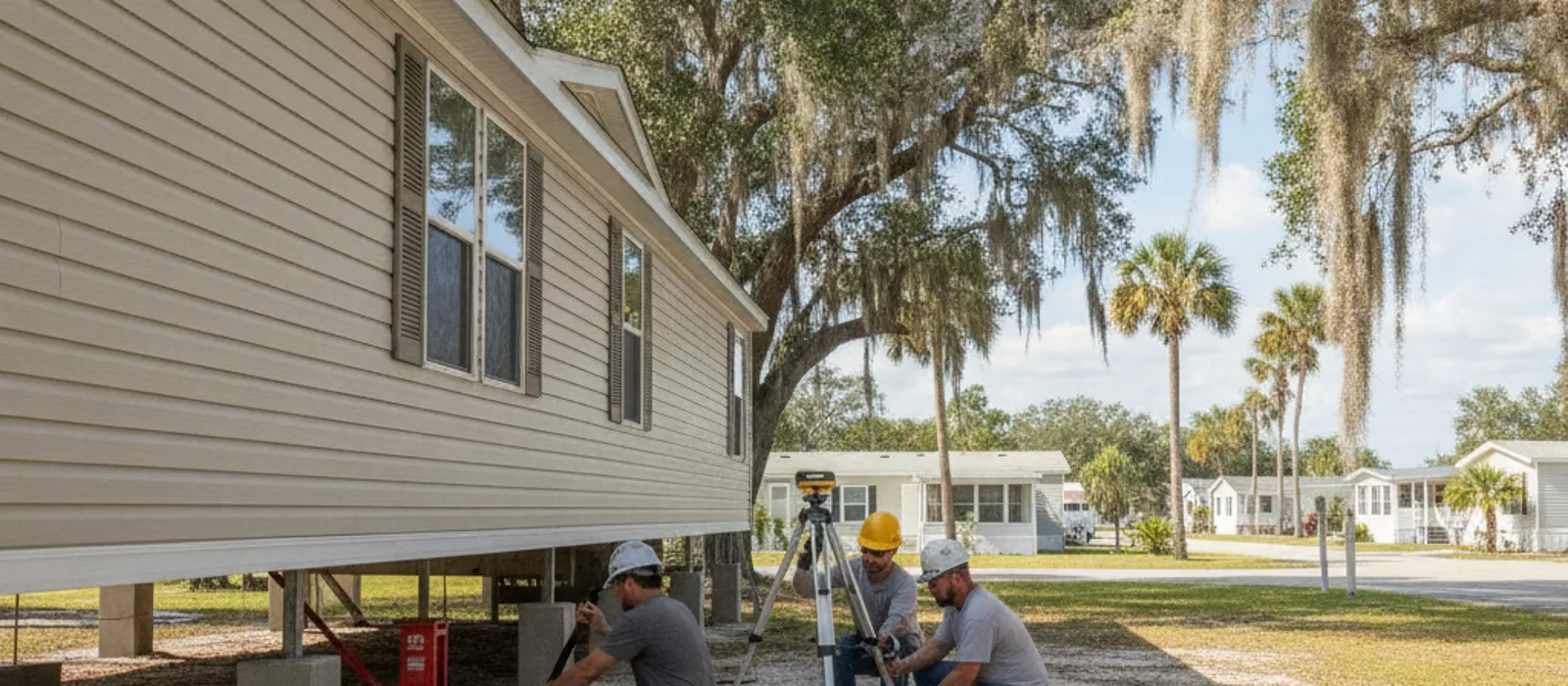
Your bedroom door swings open by itself. A crack just showed up over the kitchen window. And last week you noticed the floor near the hallway feels like it tilts a little downhill. Those three things almost always trace back to one cause, and fixing it usually takes less than a day.
If you’ve been searching for how to level a mobile home, this article walks you through the whole process the way a professional crew does it. You’ll see every step, what the tools look like, what it costs here in Marion County, and where the line sits between a job you can handle and one that can hurt you.
We level homes all over Ocala, Belleview, Summerfield, Dunnellon, Silver Springs, and down into Lady Lake. The steps below are the same ones our crews run through under hundreds of homes a year.
Why Mobile Homes Get Out of Level in Florida
Every manufactured home sits on a series of piers, usually concrete blocks stacked on ABS pads or poured footers, spaced along the steel frame. The home is only as level as those piers, and the piers are only as stable as the ground under them.
Central Florida ground moves. Our sandy soil drains fast, then compacts when it stays wet through a long rainy summer. One pier settles a half inch, the frame above it drops, and the whole structure starts twisting by tiny amounts. You don’t see the piers move. You see the symptoms upstairs: doors that won’t latch, cracks in drywall seams, windows that stick, floors that slope or bounce.
If you’re seeing those symptoms now, our post on the signs your mobile home needs leveling breaks down which ones matter most. The short version: the earlier you catch it, the cheaper the fix.
Ruth in Belleview is a good example. She called us because two interior doors had stopped latching over the course of a spring. Our tech found four piers along one side had settled between a quarter inch and three quarters of an inch. The relevel ran $1,400, took about five hours, and both doors latched again before the crew packed up. No drywall repair, no subfloor work, because she called early.
Not sure if your home has drifted out of level? Call us at (352) 820-4441 and we’ll come check it for free. The estimate is written, and there’s no pressure attached to it.
How Pros Check a Mobile Home for Level Before Lifting Anything
The first step isn’t a jack. It’s measurement. You can’t fix what you haven’t mapped, and a crew that starts lifting without a full reading of the frame is guessing.
Most pros use a water level: a long clear tube filled with water, sometimes with an electronic sensor on one end. Water finds its own height no matter how the tube snakes around piers and plumbing, so it gives a true reading across the entire footprint of the home. Laser levels work too, but under a home full of ductwork and belly board, the water level is still the tool most crews trust.
Here’s the sequence:
- Pick a reference point. The tech chooses one spot on the steel I-beam frame, usually near the center of the home, and calls it zero.
- Read every pier location. Moving pier to pier, the tech records how far above or below zero the frame sits at each point. A typical single wide has 12 to 20 piers. A double wide can have 30 or more, plus a marriage line down the center.
- Map the problem. The readings get sketched onto a diagram of the home. Now the crew can see the pattern: one settled corner, a sunken center line, or a whole side that’s dropped.
- Inspect every pier. While they’re under there, the crew checks each stack for cracked blocks, crushed or split wood shims, tilted caps, and pads that have sunk into the soil.
That last step matters more than people think. A relevel on top of a cracked pier is a temporary fix. If piers are failing, they need to be rebuilt or replaced during the same visit, which is why quotes can vary. Our guide on how pros check a mobile home for level goes deeper on the measurement side if you want the full picture.
Frame tolerance is tighter than most homeowners expect. Manufacturers generally want the frame within about a quarter inch over the length of the home. By the time you can feel a slope in the floor, you’re usually past three quarters of an inch somewhere.
The Step-by-Step Mobile Home Leveling Process
Once the frame is mapped, the actual leveling starts. Here’s how the work goes, step by step.
Step 1: Clear the work zone. The crew removes a few skirting panels for access, checks for plumbing and electrical lines near the lift points, and lays out jacks, blocks, and shims where they’ll be needed.
Step 2: Set the jacks. Hydraulic bottle jacks, usually 12 to 20 ton units, go under the steel I-beam next to the low piers. Never under the axles, never under the plumbing, always on solid cribbing so the jack can’t sink or kick out. On soft ground, crews stack hardwood cribbing to spread the load.
Step 3: Lift in small increments. This is the part that separates pros from weekend attempts. The frame comes up slowly, an eighth to a quarter inch at a time, often at multiple points in sequence. Lift one spot two inches in one shot and you can crack drywall, split the ceiling at the marriage line of a double wide, or stress plumbing joints. Small moves, constant re-checking against the reference point.
Step 4: Rebuild and shim the piers. With the frame held at the correct height, the crew rebuilds each pier stack to fit the new gap. Cracked blocks get replaced. Then hardwood wedge shims get driven in from both sides between the pier cap and the frame until the fit is snug. Shims are the fine tuning of the whole job; there’s a reason we wrote a whole post just on mobile home leveling shims.
Step 5: Lower and verify. The jacks come down slowly so the full weight transfers onto the rebuilt piers. Then the tech runs the water level across every pier point again. Anything off gets adjusted before the crew moves on.
Step 6: Re-check tie-downs and close up. Lifting a frame changes the tension on anchor straps. A good crew re-checks the tie-downs before reinstalling skirting, because a strap that went slack during the lift isn’t protecting you in a storm. Florida regulates mobile home installation and tie-down standards through the state, and the Florida Highway Safety and Motor Vehicles mobile home program is the agency behind those rules. If your straps are rusted or loose, our mobile home tie-down service in Ocala handles re-anchoring, often in the same visit.
Step 7: Test inside the home. Doors, windows, floor slope. The problems that brought you to this article should be visibly better before the crew leaves.
Total time for most single wides: 2 to 4 hours. Double wides usually run 4 to 8 hours because of the pier count and the marriage line. If timing matters for a closing or an insurance deadline, see how long mobile home leveling takes for realistic schedules.
What It Costs to Level a Mobile Home in Marion County
Here’s what leveling work typically runs in our service area. Every home is different, so treat these as honest ranges, not quotes.
| Job type | Typical price range | Typical time |
|---|---|---|
| Single wide relevel | $450 to $1,500 | 2 to 4 hours |
| Double wide relevel | $800 to $2,500 | 4 to 8 hours |
| Relevel plus pier repairs | $1,500 to $4,000 | 1 day |
| Full pier replacement plus relevel | $3,000 to $8,000+ | 1 to 2 days |
| Level check and written estimate | Free | About an hour |
What pushes a job toward the high end? Bad pier condition, poor access under the home, very soft or washed-out soil that needs new pads or footers, and homes that sat unlevel for years and developed structural stress. Our mobile home leveling cost guide breaks the pricing down line by line.
Two quick local examples. Mike in Summerfield had a double wide with a settled marriage line: humps in the floor down the center hallway and a kitchen ceiling crack. His relevel plus six replaced blocks came to $2,100, done in one day. Carla in Dunnellon waited about three years after her doors first started sticking. By then, water pooling under the home had rotted several pier caps and the settling had opened a gap at the marriage line. Her job needed twelve pier rebuilds along with the relevel and came to $4,700. Same size home as Mike’s. The difference was time.
If you’d rather not find out which example you are, request a free written estimate and we’ll put real numbers on paper for your home.
Can You Level a Mobile Home Yourself?
Honest answer: parts of this job are DIY-able for a careful person, and parts of it can put you in the hospital.
What you can safely do yourself: crawl the perimeter with a flashlight and look for tilted piers, crushed shims, and gaps between pier caps and the frame. Check doors and windows for sticking. Set a 4-foot level on your floors in a few rooms. That inspection costs you nothing and tells you whether it’s time to make a call.
Where DIY gets dangerous is the lift. You’re putting tons of steel and structure on hydraulic jacks in a crawl space you can’t stand up in. A jack that kicks sideways, cribbing that sinks into soft sand, or a lift point that buckles can drop the frame with you under it. People are killed this way, and the federal standards that govern manufactured home installation exist partly because of it. The HUD manufactured housing program sets the construction and installation standards these homes are built and set to, and Florida layers its own installer licensing on top.
There’s also the quiet cost of getting it wrong. An uneven DIY lift can crack drywall, break plumbing joints, and stress the frame in ways that cost more to fix than the professional relevel would have. We wrote up the full risk-and-reward picture in our DIY mobile home leveling guide if you’re weighing it.
Our rule of thumb: measure and inspect yourself all you want. The moment the fix requires a jack under the frame, call a pro.
What Happens After the Crew Leaves
A good leveling job should hold for years, but Florida ground keeps doing Florida things. A few habits protect the work.
Keep water away from the piers. Gutters, downspout extensions, and grading that slopes away from the home stop the wet-dry cycles that cause most settling. If water already collects under your home, deal with it, because it also breeds mold and wrecks vapor barriers. A solid vapor barrier under the home keeps ground moisture from attacking your belly board and floors from below.
Re-check level every couple of years, or after any hurricane or unusually wet season. Most homes in our area want a professional relevel every 3 to 5 years, though homes on well-prepared pads can go longer.
And keep your paperwork. If you sell the home or your insurer asks for a 4-point inspection, a written record of professional leveling and tie-down work makes those conversations a lot easier.
Ready to get your home sitting flat again? Call (352) 820-4441, day or night if you’re up against an inspection or insurance deadline, or send us a note and we’ll schedule your free level check anywhere in Marion, Sumter, or Citrus County.
Frequently Asked Questions
How do I know if my mobile home needs leveling?
The most common signs are doors that stick or swing on their own, cracks at drywall seams and around window corners, sloped or bouncy floors, and skirting that buckles or pulls away. You can confirm with a 4-foot level on the floor in several rooms. If you’re seeing two or more of these signs, it’s worth a professional level check, which we do for free.
How long does it take to level a mobile home?
Most single wides take 2 to 4 hours, and most double wides take 4 to 8 hours. Jobs that include pier rebuilds or replacements can stretch to a full day or two. You can stay in the home during the work; you’ll just hear some noise and feel small movements as the frame comes up.
How much does mobile home leveling cost in the Ocala area?
Most single wide relevels run $450 to $1,500, and double wides run $800 to $2,500. Pier repairs, soft soil, or long-neglected settling can push totals higher. We give free written estimates so you know the exact number before any work starts.
How often should a mobile home be releveled?
In Central Florida, plan on a check every 2 to 3 years and expect most homes to need an actual relevel every 3 to 5 years. Sandy soil and heavy rainy seasons here move piers faster than in drier states. Homes with good drainage and well-compacted pads can go noticeably longer between visits.