Somewhere in your garage there’s a bottle jack, and somewhere in your head there’s a voice saying you could level your own mobile home this weekend. Before you crawl under 15,000 pounds of steel and wood with that jack, it’s worth knowing exactly what the job involves, because DIY mobile home leveling is one of those projects that looks simple on YouTube and feels very different once you’re on your back in a 24-inch crawl space in July.
Here’s the honest answer up front. Yes, some homeowners can relevel a mobile home themselves. It’s legal for an owner to work on their own home in Florida in most cases, and the basic concept isn’t complicated. But the gap between “concept” and “done right” is wide, and the price of getting it wrong is measured in cracked frames, broken piers, and in the worst cases, crushed limbs. Around Ocala and Marion County, we get called out a few times a year to fix DIY jobs that went sideways, and those repairs almost always cost more than the original leveling would have.
So let’s walk through the whole thing honestly. The tools, the steps, the money, and the moments where smart people put the jack down and pick up the phone.
What DIY Mobile Home Leveling Actually Requires
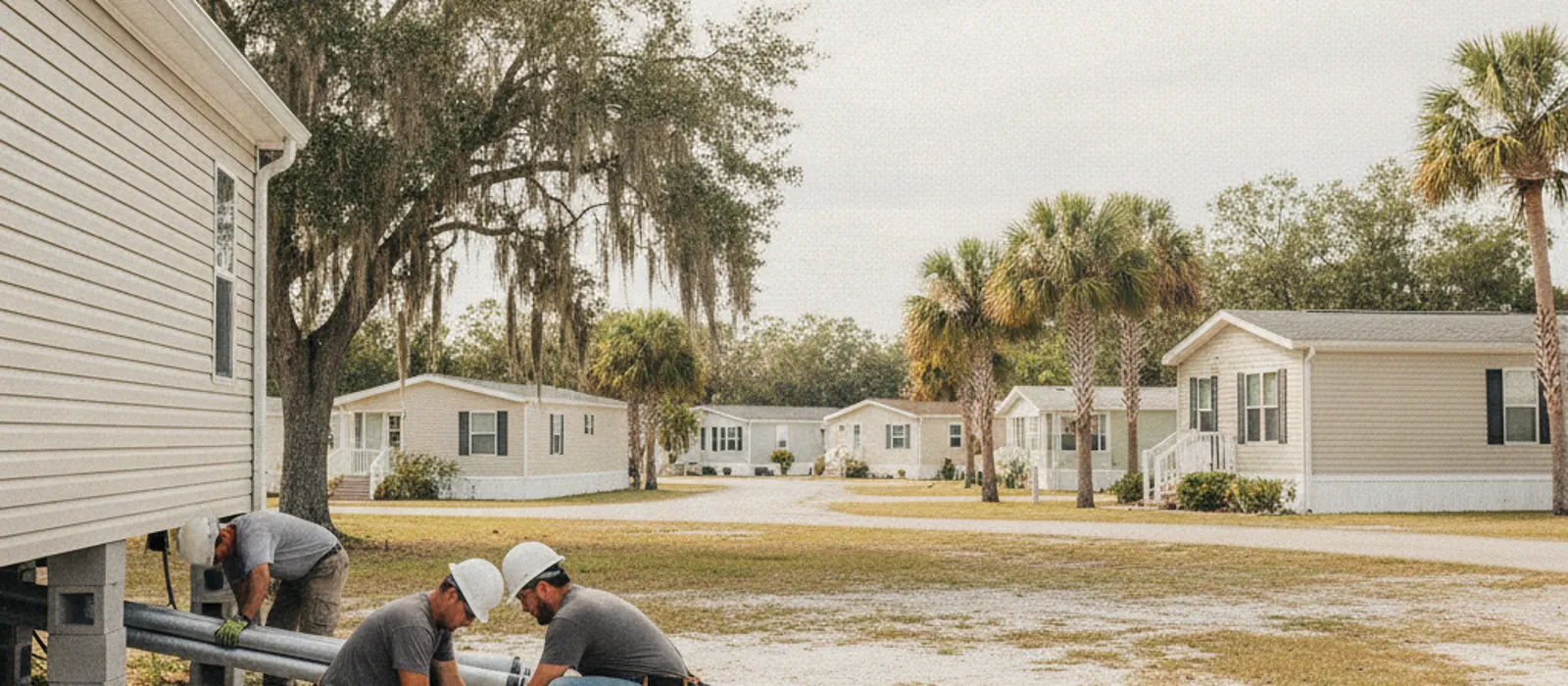
Start with what’s under your home. A typical single wide in Marion County sits on 12 to 20 concrete block piers. A double wide can have 30 or more, plus piers along the marriage line where the two halves join. Each pier carries a share of the home’s weight, and over time our sandy Central Florida soil shifts, washes, and compacts unevenly. Piers settle at different rates, the steel frame stops sitting flat, and you get sticking doors, sloped floors, and cracks over window corners.
Leveling means raising the low sections of the frame back to a common plane and resetting or shimming the piers underneath so they carry weight evenly again. That’s it in one sentence. In practice, it means:
- Crawling the full length of the home, often through spider webs, insulation scraps, and whatever the last owner left under there
- Reading a water level or laser level accurately at every pier, to within about a quarter inch
- Jacking a multi-ton structure a fraction of an inch at a time without twisting the frame
- Placing hardwood shims and pier caps so the load transfers cleanly, not on a wedge edge that will crush later
If you’ve never done it, plan on a full weekend for a single wide and considerably more for a double wide. Pros do a single wide in a day because they’ve done hundreds. Your first one will not go like their five hundredth.
If you’d rather skip the crawl space entirely, we get it. Call Ocala Level Pros at (352) 820-4441 and we’ll come out, measure everything, and hand you a free written estimate. No pressure, and you’ll at least know what the pro price is before you buy tools.
The Tools You’ll Need and What They Cost
Here’s where the “free if I do it myself” math starts to wobble. A proper DIY setup isn’t just a jack from the trunk of your car. Automotive scissor jacks and cheap 2-ton bottle jacks have no business under a house.
| Item | Typical Cost | Notes |
|---|---|---|
| 20-ton bottle jack (need 2) | $60 to $100 each | 12-ton minimum, 20-ton is safer under steel I-beams |
| Water level or rotary laser level | $30 to $250 | The water level is cheap and accurate; lasers are faster |
| Hardwood shims and wedges | $40 to $80 | Oak or similar hardwood only, never pine or plastic scraps |
| Steel or solid concrete jack pads | $50 to $120 | Jacks sink into sand without a solid base |
| Extra concrete blocks and caps | $60 to $150 | For piers that need rebuilding, not just shimming |
| Crawl suit, gloves, eye protection, headlamp | $50 to $90 | Non-negotiable under a mobile home |
| Total for a first-timer | $350 to $800 | Before you’ve lifted anything |
Compare that to what professional releveling runs in our area. Most single wides around Ocala land between $450 and $900, and double wides typically run $700 to $1,500 depending on pier count and access. Our mobile home leveling cost guide breaks down the ranges in detail. Once you buy decent tools, the DIY savings on a single releveling job often shrink to a few hundred dollars, and that’s if everything goes right.
Step by Step: How Leveling a Mobile Home Yourself Actually Goes
Assuming you’ve decided to try it, here’s the sequence a careful DIYer follows. Read it once as a plan and a second time as a reality check.
1. Inspect before you touch anything. Crawl the full underside with a headlamp. Look for cracked blocks, tilted piers, rusted frame sections, sagging belly board, and soft wet soil. Mark every pier with chalk and note which ones have gaps between the cap and the frame. Our underside inspection walkthrough shows what pros look for at this stage.
2. Establish your reference. Run a water level along the main I-beams and record the reading at every pier. You’re building a map of high and low spots. Most homes in our area are low at one end or along one side where rainwater has been washing soil away for years.
3. Set your jack on a solid base near the lowest pier. The jack goes under the steel I-beam, never under the floor, axles, plumbing, or the hitch. On Florida sand, the jack needs a pad or it will press itself into the ground instead of lifting the home.
4. Lift slowly, a quarter inch at a time. You’ll hear the home creak and pop. That’s the structure moving, and small moves are fine. Big fast lifts are how frames twist, drywall splits, and water lines pull apart at their fittings.
5. Shim or rebuild the pier, then ease the weight back down. Hardwood wedges go in pairs from opposite sides so the bearing surface stays flat. If a pier is cracked or leaning, it needs to be rebuilt from the footer up, not shimmed taller.
6. Re-check every pier after every adjustment. Lifting one spot changes the load on its neighbors. This is the step DIYers skip, and it’s why so many DIY jobs are out of level again within months.
7. Check your tie-downs when you’re done. Raising the frame changes strap tension. Florida law cares a lot about this, and so does your insurance company. The state’s mobile home installation standards are administered by the Florida Department of Highway Safety and Motor Vehicles, and loose or rusted straps are a common 4-point inspection failure. If your straps look questionable, our tie-down service page explains what proper anchoring involves.
Written out like that, it sounds manageable. Now let me tell you about a few neighbors of yours.
Where DIY Jobs Go Wrong: Three Local Stories
Gary in Belleview watched two videos, bought a 12-ton jack, and started lifting his 1998 single wide at the low corner. He raised it almost two inches in one go because “that’s where it needed to be.” The fast lift cracked drywall in three rooms, popped the kitchen window frame out of square, and split a pier cap. Our releveling quote before he started was $600. The bill after, including pier repair and releveling the twist he’d put into the frame, came to $1,375. The drywall repair was on top of that.
Denise in Summerfield did almost everything right on her double wide, but she shimmed with pressure-treated pine scraps from a fence project. Pine compresses under point load. Fourteen months later her marriage line had opened up, the ceiling seam cracked, and interior doors were sticking again. Releveling with proper hardwood shims and two rebuilt marriage-line piers ran her $1,100. The pine had also crushed unevenly, so the home was further out of level than when she started.
Ray in Dunnellon never got past step three, and he’s the story we’re happiest to tell. He crawled under with his jack, saw the soil was saturated from a wet June, and felt the jack pad tilt on the first pump. He backed out and called us instead. We found a washed-out footer and standing water that needed drainage work before any leveling made sense. His total came to $840 for the leveling plus a graded swale, and nobody got hurt. Ray made the single smartest DIY move there is: recognizing the moment the job stopped being DIY.
If any of these sound like where you’re headed, reach out through our contact form before the small problem becomes a Gary-sized one. Written estimates are free, and telling you “yours is actually fine” costs us nothing.
DIY vs. Professional Mobile Home Leveling: The Real Math
Money is usually the whole reason people consider DIY, so let’s be straight about it.
A pro crew brings a truck full of 20-ton jacks, cribbing, blocks, caps, and hardwood shims. They level a single wide in two to five hours and warranty the work. You bring $350 to $800 in new tools, a free weekend, and a learning curve. If your home just needs routine shimming and your piers are sound, DIY can genuinely save you $200 to $500.
But the math flips fast when anything is nonstandard. Cracked piers, a twisted frame, soft soil, plumbing that’s already tight, a double wide marriage line, or a home that hasn’t been releveled in 15 years all raise the odds of the DIY job costing more than the pro job would have. HUD’s manufactured housing program sets the construction standards these homes are built to, and those standards assume the support system is installed and maintained correctly. When a DIY fix drifts from that, you can create inspection and insurance problems that follow the home for years.
There’s also the timing question. If you’re leveling because of a 4-point inspection deadline, a sale, or an insurance requirement, a DIY job usually won’t come with the documentation the other party wants. Pros hand you paperwork. Your bottle jack doesn’t.
When to Put the Jack Down and Call a Professional
Some situations take DIY off the table completely. Stop and call a pro if you see any of these:
- Cracked, crushed, or leaning piers. These need rebuilding under load, which requires cribbing and equipment most homeowners don’t have.
- A double wide that’s off along the marriage line. Get this wrong and you damage the roof seam, ceiling, and both halves of the home.
- Rusted or damaged frame steel. Jacking against compromised steel is how frames buckle.
- Soft, wet, or washing soil. Leveling on bad ground fails within a year. Drainage or footer work comes first.
- Signs of repeated settling. If the home has needed leveling more than once in a few years, something underneath is wrong. Our post on why mobile homes settle in Florida covers the usual suspects.
- Any moment the jack tilts, sinks, or the home shifts sideways. Back out. No amount of saved money is worth being under a home that moves.
And a hard safety rule that applies to everyone, DIY or not: never put any part of your body under the frame unless the home is supported by cribbing or piers, not just the jack. Jacks fail. Hydraulics leak. Sand shifts. Every year people are killed under vehicles and structures held up by nothing but a jack, and a mobile home outweighs your truck several times over.
If you’re not sure which side of the line your home falls on, the symptoms usually tell the story. Doors that won’t latch, cracks radiating from window corners, and floors that slope toward one end are covered in our guide to the signs your mobile home needs leveling. And if you want to understand what a pro crew actually does before you hire one, how mobile home leveling works walks through our whole process.
The bottom line: DIY mobile home leveling is possible for a sound single wide on good soil with a patient owner who respects the weight involved. For everything else, the pro price is cheaper than it looks once you count tools, time, and the cost of mistakes. Call (352) 820-4441 for a free written estimate anywhere in Marion, Sumter, or Citrus County, and we’ll give you real numbers for your exact home. If you start the DIY job and hit something that worries you, call anyway. We’d rather finish your job than fix it.
Frequently Asked Questions
Is it legal to level my own mobile home in Florida?
Generally yes, an owner can perform maintenance like releveling on a home they own and occupy. The picture changes if the home is in a park with rules about who works under homes, or if the work involves the tie-down and anchoring system, which falls under state installation standards. When in doubt, check with your park manager and the Marion County building department before starting.
How much does DIY mobile home leveling cost compared to hiring a pro?
Plan on $350 to $800 for proper tools and materials if you’re starting from scratch. Professional releveling in the Ocala area typically runs $450 to $900 for a single wide and $700 to $1,500 for a double wide. If you already own good jacks and your piers are sound, DIY can save a few hundred dollars. If anything needs rebuilding, the pro route is usually cheaper in the end.
What size jack do I need to level a mobile home?
Use a 12-ton bottle jack at absolute minimum, and a 20-ton is the safer choice under steel I-beams. Automotive scissor jacks and small floor jacks are dangerous under a structure this heavy. Just as important as the jack is what’s under it: a solid steel or concrete pad, because Florida sand will swallow a jack base before the home ever lifts.
How do I know if my home needs leveling or something bigger?
Sticking doors, new drywall cracks, and sloping floors point to routine settling that leveling fixes. Cracked or leaning piers, repeated settling within a couple of years, standing water underneath, or movement after heavy rain suggest a soil or drainage problem that leveling alone won’t solve. A professional inspection sorts one from the other, and ours comes free with a written estimate.