
Set a marble on your kitchen floor. If it takes off rolling toward the hallway, your home just answered a question most owners never think to ask. Knowing how to tell if a mobile home is level isn’t guesswork, and it doesn’t take a $2,000 instrument either. Pros around Ocala and Marion County rely on three main tools: water levels, rotary lasers, and plain old string lines. Each one measures the same thing in a different way, and each has a place under your home.
Here’s how the pros actually check level, what the readings mean, why shims matter, and when to put the tools down and pick up the phone.
How to Tell If Your Mobile Home Is Level Before You Touch a Tool
Your home drops hints long before anyone crawls underneath with a gauge. The frame of a mobile home is steel, but everything attached to it is wood, drywall, vinyl, and glass. When one pier settles half an inch, those softer materials show the strain first.
Here’s what pros look for on the initial walkthrough:
- Doors that stick, swing open on their own, or won’t latch. A door is basically a giant rectangle in a frame. When the frame racks out of square, the door tells on it immediately.
- Cracks at the corners of doors and windows. Drywall and paneling crack where stress concentrates, and that’s almost always the corners of openings.
- Gaps between the floor and interior walls, or trim pulling away at the ceiling line.
- Windows that suddenly need a shove to open or close.
- A bouncy or slanted feel in one section of the floor, especially in hallways and near exterior doors.
- Skirting that’s buckling, bowing, or pulling away at the bottom. The home is pressing down unevenly on it.
None of these prove anything on their own. Florida humidity swells doors, and old subfloors get soft for their own reasons. But two or three signs showing up together in the same end of the home is a strong pattern. We break the full list down in our guide to the signs a mobile home needs leveling.
Ruth in Belleview called us last spring for exactly this reason. Her coffee mug kept sliding to one side of the kitchen table, and her back door had stopped latching. She’d assumed the door was just old. Our tech ran a water level under the home and found the rear corner sitting 2.5 inches low. Six piers needed adjustment and new shims. Total bill: $850, and her door latched again before the truck left the driveway.
If your home is showing two or more of these signs, don’t wait for the marble test to get worse. Request a free written estimate or call us at (352) 820-4441. The check itself takes under an hour at most homes.
The Water Level: The $20 Tool Pros Still Trust Most
The water level is the oldest leveling instrument in the trade, and plenty of experienced crews in Marion County still reach for it first. It’s nothing fancy: a long clear vinyl tube filled with water, sometimes with a little food coloring so it’s easier to read in the dark under a home.
The physics are simple and impossible to argue with. Water in a connected tube always settles at the same height on both ends, no matter how the tube twists, dips, or snakes around piers. Gravity does the calibrating.
Here’s how a pro uses one under a mobile home:
- One end of the tube is fixed at a reference point, usually near the center of the home at a known pier.
- The tech carries the other end to each pier location along both main steel I-beams.
- At every pier, they compare the water height in the tube against a mark on the frame.
- Each reading gets written down, pier by pier, until there’s a complete map of highs and lows.
That map is the whole game. A single reading tells you nothing. Twenty readings tell you the rear corner is 2 inches low, the center is holding, and the hitch end has risen slightly. Now you know exactly which piers need attention and by how much.
Water levels have two big advantages under a mobile home. First, they don’t need line of sight. Lasers get blocked by piers, ductwork, plumbing, and sagging belly board. Water doesn’t care. Second, they’re accurate to roughly an eighth of an inch over a 70-foot run, which is tighter than the tolerance most manufacturers call for anyway. HUD’s manufactured housing program, which sets the federal construction standards these homes are built to, is a good place to read about how these homes are engineered to sit on their supports: hud.gov manufactured housing standards.
The downside? Water levels are slow. Every reading means walking the tube to a new spot, letting the water settle, and reading it by flashlight. That’s why many crews now pair the old tool with a newer one.
Rotary Lasers and String Lines: What Pros Use to Check If a Mobile Home Is Level Fast
A rotary laser level spins a beam of light in a perfectly flat plane, 360 degrees around itself. Set it on a tripod under the home, and every pier gets swept by the same reference plane. The tech holds a receiver or a grade rod at each pier, and the unit beeps when it finds the beam. Readings that took 45 minutes with a water tube take 10 with a laser.
Good rotary lasers used by leveling crews are self-leveling and accurate to about a sixteenth of an inch per hundred feet. That’s more than enough precision for this work. The limitation is the crawl space itself. Under a mobile home you’re working in 24 to 36 inches of clearance, dodging piers, straps, plumbing drops, and insulation. The beam gets interrupted constantly, so the tech repositions the unit or shoots segments and ties them together.
Then there’s the string line, the humblest tool of the three. Pull a mason’s line tight along the bottom of the steel I-beam from one end of the home to the other. The frame should follow the string. Anywhere the beam sags below or humps above the line, you’ve found a problem pier. String lines don’t give you numbers, but they show frame deflection at a glance, and frame deflection is what actually damages a home.
A quality check by a pro usually combines methods. The laser or water level maps the pier heights, and the string line confirms the frame itself is running straight and true between them. A frame can sit on level piers and still be twisted, which is why one tool alone never tells the whole story. That’s also why the little bubble level from your junk drawer, set on the kitchen floor, can lie to you. It reads one 2-foot spot on a 70-foot structure.
Marcus in Dunnellon learned the value of a full check before buying. He was under contract on a used single wide and asked us to inspect before closing. His own torpedo level on the countertop read dead flat. Our laser map told a different story: the far end sat 1.75 inches low across four piers, and the string line showed the beam sagging between two of them. He took the report back to the seller, negotiated $1,200 off the price, and paid us $700 after closing to relevel it. He came out ahead by about $500 and got a straight home out of the deal.
Water Level vs. Laser vs. Bubble Level: How the Tools Compare
| Tool | Typical Cost | Accuracy | Best For | Weakness |
|---|---|---|---|---|
| Water level | $15 to $40 | About 1/8” over 70 ft | Full pier mapping, cluttered crawl spaces | Slow, two hands or two people |
| Rotary laser | $300 to $1,500 | About 1/16” per 100 ft | Fast pier mapping, pre-purchase checks | Needs line of sight, batteries, setup |
| String line | $5 to $10 | Visual only | Spotting frame sag and humps | No numbers, needs experience to read |
| Bubble (spirit) level | $10 to $60 | Good over 2 to 6 ft only | Checking a single door frame or countertop | Can’t judge the whole home, misleads DIYers |
Notice what’s not on that list: anything expensive. The tools are cheap. The skill is in reading every pier, interpreting the map, and knowing the tolerance, which for most homes is about a quarter inch over any 10-foot span. Beyond that, the frame flexes in ways it wasn’t designed for.
Where Shims Come In: Turning a Reading Into a Fix
Finding the low spots is half the job. Fixing them is the other half, and that’s where shims earn their keep.
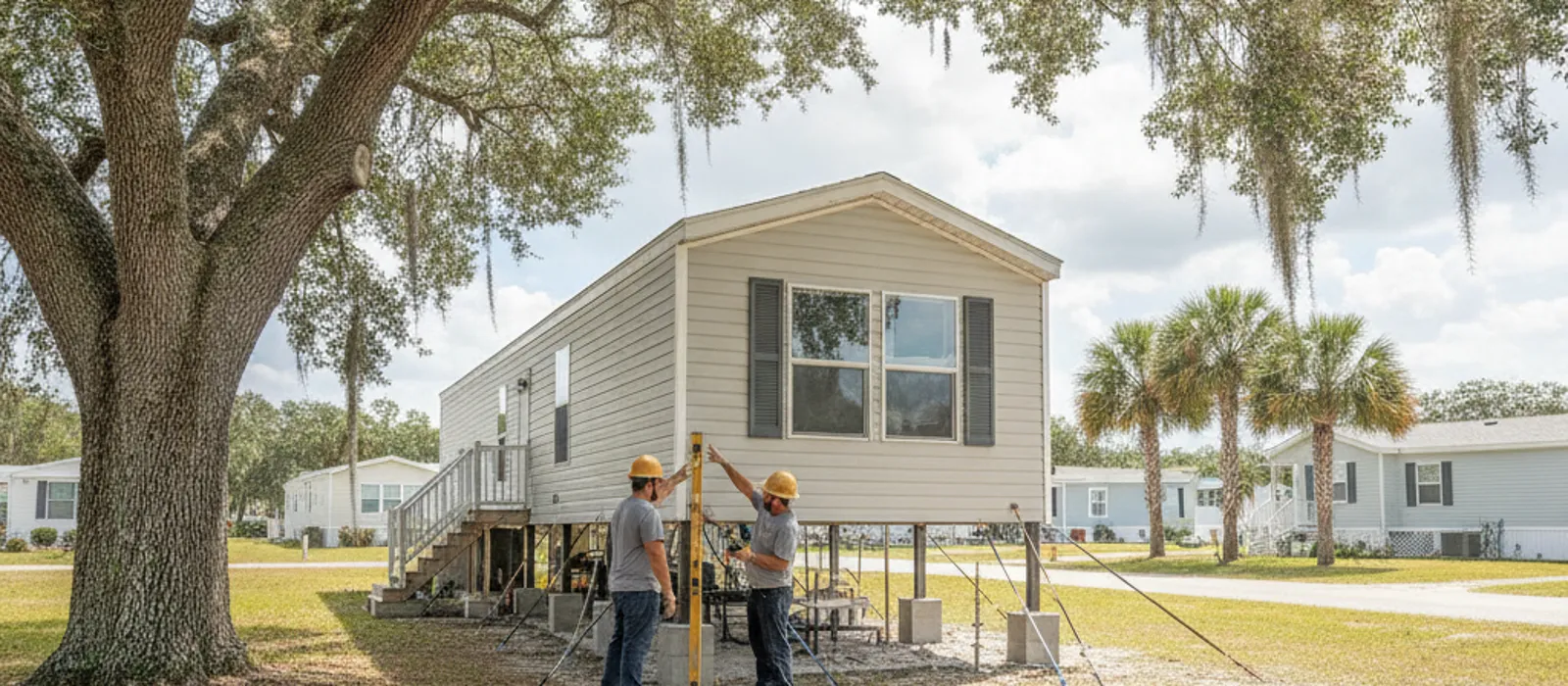
A shim is a tapered wedge, usually hardwood or high-density plastic, driven between the top of a pier and the steel frame. Piers themselves are stacked in fixed increments: concrete blocks are 8 inches, caps are 2 or 4 inches. You can’t stack blocks to hit a height of exactly 31 and 5/8 inches. Shims close that final gap and let the crew dial in each pier to within a fraction of an inch.
On a releveling job, the crew works from the measurement map. Hydraulic bottle jacks lift the frame slightly at each low pier, just enough to take the weight off. Then the tech adds or adjusts shims, lowers the jack, and rechecks the reading. It’s a patient loop of lift, shim, lower, verify, repeated across every pier that’s out of tolerance. Done right, opposing shims get driven from both sides so the frame bears on a flat surface, not a slope.
Two things matter here for homeowners. First, never let anyone shim with scrap lumber, stacked plywood offcuts, or bricks. Soft or brittle materials crush and crack under a point load of several thousand pounds. Second, shimming is a symptom-level fix if the pier below it is sinking. A pier settling because of soil movement will keep settling, and the shim stack just gets taller and less stable each visit. At that point the pad and pier need attention, not more wedges.
We cover the materials and methods in more depth in our post on mobile home leveling shims, and the full jack-and-pier process step by step in how mobile home leveling works. If you’d rather have a pro map your piers and handle the shimming, our mobile home leveling service in Ocala includes a written pier-by-pier report with every estimate.
How Often Should You Check If a Mobile Home Is Level in Florida?
In Marion County, the honest answer is more often than the national advice says. Central Florida sits on sandy soil over limestone, and our wet season dumps rain from June through September. Wet sand compacts. Dry sand shifts. Homes here settle in cycles that follow the weather.
A practical schedule looks like this:
- Once a year, do the free checks yourself. Walk the home and test every door and window. Roll a marble in a few rooms. Eyeball the skirting line from across the yard; a wavy top edge often means the home moved, not the skirting.
- Every 3 to 5 years, get a professional check with instruments. That’s the interval where small settling shows up in readings before it shows up in cracked drywall.
- After any event that moves soil or water: a tropical storm, a plumbing leak under the home, new drainage problems in the yard, or heavy construction next door.
- Before buying or selling. Level readings are a standard part of a smart pre-purchase inspection, and Florida’s program for licensed mobile home installers falls under the state’s Division of Motorist Services, which you can read about at flhsmv.gov.
Ed in Summerfield skipped the checkups for about eight years. Nothing seemed wrong until the summer of back-to-back tropical systems, when three doors quit latching in the same month. By the time we mapped his piers, the north side had settled unevenly, two pier stacks had tilted, and the frame was twisted enough to crack the drywall in two rooms. The releveling itself ran $1,150, but the drywall and trim repairs added another $900 he could have avoided with a $150 checkup a few years earlier.
The lesson isn’t fear, it’s timing. Settling caught early is a shim adjustment. Settling caught late is a repair bill with three trades on it.
One safety note: looking is fine, lifting is not. Never put any part of your body under the frame while jacking, and never trust a jack alone to hold a home. A single section weighs upwards of 15,000 pounds. When the readings say something needs to move, call a crew with the jacks, blocking, and insurance to do it safely.
Ready to know exactly where your home stands? Schedule a free written estimate or call (352) 820-4441. We check homes across Ocala, Marion, Sumter, and Citrus counties, and our 24/7 line covers pre-closing deadlines when a sale can’t wait.
Frequently Asked Questions
Can I check if my mobile home is level myself?
You can do a useful first pass. Roll a marble on hard floors, test every door and window, and sight along the skirting line from a distance. You can even run a $20 water level at a few piers if you’re comfortable in the crawl space. What you shouldn’t do is jack or lift anything yourself. Leave the correction work to an insured crew.
How much out of level is too much for a mobile home?
Most installers work to a tolerance of about a quarter inch over any 10-foot span, and roughly an inch or less across the whole home. Readings beyond that start stressing the frame, floors, and walls. If a pro’s map shows any pier more than an inch out, releveling is worth scheduling soon rather than someday.
What does a professional level check cost in the Ocala area?
A standalone instrument check with a written pier-by-pier report typically runs $100 to $200 in Marion County, and we apply it toward the work if releveling is needed. Full releveling for most single wides lands between $500 and $1,200, with double wides running higher. You can see what drives the price on our mobile home leveling cost page.
Are laser levels more accurate than water levels?
Not meaningfully, for this job. A good rotary laser reads to about a sixteenth of an inch per hundred feet, and a water level to about an eighth of an inch over a home’s length. Both beat the tolerance the work requires. Lasers are faster, water levels handle cluttered crawl spaces better, and experienced crews often carry both.