
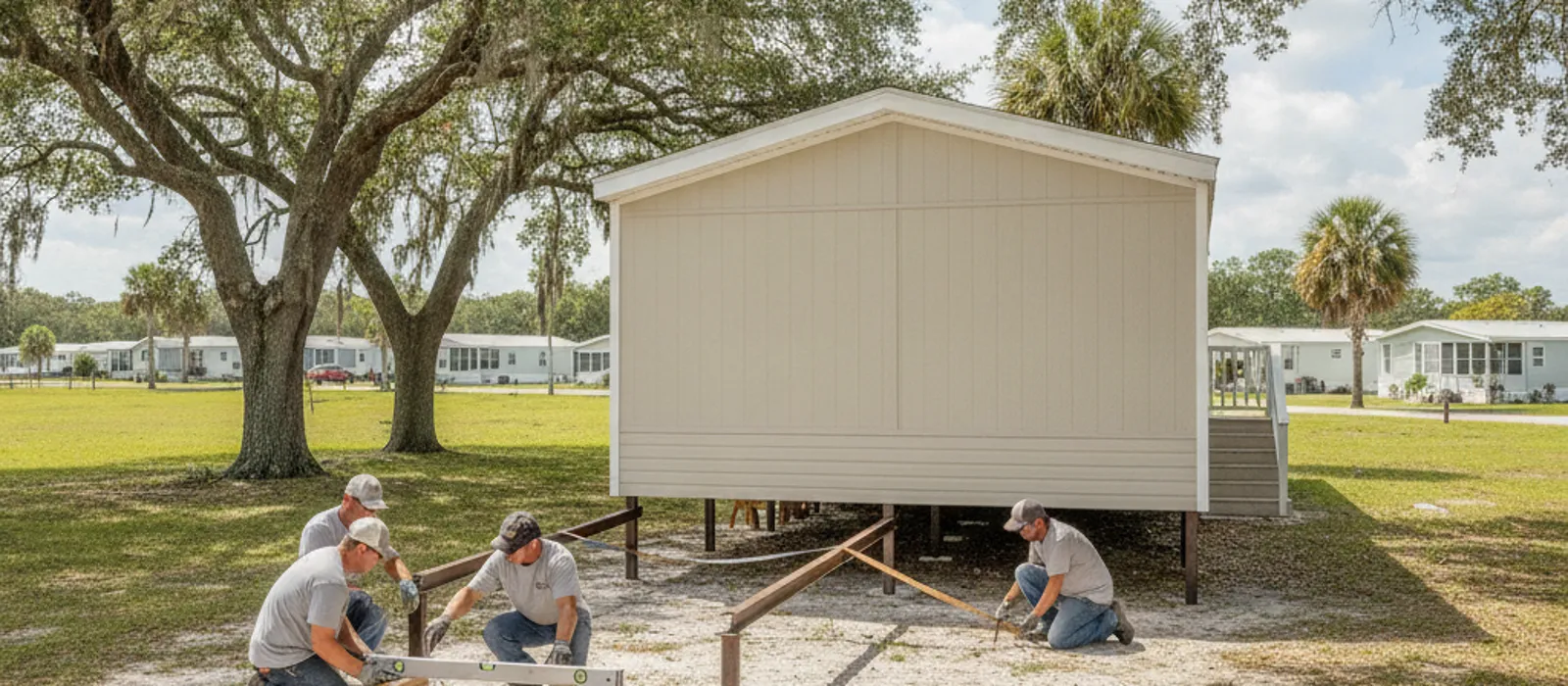
Your whole house might be sitting on wedges smaller than a paperback book. That’s not an exaggeration. The average double wide in Marion County rests on 30 to 40 piers, and nearly every one of those piers has a shim or two sitting between the cap and the steel frame.
Those little wedges are the fine-tuning system for your entire home. When mobile home leveling shims are the right material, installed tight, and checked every few years, your doors swing clean and your floors stay flat. When they’re the wrong material, or somebody stacked six of them like pancakes, you get sticking doors, wavy floors, and cracked drywall seams.
So which material actually belongs under your home here in Central Florida: wood, plastic, or steel? Let’s walk through all three, with real prices and a few stories from Ocala and the surrounding towns.
What Mobile Home Leveling Shims Actually Do
A pier under your home is built in layers. At the bottom there’s a footing or pad on the soil. On top of that sits the pier itself, usually a stack of concrete blocks. Then comes a cap, and finally the shims, which close the last small gap between the cap and the home’s steel I-beam.
Piers come in fixed heights. Soil doesn’t. Central Florida’s sandy ground settles unevenly, especially after our summer rains, so the gap above each pier is a little different. Shims take up that difference, usually anywhere from a sliver up to about an inch.
Federal installation rules are surprisingly specific about this. Under HUD’s manufactured home installation standards, shims must be at least 4 inches wide and 6 inches long, fitted and driven tight between the pier cap and the frame, and they can’t occupy more than 1 inch of vertical space. You can read the actual standard in 24 CFR Part 3285, the federal installation rule that Florida’s own installation code builds on.
Why the 1 inch limit? Because shims are wedges, not building blocks. Stack too many and the pile can shift, crush, or kick out sideways under load. That’s when a pier stops supporting the frame and your floor starts telling you about it.
If your doors are already sticking or you can feel a slope when you walk the hallway, that’s usually a shim or pier problem announcing itself. You can call us at (352) 820-4441 for a free written estimate, and we’ll actually crawl under there and look instead of guessing from the driveway.
Wood Shims: The Old Standby
Walk under almost any mobile home set before 2010 around here and you’ll find wood shims. Usually oak or another hardwood, cut in matched pairs so two wedges slide together to form a flat, tight block.
Wood earned its place for good reasons. Hardwood shims are cheap, easy to trim on site, and they grip well once driven tight. A pair costs a dollar or two, and a whole home’s worth might run $40 to $80. In a dry crawl space, good hardwood can last decades.
The catch is that word “dry.” Central Florida crawl spaces are rarely dry. Between summer humidity, rain blowing through vented skirting, and ground moisture rising off the sand, wood shims down here absorb water, swell, dry out, shrink, and repeat. Over the years that cycle crushes the wood fibers and invites rot and termites. A rotted shim compresses, the frame drops a fraction of an inch, and the settling cycle starts.
Softwood shims are worse. The cheap pine wedges sold for hanging interior doors have no business under a 15,000 pound home, but we find them under homes all the time, usually after a DIY “fix.”
Here’s a real example. Ray in Belleview called us about a front door that needed a shoulder to close. Under the home we found original oak shims from the mid 1990s, and about a third of them had gone punky from moisture near a skirting vent. Nothing dramatic, just 30 years of Florida doing its thing. We releveled the home and replaced the bad shims with composite for $680. His door closed with two fingers before we packed up the truck.
Wood isn’t wrong. It’s code-approved and it works. But in our climate, it’s the material with the shortest and least predictable lifespan, and moisture control matters as much as the shim itself. A ground cover makes a real difference here, which is why we often pair releveling with vapor barrier work when the plastic under a home is torn or missing.
Plastic and Composite Shims: The Modern Middle Ground
Structural plastic shims changed the game for Florida installers. These are wedges and flat spacer plates made from high-density polyethylene or fiber-reinforced composite, rated for loads that would flatten a pine wedge.
Their big advantage is simple: plastic doesn’t care about water. It won’t rot, swell, shrink, or feed termites. In a humid crawl space in Silver Springs or Summerfield, that’s exactly the property you want. Quality structural plastic shims carry compressive ratings in the thousands of pounds per square inch, far beyond what a typical pier point load demands.
They cost more than wood, usually $2 to $5 per shim depending on size and rating, so a full home’s worth might run $100 to $250 in material. Against the total cost of a releveling job, that difference is small, and you buy a shim that should outlast the piers themselves.
Two cautions. First, not all plastic is structural plastic. The thin shims sold for cabinets and windows can deform under sustained frame loads, especially in a hot crawl space where summer temps push past 100 degrees. Look for shims specifically rated for structural or manufactured housing use. Second, plastic is slick compared to wood, so the pairs must be driven tight and seated properly or they can work loose as the home moves through seasons.
Marlene in Silver Springs learned the first lesson the hard way. Her son-in-law leveled a soft corner of her single wide using a stack of hardware store cabinet shims. It felt solid for about a year. Then the stack compressed and spread, the corner dropped again, and this time it took the skirting out of alignment with it. Our fix, which included two new pier caps, proper structural shims, and a full relevel, came to $1,150. The original stack of cheap shims had cost her about $12. Worst dollar-per-headache ratio in the business.
If you’re weighing costs on a bigger job like this, our mobile home leveling cost guide breaks down what drives the price up or down.
Steel Shims and Plates: When You Need Real Strength
Steel is the heavyweight of the shim world, literally. Steel shims and bearing plates don’t compress, don’t rot, and spread load beautifully. You’ll see them used where point loads are highest: under heavy double wides and triple wides, at marriage line piers, under frame splices, and anywhere a pier carries extra weight from a porch or addition.
Steel has two enemies under a Florida home. The first is rust. Plain steel in a damp crawl space corrodes, and rust scale can slowly change the bearing surface. Galvanized or painted steel holds up far better, and it’s what we use. The second is cost and workability. Steel shims run $4 to $10 apiece, and you can’t trim one with a utility knife on site.
One more note: steel shims fix leveling problems, not anchoring problems. If your inspector flagged rusted straps or loose anchors, that’s a separate system, and it’s covered under our tie-down and anchoring service rather than a shim job.
Dale and Renee in Summerfield are a good example of steel used right. They were selling their 2004 double wide, and the buyer’s four point inspection noted “inadequate shimming at marriage wall piers.” The original installer had used single wood wedges at the heaviest piers under the center line. We swapped in steel plates with composite wedges at eight marriage line piers, releveled both halves, and handed them paperwork for the buyer’s lender. Total was $890, and the sale closed on schedule two weeks later.
Comparing Leveling Shim Materials Side by Side
Here’s how the three materials stack up under a Central Florida home:
| Factor | Hardwood | Structural Plastic | Steel |
|---|---|---|---|
| Cost per shim | $1 to $2 | $2 to $5 | $4 to $10 |
| Typical lifespan in FL | 10 to 25 years | 30+ years | 30+ years (galvanized) |
| Moisture resistance | Poor to fair | Excellent | Good if coated |
| Termite risk | Yes | No | No |
| Compression over time | Moderate | Very low | None |
| Best use | Budget relevels, dry crawl spaces | Most Florida homes | Heavy point loads, marriage lines |
Notice there’s no single winner. On most jobs we run a mix: structural plastic wedges as the workhorse, steel plates where loads concentrate, and hardwood only where a customer asks for it.
The material matters less than the installation. A properly driven oak pair beats a loose plastic pair every time. Tight, paired, full-bearing contact is the whole game.
When Shimming Turns Into a Bigger Leveling Job
Here’s the part a lot of homeowners miss: shims are the last inch of the system, not the system itself. If your home has drifted out of level, replacing shims without releveling is like adjusting one guitar string and calling the whole thing tuned.
A real releveling job means checking the frame with a water level or laser at every pier, lifting with jacks where needed, and then setting fresh shims tight at the corrected height. Skip the measuring and lifting, and new shims just lock in the old slope. If you’re curious what that process looks like start to finish, we walk through it in how mobile home leveling works.
There are also situations where no shim of any material will save you:
- The pier itself is cracked, tilted, or sinking into the soil
- The gap above a pier has grown past 1 inch, which is the legal shim limit
- Blocks are crushed or the footing pad has snapped
- Water is pooling under the home and softening the ground every summer
Those are pier and drainage problems. Stacking shims taller to chase a sinking pier is one of the most common and most dangerous DIY mistakes we see, because a tall shim stack can kick out sideways with a home’s weight on it. If a pier needs to grow, it needs more block courses or a new pier, not more wedges. Our post on when to replace mobile home piers covers the warning signs.
And a safety line we don’t cross, and you shouldn’t either: never crawl under a home that’s supported only by jacks, and never work under a frame while lifting it. Homes have killed people that way. Checking your shims visually from the crawl space entrance with a flashlight is fine. Getting under a lifted frame is professional-only territory, full stop.
Not sure whether you’re looking at a $20 shim fix or a full relevel? Send us a note through our contact form and we’ll schedule a free inspection with a written estimate. No pressure, just numbers on paper.
How to Tell Your Shims Need Attention
You don’t need to be a contractor to catch shim problems early. Most of the evidence shows up inside the house first:
- Doors that stick, swing open on their own, or won’t latch
- Cracks appearing at drywall seams or around window corners
- A floor that slopes, bounces, or feels soft in spots
- Skirting panels that buckle or pull away from the track
- Gaps opening along the marriage line of a double wide
Any two of those together is a strong hint the home has moved. Our guide to the signs your mobile home needs leveling goes deeper on each symptom, and if doors are your main complaint, mobile home doors that won’t close explains what’s happening in the frame.
If you do peek under the skirting, look for shims that are split, crushed, darkened with rot, or sitting loose enough to wiggle by hand. Loose is the big one. Every shim should be tight enough that it rings when you tap it, not rattles.
In Florida, plan on a professional level check every 3 to 5 years, and after any hurricane or tropical storm that soaked the ground for days. Manufactured homes are federally regulated for construction, and HUD’s own manufactured housing program exists because these homes perform well when they’re installed and maintained to standard. Shims are a small, cheap part of that standard. Ignore them and they get expensive.
Ready to know what’s actually under your home? Call Ocala Level Pros at (352) 820-4441. We serve Ocala and all of Marion, Sumter, and Citrus counties with free written estimates, and we’re licensed and insured. If you’re up against a closing date or an insurance deadline, our emergency line runs 24/7.
Frequently Asked Questions
Can I replace mobile home leveling shims myself?
Swapping a single accessible shim while the home’s weight stays fully on the pier is within reach for a careful homeowner. But the moment a job requires jacking the frame, even a quarter inch, stop and call a pro. Working under a lifted home is genuinely dangerous, and an uneven lift can crack drywall, plumbing, and even the frame welds.
How many shims can be stacked under one pier?
Federal installation standards limit shims to 1 inch of total vertical height, fitted and driven tight between the pier cap and the frame. If the gap is bigger than that, the fix is adding lumber or block to the pier itself, not stacking more wedges. Tall shim stacks are unstable under load and are a common red flag in four point inspections.
Are plastic shims approved for mobile homes in Florida?
Yes, as long as they’re structural-grade shims rated for the load, not thin cabinet or window shims. Florida’s installation rules follow the federal standard, which allows any shim material that carries the design load without crushing. Most professional installers in Central Florida now prefer rated plastic or composite because it shrugs off our humidity and termites.
How much does it cost to have shims replaced?
If the home is still level and a few shims just need to be tightened or swapped, a service call typically runs $150 to $400 in our area. If the home has settled and needs releveling along with new shims, expect roughly $450 to $900 for a single wide and $600 to $1,400 for a double wide, depending on pier condition and access. Either way, get the estimate in writing before anyone starts work.