
You’ve shaved that door twice. You’ve tightened the hinges, swapped the strike plate, maybe even bought a new door. And it still won’t latch by October.
Here’s the truth most homeowners around Ocala don’t hear until it’s cost them real money: when a mobile home door won’t close, the door is almost never the problem. The door is the messenger. What it’s usually telling you is that the home underneath it has shifted, and the frame around that door isn’t square anymore.
The good news? Caught early, this is one of the cheapest structural problems to fix in all of manufactured housing. Caught late, it turns into subfloor damage, cracked walls, and plumbing leaks that cost five to ten times more.
Let’s walk through what’s actually happening under your home, how to check it yourself this weekend, and what a real fix costs in Marion County.
What a Mobile Home Door That Won’t Close Is Really Telling You
Your doors are the most sensitive level indicators in your house. A door only closes cleanly when its frame is a true rectangle. Shift one corner of that frame by a quarter inch and the door starts rubbing. Shift it by half an inch and it won’t latch at all.
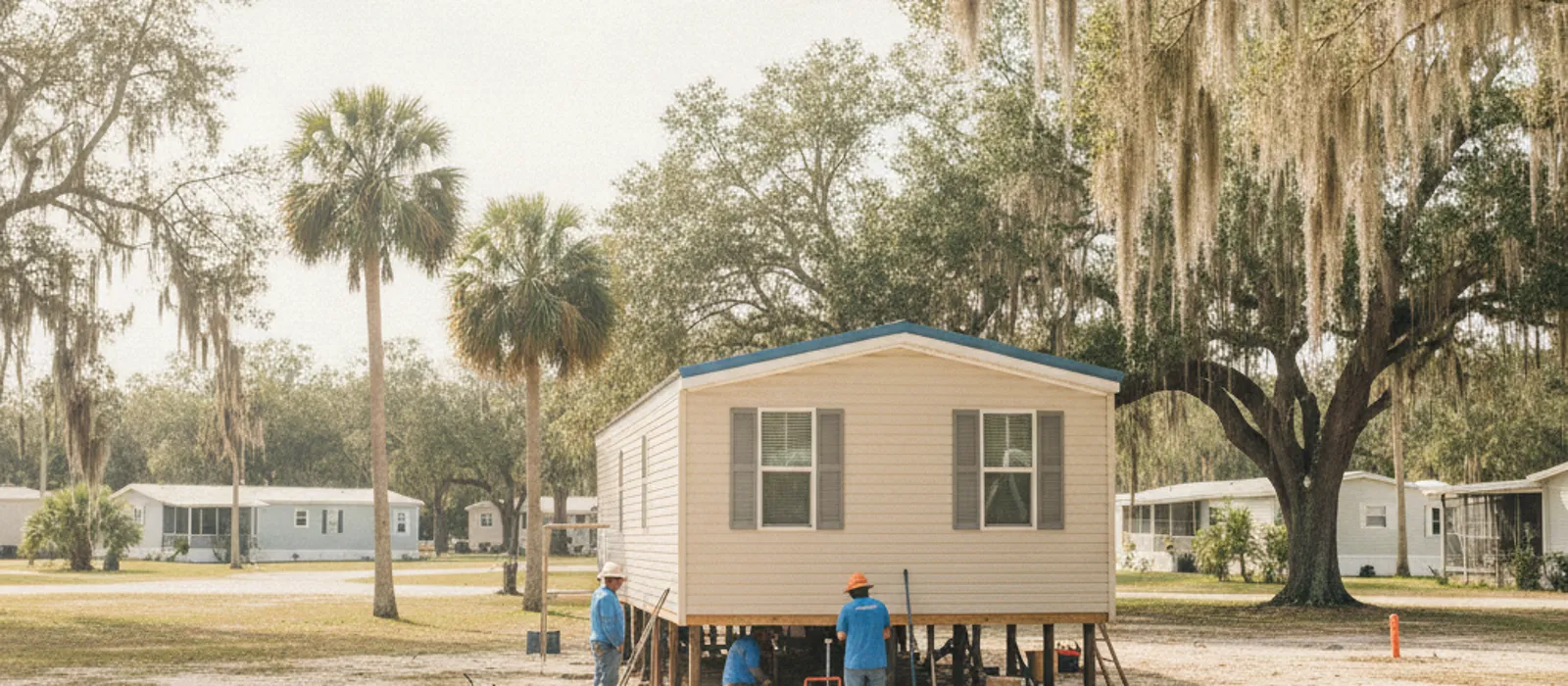
Site-built homes sit on continuous foundations, so they move as one unit. Mobile homes are different. Your home rests on a steel frame supported by a series of piers, usually concrete blocks on pads, spaced every 6 to 8 feet. Each pier settles independently. When one pier sinks even slightly, the frame above it flexes, the walls attached to that frame rack out of square, and every door and window in that section goes crooked with them.
That’s why sticking doors in a mobile home tend to show up in clusters. One door acting up might be humidity or a loose hinge. Two or three doors acting up in the same end of the home is a settling pattern, and it’s worth taking seriously.
Carl in Belleview learned this the practical way last year. His front door started dragging in June. By September his bathroom door wouldn’t latch and there was a hairline crack over the hallway doorway. We found two piers on the south side had sunk into softened soil. The relevel ran him $625, and every door in the house closed properly again the same afternoon, no carpentry needed.
If your doors are doing the same thing, don’t wait for door number three. Request a free written estimate or call us at (352) 820-4441. We’ll tell you honestly whether it’s a $10 hinge problem or a settling problem.
The Chain Reaction: From Florida Soil to Your Door Frame
Here’s the sequence that ends with a door that won’t close, step by step:
- The soil moves first. Central Florida sits on sandy soil over limestone. Sand compacts under load, and our summer rain cycle makes it worse. Soil swells when saturated, then shrinks as it dries, and piers ride that movement up and down. If you want the geology version, the USGS explains why Florida karst terrain is so prone to subsidence.
- A pier loses full contact. Once soil settles under a pad, the pier either sinks with it or ends up carrying less than its share. Nearby piers pick up the extra weight and start compressing their own soil faster.
- The steel frame deflects. The I-beams under your home are strong, but they’re designed to be supported every few feet. Take away one support and the beam sags between its neighbors.
- The walls rack. Your wall panels are attached to the floor system. When the floor tilts, rectangular door openings lean into parallelograms. The hinge side and latch side are no longer plumb with each other.
- The door tells on everything. It rubs at the top corner, scrapes the threshold, or the latch misses the strike plate entirely.
Notice the door is the last step in the chain, not the first. That’s why fixing the door without fixing the piers never holds. It’s also why sticking doors often travel with other symptoms: gaps over interior walls, hairline cracks near door corners, and floors that feel slightly downhill toward one end.
Our full rundown of signs your mobile home needs leveling covers the whole symptom list, but doors are usually the first and loudest.
Quick Checks You Can Do This Weekend
Before you call anyone, spend 20 minutes ruling out the simple stuff. You’ll either save yourself a service call or walk into the conversation knowing exactly what you’re dealing with.
Check the hinges first. Open the door and lift up on the handle. If the whole door moves noticeably, your hinge screws are loose or stripped. Tighten them, or replace the top hinge screws with 3-inch screws that bite into the framing. That fix costs about $2.
Look at the reveal. Close the door as far as it goes and study the gap between the door and frame. An even gap all the way around that’s just tight means swelling, common in our humid summers. A gap that’s wide at one corner and pinched at the opposite corner means the frame is out of square. That’s a settling signal, not a door problem.
Do the marble test. Set a marble or golf ball on the floor in the hallway and in the room with the sticking door. If it rolls the same direction every time, your floor has a slope.
Count your doors. Walk the whole home and test every interior and exterior door. One bad door could be anything. Multiple bad doors on the same end or side of the home is a pattern.
Check the season. Write down which doors stick and check them again after a dry week. Doors that stick only in August but close fine in January are reacting to soil moisture and humidity swings. That still points to marginal pier support. A properly supported home shouldn’t change that much between seasons.
What not to do: don’t crawl under the home and start adjusting piers or stacking shims yourself. A single-wide can weigh 15,000 pounds or more, and a pier that shifts while you’re under there is a genuine, life-threatening hazard. Checking from inside the home is smart homework. Working under the frame is a job for people with the jacks, cribbing, and training to do it safely.
Why Shaving the Door Makes Everything Worse
This is the most common mistake we see in Marion County, and it’s an expensive one.
Miguel in Dunnellon had a double-wide where the back door dragged along the top. He planed a quarter inch off the door in 2023. It closed fine for about eight months, then started dragging again, so he planed it again. By the time he called us in early 2026, the door had a visible wedge shape, daylight showed through the top corner, and his electric bill had crept up from the air leak. The home had continued settling the whole time. His relevel cost $780. The replacement exterior door he no longer had a choice about cost another $340 installed. Two years of planing bought him nothing except a ruined door.
Shaving, adjusting strike plates, and bending latch tongues all treat the symptom while the cause keeps working underneath you. Meanwhile, the same settling that’s racking your door frames is doing quieter damage:
- Stressing plumbing joints under the floor, which leads to slow leaks and standing water under the home
- Flexing the subfloor until seams open up and you get soft spots in the floor
- Pulling siding and skirting out of alignment
- Opening gaps around exterior doors that let in moisture, bugs, and hot air
A door you’ve shaved is also a door an inspector will notice. Which brings us to insurance.
Sticking Doors, 4-Point Inspections, and Selling Your Home
If you own a manufactured home in Florida, you’ll eventually face a 4-point inspection or a wind mitigation inspection for insurance, and settling evidence shows up in those reports. Doors that won’t close, visibly out-of-level floors, and racked frames give inspectors a reason to note structural concerns, and that can complicate your coverage or a sale.
Donna in Summerfield ran into this head-on last spring. She listed her 2004 double-wide, and the buyer’s inspector flagged three doors that wouldn’t latch plus a noticeable slope in the master bedroom. The buyer’s agent came back asking for a $4,000 credit for “foundation issues.” Donna called us instead. The actual problem was four settled piers and a rotted set of shims. The relevel and shim replacement came to $890, we documented the work in writing, and the sale closed with no credit. The gap between a scary inspection note and the real repair cost was more than $3,000 in her favor.
If you’re heading into a sale or an insurance renewal, get ahead of it. Our guide to the 4-point inspection for mobile homes explains what inspectors look for. And if you already know your doors are sticking, get a free written estimate before the inspector shows up, not after. A dated, itemized repair record from a licensed contractor is worth real money at the closing table.
What It Costs to Fix a Mobile Home Door That Won’t Close
Here’s the honest breakdown of what you’re looking at in the Ocala area, from cheapest cause to most expensive:
| Cause | Typical Fix | Typical Cost Range | Does the Fix Last? |
|---|---|---|---|
| Loose hinge screws | Longer screws, tighten hardware | $0 to $20 DIY | Yes, if that’s truly the cause |
| Humidity swelling | Seal door edges, adjust strike plate | $10 to $50 | Seasonal, returns each summer |
| Worn or rotted shims | Replace shims at affected piers | $200 to $450 | Yes, with sound piers |
| Home out of level (few piers) | Partial relevel | $400 to $700 | Yes, typically years |
| Home out of level (whole home) | Full relevel, single-wide | $450 to $900 | Yes, typically years |
| Home out of level (whole home) | Full relevel, double-wide | $700 to $1,400 | Yes, typically years |
| Failed or sunken piers | Pier replacement plus relevel | $1,200 to $3,500+ | Yes, longest-lasting fix |
A few notes on that table. First, the jump from “relevel” to “pier replacement” is the expensive one, and time is what moves you down that list. Piers that carry uneven load for years crack, tilt, and punch through their pads. Second, every relevel we do includes checking and correcting the doors, so you shouldn’t be paying a handyman separately to re-hang doors after a proper relevel.
For the full picture on pricing, see our mobile home leveling cost guide, and our post on mobile home leveling cost factors explains what pushes a job toward the high or low end.
One more thing worth knowing: HUD-code homes are engineered around the assumption of level, continuous pier support. The HUD Manufactured Housing Program sets those construction standards, and installation standards in Florida exist precisely because an out-of-level home stresses components that were never designed to flex.
When to Stop Troubleshooting and Call a Pro
Here’s a simple decision rule that will serve you well.
Handle it yourself when: one door sticks, the gap around it is even, the hinges are loose, or it only swells in peak humidity and closes fine the rest of the year.
Call a professional when: two or more doors won’t close, the gaps are wedge-shaped, you can see cracks at door corners, the marble rolls, exterior doors have daylight at a corner, or the problem comes back after you’ve fixed the door itself once already.
A proper leveling check isn’t guesswork. We go under the home with a water level or laser, measure the frame at every pier, and map exactly which supports have dropped and by how much. You get a written report and a firm price before any work starts. Most relevels in our area are done in a single day, and the doors are usually the first thing homeowners test when we’re done. Our mobile home leveling service in Ocala covers all of Marion, Sumter, and Citrus counties.
If you’re staring at a door right now that won’t latch, call (352) 820-4441. Estimates are free and in writing, and if it turns out to be a $2 hinge screw, we’ll tell you that too.
Frequently Asked Questions
Why do my mobile home doors stick in summer but close fine in winter?
That pattern usually means two things are stacking up: wood and weatherstripping swell in humid months, and Florida’s soil expands and contracts with the rain cycle, which moves marginally supported piers. A well-supported home shouldn’t change enough seasonally for doors to stop latching. If the swing between seasons is that dramatic, have the piers and shims checked, because seasonal sticking is often the early stage of year-round sticking.
Can I just adjust or replace the door instead of releveling?
You can, but if settling is the cause, the new door will start sticking within months because the opening itself is out of square and still moving. You’ll have spent $150 to $400 on a door that solves nothing. The reliable order of operations is to level the home first, then see if the door needs any work at all. In most of our jobs, doors close normally the moment the frame comes back to level.
How fast does a sticking door turn into expensive damage?
There’s no fixed timeline, but in our experience around Ocala, homes that ignore multiple sticking doors for two or more years often graduate to soft floors, plumbing leaks, or cracked piers, and those repairs run $1,200 to $5,000 instead of $400 to $900 for a relevel. Florida’s wet season accelerates everything because saturated soil settles faster. The cheapest version of this repair is always the earliest one.
Is a mobile home door that won’t close a sign of a sinkhole?
Almost never. Marion County does sit on karst limestone, but the overwhelming majority of sticking doors trace back to ordinary pier settling, soil compaction, or moisture swings. Sinkhole warning signs look different: rapidly widening cracks, doors that go from fine to jammed in days, depressions forming in the yard. If you’re seeing that combination, get a professional out quickly. Otherwise, assume settling, because that’s what it is more than 95 percent of the time.