
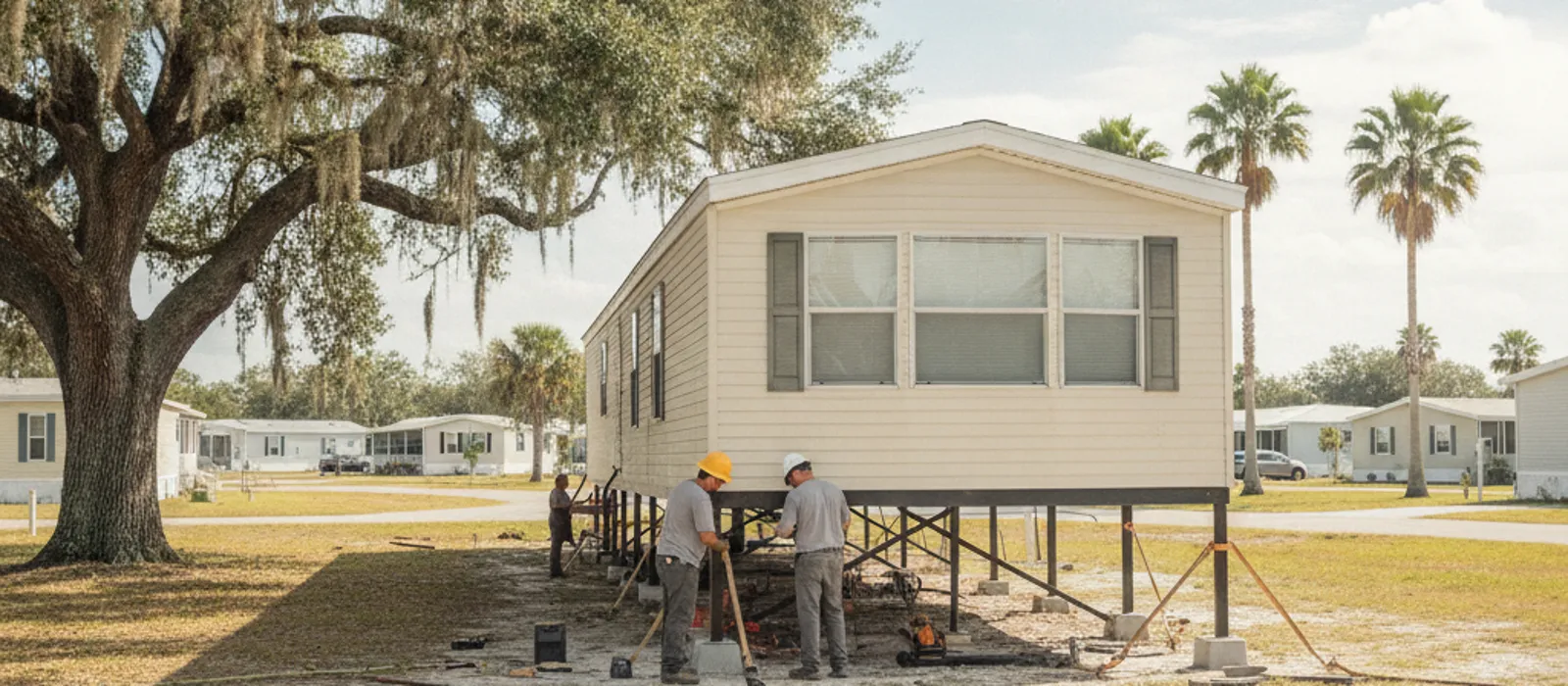
Two homeowners in the same Belleview park called us the same week last spring. Same size double-wide, same street, same complaint about sticking doors. One paid $950. The other paid $2,600.
That gap surprises a lot of people, but it makes sense once you understand the mobile home leveling cost factors that drive every quote. Leveling isn’t a flat-rate service like an oil change. The price depends on what’s actually happening under your home, and no two crawl spaces in Marion County look alike.
In this guide, we’ll walk through the six factors that matter most, with real numbers from jobs around Ocala, Belleview, Dunnellon, and Citra. By the end, you’ll know why quotes vary, what a fair price looks like, and how to keep your own bill on the low end.
Here’s a quick look at typical ranges before we dig in:
| Situation | Typical range in Marion County |
|---|---|
| Minor relevel, single-wide, piers in good shape | $450 to $800 |
| Full relevel, single-wide | $600 to $1,200 |
| Full relevel, double-wide | $900 to $2,000 |
| Relevel plus 4 to 8 pier replacements | $1,500 to $3,000 |
| Relevel plus soil correction and drainage work | $2,500 to $4,500 and up |
Now let’s break down what pushes a job from one row of that table to another.
1. Home Size and Type: The Biggest Mobile Home Leveling Cost Factor
Size sets the baseline for everything else. A single-wide sits on two main steel beams with maybe 12 to 20 piers underneath. A double-wide has four beams, a marriage line down the middle, and often 30 or more piers. A triple-wide adds even more.
More piers means more points to check, jack, shim, and reset. It also means more labor hours. A crew can relevel a healthy single-wide in a morning. A double-wide with marriage line problems can take a full day or longer.
The marriage line is the big one for double-wides. That’s the seam where the two halves join, and it needs its own row of support. When those center piers settle, the two halves pull apart slightly. You’ll see cracks at the ceiling seam, gaps in the floor transition, and interior doors that won’t latch. Fixing marriage line settlement takes more care than jacking a perimeter beam, because you’re realigning two structures at once. We cover the differences in detail in our guide to leveling a single-wide vs a double-wide.
Rule of thumb: expect a double-wide relevel to run roughly 50 to 80 percent more than a single-wide in the same condition.
If you’re not sure what your home needs yet, that’s fine. Call us at (352) 820-4441 and we’ll come out, crawl under, and give you a free written estimate with no pressure attached.
2. How Far Out of Level the Home Has Drifted
Catching settlement early is the single best way to save money. A home that’s a half inch out of level at a few piers is a quick job. A home that’s dropped two or three inches on one corner is a different animal.
Here’s why severity matters so much. Small drift gets fixed with shims and minor jacking. Big drift means the frame has been carrying weight unevenly for months or years. That stress can twist door frames, crack drywall, open plumbing joints, and pull tie-down straps out of position. The leveling itself takes longer, and there’s usually secondary damage to address.
Earl in Citra is a good example of catching it early. He noticed his back door started rubbing the frame in January and called us that same month. We found four piers that had settled about three quarters of an inch on the shady side of his single-wide. Total bill: $600, done before lunch.
Compare that to homes we see where the doors have been sticking for three or four years. By then the floors slope enough to feel underfoot, the skirting is buckling, and a few piers have tilted past the point of saving. The same problem that cost Earl $600 can grow into a $2,500 job with pier replacements.
If you’re seeing early warning signs, our post on the signs your mobile home needs leveling walks through exactly what to look for, room by room.
3. The Condition of Your Piers, Pads, and Shims
Leveling and pier work go hand in hand, and pier condition is often the difference between a basic quote and a bigger one.
When we jack a home back to level, every pier has to be able to carry its share of the load again. If a pier is cracked, crumbling, tilted, or sitting on a broken pad, releveling on top of it is a waste of your money. The home will just settle again, usually within a year or two.
Common pier problems we find under Marion County homes:
- Concrete blocks cracked from decades of load cycling
- Piers tilted because the pad beneath them sank on one edge
- Rotted wood shims that have compressed to mush
- Pads that were undersized for our sandy soil in the first place
- Rust damage on steel piers in homes near wet ground
Replacing a pier typically adds $100 to $250 per pier depending on height and access. Most releveling jobs that need pier work involve 3 to 8 replacements, not the whole set. A good contractor will show you photos of each failed pier and explain why it can’t be reused. We break down the full numbers in our post on mobile home pier replacement cost.
One thing worth knowing: HUD’s construction and safety standards govern how manufactured homes are built and supported, and you can read the federal program details at the U.S. Department of Housing and Urban Development. Piers that meet spec today protect the leveling work you’re paying for.
4. Florida Soil and Drainage: The Hidden Cost of Leveling a Mobile Home
This is the factor most homeowners never see coming, and it’s the one that explains that $1,650 gap between the two Belleview neighbors at the top of this article.
Marion County sits on sandy soil over limestone, with pockets of clay and organic material mixed in. Sandy soil drains fast but compacts unevenly under point loads like piers. Add our summer rain pattern, where the ground cycles between soaked and bone dry, and you get soil that shifts more than homeowners expect. The University of Florida’s IFAS Extension publishes solid research on Florida soil behavior if you want to go deeper: edis.ifas.ufl.edu.
When the soil under a home is stable, leveling is straightforward. When it’s not, we have to fix the cause or the fix won’t hold. That can mean:
- Larger pier pads to spread the load over more soil
- Regrading so roof runoff flows away from the home instead of under it
- Gutter and downspout corrections
- In wet spots, drainage work before any leveling happens
Marisol in Dunnellon learned this the hard way. Her double-wide sits on low ground not far from the river, and the previous owner had releveled it twice in six years using the cheapest bid each time. Nobody addressed the water pooling under the north side after every storm. We releveled the home, replaced six failed piers, upsized the pads, and corrected the grading so water finally moved away from the foundation. Total: $2,700. It’s held level for two years now, through two hurricane seasons.
If your home keeps settling in the same spot, the soil is trying to tell you something. Our post on why mobile homes settle in Florida explains the pattern. And if you’d like our crew to look at your specific lot, request a free estimate here. We’ll tell you honestly whether you need drainage work or just a standard relevel.
5. Access and Clearance Under the Home
Here’s a factor that has nothing to do with your home’s condition and everything to do with how hard it is to work on: crawl space access.
Leveling crews work under your home with bottle jacks, blocks, levels, and lights. When the belly of the home sits 30 inches off the ground with clean, dry soil underneath, work moves fast. When there’s 14 inches of clearance, standing water, old debris, or a torn vapor barrier hanging down in sheets, everything takes two or three times longer. Labor hours drive cost, so access drives cost.
Things that slow a crew down and raise the bill:
| Access issue | Typical cost impact |
|---|---|
| Low clearance under 18 inches | Adds 20 to 40 percent labor |
| Attached additions, porches, or carports over the frame | Adds jacking complexity, $150 to $500 |
| Skirting that must be removed and reinstalled | $100 to $300 |
| Debris, old ductwork, or stored items underneath | Cleanout charges vary |
| Standing water or mud | Job may need to wait or need drainage first |
You can trim some of this yourself before the crew arrives. Clear stored items away from the skirting, note where your access panel is, and if you have removable skirting sections, ask whether opening them ahead of time helps. Never crawl under a visibly sagging home to clean it out yourself, though. If the frame is under stress, leave the crawl space to people with jacks and training.
Ray in Belleview, the neighbor who paid $950, had a clean, dry, high crawl space and modern vinyl skirting with big access panels. His neighbor had a 1980s home with low clearance, mortared block skirting that had to be partially opened, and years of debris underneath. Same leveling problem, very different working conditions.
6. Add-Ons and Repairs That Ride Along With the Job
The last cost factor is everything else the crawl space reveals once someone is actually under there looking.
Leveling puts eyes on parts of your home nobody has seen in years. It’s common to find related issues that are cheaper to fix while the crew is already on site:
- Tie-down problems. Rusted anchors or loose straps matter for both safety and insurance. Florida requires proper anchoring, and your insurance carrier may ask for tie-down certification during a 4-point inspection. See our mobile home tie-down service in Ocala for what that involves.
- Vapor barrier damage. Torn belly wrap lets moisture reach your subfloor and insulation.
- Subfloor soft spots. Often found near bathrooms and exterior doors.
- Skirting damage. Buckled skirting is frequently a symptom of the settling itself.
None of these are required to level the home, and a trustworthy contractor will price them separately in writing so you can decide item by item. Be cautious of anyone who bundles everything into one vague number or pressures you to approve extras on the spot.
Timing can also nudge price. If you need work done fast to meet a closing date or an insurance deadline, ask about scheduling when you call. We keep a 24/7 line open for exactly those situations.
What a Fair Leveling Quote Should Include
Now that you know the six factors, you can read a quote intelligently. A solid written estimate for mobile home leveling in Ocala should spell out:
- The number of piers being adjusted, and how many, if any, are being replaced
- Whether marriage line work is included for double-wides
- What happens with skirting removal and reinstallation
- Any soil, pad, or drainage recommendations, priced separately
- Whether the contractor will recheck level after the home settles in
If a bid is hundreds of dollars below everyone else’s, one of these items is usually missing. The cheapest relevel is the one you only pay for once. For a deeper dive into overall pricing, our mobile home leveling cost page lays out the full picture, and our post on how mobile home leveling works shows what a professional process looks like step by step.
One last piece of advice on the DIY question. Checking your home with a 4-foot level and walking the skirting line for gaps is smart homeowner maintenance. Jacking a 15,000-pound structure is not a DIY job. Homes can shift off jacks, and the injuries are serious. If your level shows a problem, stop there and bring in a pro.
Ready for real numbers on your home? Call (352) 820-4441 or request your free written estimate. We serve Ocala and all of Marion, Sumter, and Citrus counties, we’re licensed and insured, and we’ll show you photos of everything we find under your home before you spend a dollar.
Frequently Asked Questions
What is the average cost to level a mobile home in Ocala?
Most single-wide relevels in the Ocala area run $600 to $1,200, and most double-wides run $900 to $2,000. Jobs that include pier replacement or drainage correction can reach $2,500 to $4,500. The best way to pin down your number is a free on-site estimate, since crawl space condition changes everything.
Why did my neighbor pay less for leveling than I did?
Two homes of the same size can hide very different conditions underneath. Pier condition, soil moisture, crawl space clearance, and how long the home has been out of level all change the labor and materials involved. A written, itemized estimate lets you see exactly where your money is going.
Does insurance ever cover mobile home leveling?
Usually not for normal settling, since carriers treat that as maintenance. Coverage sometimes applies when settlement traces to a covered event, like a plumbing leak washing out soil under the home. Leveling and tie-down condition do come up during 4-point inspections, so keeping the home level protects your insurability either way.
How often should a mobile home be releveled?
There’s no fixed schedule, but Florida homes should be checked every 3 to 5 years, and sooner if you notice sticking doors, sloped floors, or new wall cracks. Homes on sandy or low-lying lots may need attention more often. A quick check costs little and catches problems while they’re still cheap to fix.