
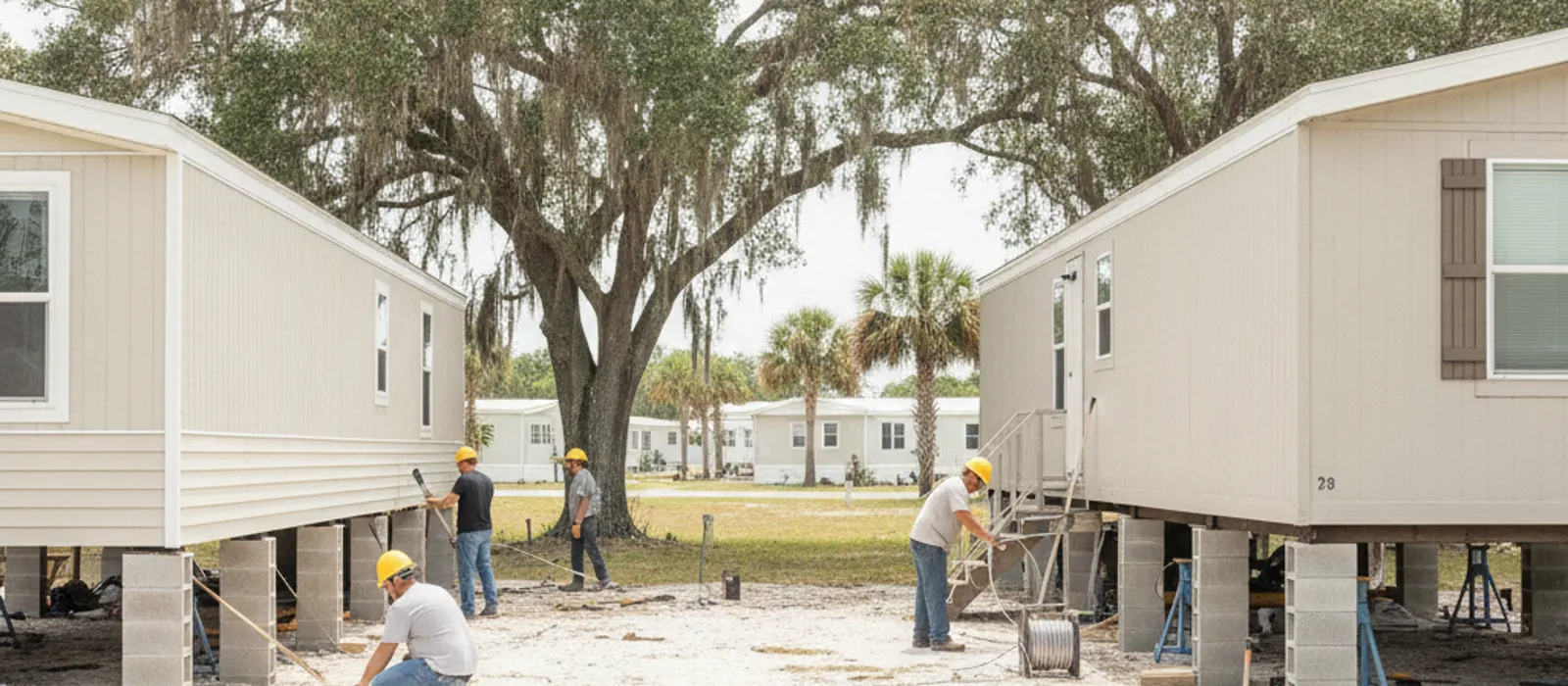
Here’s a number that surprises most homeowners: a double wide usually sits on twice as many piers as a single wide, sometimes more. That one fact drives almost everything about how the two homes get leveled, how long the job takes, and what it costs.
If you own a double wide in Marion County and your doors have started sticking, you might be tempted to price the job like your neighbor’s single wide. Don’t. Double wide leveling is a different animal, and knowing why will save you from lowball quotes that fall apart and high quotes you can’t check. This guide walks through exactly what changes between the two, with real numbers from jobs around Ocala.
The Frame Is the First Big Difference
A single wide is one box on one steel frame. Two main I-beams run the length of the home, and piers sit under those beams every 6 to 8 feet. When a single wide settles, the fix is usually straightforward: jack the low beam, adjust or shim the piers, and check the level as you go.
A double wide is two boxes built separately, hauled to your lot separately, and joined down the middle. That joint is called the marriage line, and it’s the spine of the whole house. A typical double wide has four main I-beams (two per section) plus a row of piers directly under the marriage line supporting the ridge beam, heavy walls, and any openings between the two halves.
So where a 70-foot single wide might have 18 to 24 piers, a similar-length double wide often carries 40 to 50 or more. Every one of those piers is a spot that can settle, and every one has to be checked during a relevel.
The marriage line changes the physics too. When one half of a double wide drops even half an inch relative to the other, the two sections start pulling against each other. You’ll see it as a gap opening in the ceiling down the centerline, cracks in the drywall where the halves meet, or a hump or valley in the floor along the middle of the house. A single wide can’t develop any of those problems because there’s no seam to separate.
If you’re seeing symptoms but aren’t sure what they mean, our guide to the signs your mobile home needs leveling breaks down what’s urgent and what can wait.
What Double Wide Leveling Involves That a Single Wide Doesn’t
Beyond pier count, four things make double wide leveling a more careful job.
The two halves have to move together. You can’t just jack up the low corner of one section until it reads level. Lift one half too far or too fast and you stress the marriage line fasteners, crack the ceiling closure strip, and sometimes split the roof cap. A good crew lifts in small increments, alternating between sections, checking the marriage line gap constantly.
The centerline piers do the heavy lifting. Marriage line piers carry point loads from columns and headers, especially around big openings like a pass-through kitchen or a wide living room. These piers settle more often than perimeter piers because they carry more weight. They’re also the hardest to reach, dead center under the house.
There’s more that can hide the problem. A double wide has more floor area, more ductwork, and more plumbing runs underneath. Crews spend more time crawling, and there’s more belly board and insulation in the way.
Utilities cross the marriage line. Ducts, wiring, and sometimes plumbing cross from one section to the other. If the halves have shifted, those crossover connections may have pulled loose. A proper double wide relevel includes checking them, because a separated duct under the house can quietly double your power bill.
Quick gut check: if your doors won’t latch and you own a double wide, look at your ceiling centerline first. A visible gap there means the sections are moving apart, and that’s a call-a-pro situation, not a weekend project. Call us at (352) 820-4441 and we’ll take a look, usually within a day or two anywhere in Marion County.
A Tale of Two Jobs: Belleview and Summerfield
Real jobs show the difference better than theory.
Last spring, Carl in Summerfield called about his 1998 single wide. His bedroom door had started swinging open on its own, and the kitchen floor felt slightly downhill toward the back wall. Our crew found six piers on the east beam that had settled into soft, sandy soil after a wet winter. The fix took about three and a half hours: jack the beam, re-shim six piers, reset two that had tilted, and verify with a water level end to end. His bill came to $650, and the door stopped moving that afternoon.
Compare that to Rita in Belleview, who owns a 2004 double wide. Her symptoms sounded similar at first, sticky doors and a couple of drywall cracks. But her cracks ran along the marriage line, and there was a gap you could slide a quarter into where the ceiling halves met in the hallway. Underneath, we found nine marriage line piers that had settled unevenly, plus four perimeter piers on the north section. The relevel took a full day with two techs, lifting both halves in stages to close the gap without stressing the roof. Rita paid $1,450, and we replaced two crumbling pier caps while we were under there for another $120.
Same county, same soil, similar symptoms above the floor. The double wide job cost more than double and took three times as long, purely because of what’s underneath.
One more, because it shows the marriage line risk: a couple in Silver Springs bought a used double wide where a previous owner had “leveled” it himself with a bottle jack and some 2x6 scraps. He’d lifted one section only. The marriage line had opened almost an inch at the roof, and rain had been getting in for months. The releveling itself was $1,300, but the ceiling and insulation repairs pushed the total project past $3,800. Leveling both halves together the first time would have avoided most of that.
Double Wide Leveling Cost vs Single Wide: The Numbers
Here’s how the two compare on typical jobs in the Ocala area. Your home may land outside these ranges depending on access, pier condition, and how far out of level it sits, but this is the honest ballpark.
| Factor | Single Wide | Double Wide |
|---|---|---|
| Typical relevel cost | $450 to $900 | $900 to $2,000 |
| Typical piers to check | 18 to 24 | 40 to 50+ |
| Crew time on site | 2 to 5 hours | 5 to 10 hours (often a full day) |
| Marriage line work | None | Gap check, staged lifting, crossover duct check |
| Common add-ons | Shims, a few pier caps | Pier replacements, centerline pier resets |
| Full pier replacement (if needed) | $2,000 to $4,000 | $4,000 to $8,000+ |
A few notes on those numbers. The price gap isn’t padding, it’s pier count and time. Two techs for a full day simply costs more than one tech for an afternoon. And the “if needed” row matters: most relevels don’t require replacing piers, just adjusting and shimming them. If a contractor jumps straight to full replacement without showing you failed piers, get a second opinion. Our page on mobile home leveling cost breaks down every line item so you can compare quotes fairly.
Access matters too. A double wide with 30-inch clearance and dry ground underneath is a much faster job than one sitting low over damp soil with sagging belly board in the way, and a double wide has twice the crawling territory.
Want a real number for your home instead of a range? We give free written estimates anywhere in Marion, Sumter, and Citrus counties. Request yours here and we’ll put the actual pier count and price on paper.
How the Work Actually Goes, Step by Step
The core process is the same for both home types, and we walk through it in detail in how mobile home leveling works. Here’s the short version, with the double wide differences flagged.
Step 1: Reading the home. The crew checks floor level inside with a water level or laser, noting every low spot. On a double wide, they also measure the marriage line gap at several points along the ceiling and check whether the two sections read level relative to each other, not just to the ground.
Step 2: Underside inspection. Every pier gets looked at: cracked blocks, tilted stacks, rotted wood caps, shims that have crushed or slipped. On a double wide, the centerline row gets extra attention because it fails first. This is also when the crew checks your anchors and straps, since a jack can’t safely lift near a strap that’s about to snap. If your straps look rusty, that’s a separate fix covered on our tie-down service page.
Step 3: Lifting. Hydraulic jacks go under the I-beams, never under the floor itself. A single wide gets lifted beam by beam. A double wide gets lifted in an alternating pattern, a little on one section, a little on the other, so the marriage line closes evenly instead of binding.
Step 4: Shimming and resetting. Hardwood or steel shims go between pier and beam at each corrected point. Tilted piers get restacked. HUD’s installation standards, spelled out in 24 CFR Part 3285, set the requirements for pier spacing and load capacity that installers follow, and a relevel should leave your setup meeting them.
Step 5: Verification. Level readings get taken again inside, doors get tested, and on a double wide the marriage line gap gets measured one more time. If a door still rubs after the frame reads level, that’s usually a door problem now, not a foundation problem. Our post on doors that won’t close explains how to tell the difference.
Florida Soil Doesn’t Care Which Home You Own, But It Punishes Double Wides More
Central Florida sits on sandy soil over limestone, and that sand moves. Heavy summer rain saturates it, dry spells shrink it, and piers ride up and down with it a little every year. The Florida Division of Emergency Management notes that proper installation and anchoring are the biggest factors in how manufactured homes handle severe weather, and a level frame is where proper anchoring starts.
Both home types settle here. The difference is tolerance. A single wide that’s a half inch out of level is annoying. A double wide that’s a half inch out along the marriage line is actively damaging itself: the seam works open, fasteners loosen, and the roof cap flexes. That’s why we suggest double wide owners check level every year or two, while single wide owners can often stretch to three, unless something obvious shows up sooner.
There’s an insurance angle too. During a 4-point inspection or a tie-down certification for a Florida policy, an inspector who sees a wavy roofline or a gapped marriage line will flag it, and some carriers won’t bind coverage until it’s corrected. If you’re buying or selling a double wide in Marion County, get the level checked before the inspector does. It’s a cheap problem to fix early and an expensive one to discover at closing.
Where DIY Ends for Each Home Type
We’re straight with people about this. Some leveling-adjacent work is fine to do yourself, and some isn’t.
For a single wide, a capable owner with a proper bottle jack rated well above the load, solid cribbing, and a lot of patience can sometimes re-shim one or two accessible piers. Even then, one mistake matters: never get under a home supported only by a jack, and never lift more than the small amount needed to slip a shim.
For a double wide, our honest advice is don’t. Lifting one section without coordinating the other is exactly how the Silver Springs home ended up with a $3,800 repair instead of a $1,300 one. The marriage line makes staged, measured lifting mandatory, and that takes multiple jacks, two sets of hands, and experience reading how the halves respond. The money you’d save doing it yourself is small next to what a split roof cap or torn ceiling costs.
Either way, stop and call a professional if you see any of these: piers leaning more than a few degrees, cracked or crumbling blocks, a marriage line gap you can see daylight through, soft or sunken soil under multiple piers, or a home that’s settled noticeably after one heavy rain. Those point to problems a shim won’t fix.
Ocala Level Pros levels single wides and double wides across Ocala, Belleview, Summerfield, Silver Springs, Dunnellon, Lady Lake, and Citra. Estimates are free and written, so you know the price before we start. Call (352) 820-4441 or request your free estimate online, and if you’re up against an insurance or closing deadline, our emergency line runs 24/7.
Frequently Asked Questions
Does a double wide cost twice as much to level as a single wide?
Usually a bit more than twice, on average. Most single wide relevels in the Ocala area run $450 to $900, while double wides run $900 to $2,000. The gap comes from pier count and crew time: a double wide has roughly twice the piers plus a marriage line that requires slow, staged lifting.
How do I know if my double wide’s marriage line has separated?
Check the ceiling along the centerline of the house for a gap, a crack, or a strip of trim that’s pulled loose. Other signs include a hump or dip in the floor down the middle, drywall cracks where the two halves meet, and interior doors near the centerline that suddenly stick. Any visible ceiling gap is worth a professional look soon, since water and energy loss follow separation.
How often should a double wide be releveled in Florida?
Have the level checked every year or two, and expect to actually relevel every 3 to 5 years in Central Florida’s sandy soil. Homes on well-compacted pads with good drainage go longer, and homes with water pooling underneath go shorter. Checking is cheap, and catching settlement early keeps the fix in the hundreds instead of the thousands.
Can I level just one side of my double wide?
No, and this is the most common DIY mistake we see. The two sections are fastened together at the floor, walls, and roof, so lifting one side changes the load on the other and can open the marriage line or crack the roof cap. Both halves need to be measured and lifted together in small, alternating stages, which is why double wide leveling is a two-tech job.