
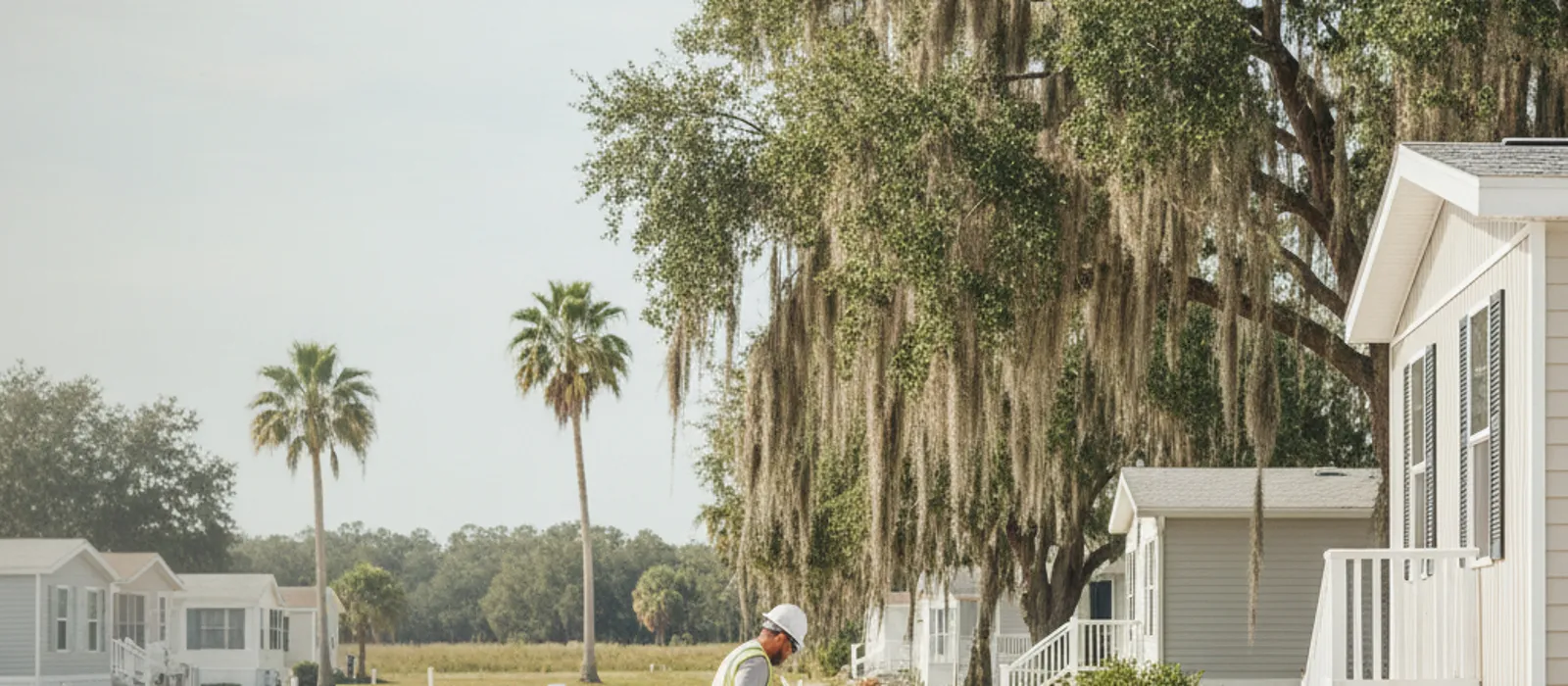
Set a marble on your kitchen floor tonight. If it rolls on its own, your home has been moving without telling you, and in Central Florida that’s less a possibility than a schedule.
So why do mobile homes settle in Florida faster than almost anywhere else? The short answer is sand. Most of Marion County sits on deep, loose, fast-draining sand that shifts every time it gets soaked and dries back out. Your home rests on piers, those piers rest on that sand, and the sand doesn’t stay put. Over a few wet seasons, one corner drops half an inch, then an inch, and suddenly doors stick, floors slope, and cracks show up around window frames.
The good news is that settling is normal, predictable, and fixable. In this article we’ll walk through exactly what’s happening under your home, how fast it happens here in Ocala and the surrounding towns, what repairs actually cost, and what you can do to slow the whole process down.
Why Do Mobile Homes Settle in Florida in the First Place?
Every structure settles a little. A mobile home in Florida settles more, and more unevenly, because of three things stacked on top of each other.
First, the foundation is a point-load system. A site-built house spreads its weight across a continuous footing. A mobile home concentrates its entire weight onto 12 to 30 individual piers, each one pressing down on a footing pad maybe 16 inches square. That’s a lot of pounds per square inch pushing into soft ground.
Second, the ground here is sand, not clay or rock. Sandy soil compacts when it’s loaded and vibrated, and it erodes when water moves through it. Both things happen constantly under a Florida mobile home.
Third, our water table and rainfall swing hard. Marion County averages around 50 inches of rain a year, most of it dumped between June and September. The soil under your home goes from bone dry in April to saturated in July, and every one of those cycles lets the sand rearrange itself a little.
Put those three together and you get the classic Florida pattern: a home that was dead level at setup drifts out of level within three to five years, usually on one side or one corner first.
If you’re already seeing sticking doors or sloped floors, don’t wait for it to get worse. Call Ocala Level Pros at (352) 820-4441 or request a free written estimate. We’ll check every pier and tell you exactly where you stand, in writing, at no cost.
The Trouble With Sand: What’s Really Under Marion County
Dig a posthole almost anywhere in Ocala, Belleview, or Summerfield and you’ll hit the same thing: fine gray or tan sand that runs deep. Soil scientists at the USDA Natural Resources Conservation Service map big stretches of Central Florida as Candler, Astatula, and Myakka series soils. Myakka is literally the official state soil of Florida, and it’s basically sand with a thin dark layer in it.
Sand behaves differently from clay in two ways that matter for your home.
Sand compacts under repeated load. Picture walking on dry beach sand versus wet packed sand near the water. Loose sand squeezes down when weight and vibration hit it. Every footstep inside your home, every washing machine spin cycle, every truck rumbling past on the county road sends tiny vibrations into the piers, and the sand grains keep nesting tighter. The pad sinks a fraction of a millimeter at a time.
Sand erodes when water moves through it. This is the bigger problem. Clay holds together when wet. Sand washes. When a downspout dumps roof runoff next to your skirting, or the lot grades toward the home instead of away from it, moving water carries sand grains right out from under a footing. That pier isn’t slowly compacting anymore. It’s losing its support entirely.
There’s one more Florida wrinkle worth naming without panic: our limestone bedrock dissolves over centuries, which is why Central Florida has sinkhole activity. True sinkholes are rare compared to ordinary settling, and 99 times out of 100 what looks alarming is just a sunk pier. But if you see circular ground depressions, multiple new cracks appearing fast, or fence posts leaning in a pattern, it’s worth reading up through the Florida Geological Survey and getting a professional opinion quickly.
Rain Is the Engine That Drives the Settling
If sand is the fuel, rain is the engine. Ask anyone who’s owned a mobile home here for a decade and they’ll tell you the same thing: the home moves most in late summer.
Here’s the cycle. Dry season firms the sand up. Then June arrives, afternoon storms drop an inch or two at a time, and the soil under your home saturates. Saturated sand loses bearing strength, so heavily loaded piers press deeper. Then the water drains away fast, because sand drains fast, and the grains settle into a slightly different, slightly lower arrangement. Repeat 60 or 70 times a season.
That’s why so many of our leveling calls come in September and October. Homeowners notice the changes after the wet season has done its work. We wrote a whole piece on this pattern in why mobile homes settle after heavy rain if you want the deeper dive.
Ramona in Belleview is a good example. Her double wide sat level for six years, then one wet August her back door started dragging on the frame and a hairline crack opened above the hallway arch. When we crawled under, three piers along the northeast corner had sunk almost an inch where a clogged gutter had been sheeting water off the roof edge all summer. The fix was a relevel with new shims and one replacement pad, $780 total, plus twenty minutes of her son’s time cleaning the gutter so it wouldn’t happen again.
Drainage problems compound quietly. Standing water under a home doesn’t just sink piers. It rots belly board, rusts anchors, and feeds mold. If you’ve got puddles under there after storms, start with our guide to water pooling under a mobile home, because fixing the water problem is half of fixing the settling problem.
How Fast Do Mobile Homes Settle in Florida?
There’s no single number, but after years of crawling under homes across Marion, Sumter, and Citrus counties, we see consistent patterns.
New setups move the most. The first two to three years after a home is set, the disturbed soil under the pads is still finding its final density. Some settling in year one and two is completely normal and usually even. This is why smart owners get a level check around year three.
Established homes drift slower but unevenly. After the early compaction phase, a well-drained lot might hold level for five to ten years. A lot with drainage issues, heavy shade holding moisture on one side, or a slope can go out of level in two or three.
One side always leads. Settling almost never happens evenly. The wet side, the shaded side, or the downhill side drops first. That’s why symptoms cluster: doors stick along one wall, floors slope toward one corner, skirting buckles on one run.
Walt in Dunnellon learned this the hard way. He bought a 1998 single wide and skipped the underside check because the floors “felt fine.” Two years later the kitchen end had dropped enough that cabinet doors swung open on their own. A downspout had been discharging against the skirting since before he bought the place, and the sand under two piers had washed into a low channel. His bill was $1,450: a full relevel, two new pier pads, and regrading a short swale to route the water away. Half of that cost was preventable with a $15 downspout extension.
The honest rule of thumb for our area: plan on a professional relevel every three to five years, and get a check anytime symptoms show up. Our post on how often a mobile home needs releveling breaks down the schedule by home age and lot condition.
What Settling Costs to Fix in Ocala and Marion County
Here’s the part most homeowners actually want: real numbers. Settling repairs are far cheaper than most people fear, especially caught early. These are typical ranges we see across our service area.
| Repair | Typical Cost | When You Need It |
|---|---|---|
| Level check and written estimate | Free | Any symptoms, or every 3 years |
| Relevel, single wide | $450 to $900 | Minor to moderate settling |
| Relevel, double wide | $700 to $1,500 | Minor to moderate settling |
| Pier pad replacement | $75 to $150 per pad | Pads sunk, cracked, or washed out |
| Full pier replacement | $150 to $400 per pier | Crumbling or badly tilted piers |
| Drainage correction (swale, extensions) | $200 to $800 | Water flowing toward or under home |
| Ignore it for 5 more years | $3,000 to $8,000+ | Subfloor, plumbing, and frame damage |
That last row isn’t a scare tactic, it’s math. Settling itself is cheap to fix. What’s expensive is what unlevel homes do over time: flexed plumbing joints that leak into the belly, subfloor that soaks and softens, doors and windows racked out of square. A $700 relevel skipped today has a way of becoming a $4,000 subfloor and plumbing job later. The full breakdown of what drives price up or down is in our mobile home leveling cost guide.
Gene in Summerfield got the timing right. He was prepping his home for sale and his agent warned him the buyer’s four-point inspection would flag anything unlevel. We found moderate settling along one beam, releveled it for $650, and gave him written documentation. The sale closed on schedule with zero inspection credits. His neighbor, same model home, ignored the same symptoms and ended up crediting a buyer $2,500 at closing for “foundation concerns” that would have cost a third of that to actually fix.
Want to know which category your home falls in? Get a free written estimate or call (352) 820-4441. We serve Ocala, Belleview, Summerfield, Silver Springs, Dunnellon, Lady Lake, Citra, and the rest of Marion, Sumter, and Citrus counties.
How to Slow Settling Down Under Your Home
You can’t change Florida’s soil, but you can change how fast it moves. These five habits do more than anything else we’ve seen.
Move roof water away from the home. Gutters with downspout extensions that discharge at least four feet from the skirting. This is the single highest-value fix in Central Florida, period.
Check your grading once a year. The ground should slope away from the home on all sides. Sand migrates, mulch builds up, and lots flatten out over time. A weekend with a rake can restore a proper slope on minor issues. If water is actively flowing under the home, that’s a job for a pro with equipment.
Keep the crawl space dry and sealed. A good vapor barrier keeps ground moisture from cycling up into your floor system, and intact skirting in good condition keeps blowing rain and animals out. If your barrier is torn or missing, our vapor barrier service page covers what replacement involves.
Do a marble-and-door check every season. Roll a marble in a few rooms, swing every door, and eyeball your skirting line from across the yard. Ten minutes, four times a year. Our checklist of signs your mobile home needs leveling tells you exactly what to look for.
Know when to stop DIY. Cleaning gutters, extending downspouts, and watching for symptoms are all safe homeowner jobs. Getting under a 15,000-pound home with a jack is not. Homes shift suddenly when lifted, piers can kick out sideways, and there’s no warning when it happens. If the fix involves lifting the home or moving piers, call someone licensed and insured for it.
Settling in Florida isn’t a defect in your home. It’s the ground doing what sandy ground does. The owners who come out ahead are the ones who treat it like mowing the lawn: a routine maintenance item with a known cost, not an emergency. Catch it early, fix the water, relevel on schedule, and your home will sit straight and solid for decades.
Frequently Asked Questions
Why do mobile homes settle in Florida more than in other states?
Florida homes sit on deep, loose sand instead of clay or rock, and that sand compacts under the concentrated weight of piers. Add 50 inches of annual rain that saturates and drains the soil dozens of times a year, and the ground under each footing keeps rearranging itself. The result is faster, more uneven settling than most other states see.
Is settling the same thing as a sinkhole?
Almost never. Ordinary settling means individual piers sinking gradually into compacting or eroding sand, and it’s routine and inexpensive to fix. Sinkholes involve the limestone bedrock dissolving and are far rarer. If you see circular ground depressions or many cracks appearing quickly, get a professional inspection right away, but the overwhelming majority of shifting homes just need a relevel.
How often should a Florida mobile home be releveled?
Plan on a professional level check every three years and expect an actual relevel every three to five years for most lots in Marion County. Homes on well-drained lots with good gutters can go longer. Homes with drainage problems, new setups in their first few years, or homes near heavy traffic may need attention sooner.
Can I stop my mobile home from settling completely?
No, and anyone who promises zero settling on Florida sand is overselling. What you can do is slow it dramatically: route roof water at least four feet away, keep the ground graded away from the home, maintain your vapor barrier and skirting, and relevel on schedule. Managed that way, settling stays a small, predictable maintenance cost instead of a structural problem.