
Here’s a number that surprises most of the homeowners we meet: a mobile home in Central Florida can drift out of level in as little as two to three years, even when nothing looks wrong from the driveway. So if you’re asking how often should a mobile home be leveled, you’re already ahead of most of your neighbors.
The honest answer isn’t one number. It depends on your soil, your setup, the age of your piers, and how much rain Marion County dumped on your lot last summer. In this guide we’ll give you a real schedule you can follow, the warning signs that mean the schedule no longer matters, and what releveling actually costs around Ocala, with a few true-to-life examples from towns like Summerfield, Dunnellon, and Belleview.
How Often Should a Mobile Home Be Leveled? The Short Answer
For most manufactured homes in the Ocala area, plan on this:
- Check the level every year. A quick walk-through and a look under the skirting. Takes twenty minutes.
- Have a professional inspection every 2 to 3 years. A pro puts a water level or laser on the frame and catches drift you can’t feel yet.
- Expect an actual relevel every 3 to 5 years on typical Central Florida soil. Some homes on well-compacted pads go 8 to 10 years. Some homes on sandy, wet lots need attention every 2.
Notice the difference between checking and releveling. Checking is free or cheap and should happen often. Releveling only happens when the check finds a problem. Homeowners get into trouble when they skip the checks and wait for the house to tell them something’s wrong, because by then the fix is usually bigger.
New homes need one extra step. A freshly set home settles the most in its first year as the soil under the piers compacts under the new weight. If your home was set within the last 12 to 18 months, get it checked at the one-year mark even if everything feels fine.
Not sure where your home stands? We’ll come out and check it for free. Request a free written estimate or call (352) 820-4441 and we’ll put a level on your frame, no pressure and no obligation.
Why Central Florida Homes Need Releveling More Often
National articles will tell you a mobile home needs leveling every 5 to 10 years. That advice was written for homes sitting on dense midwestern clay. Marion County is a different animal.
Most lots around Ocala, Silver Springs, and Citra sit on fine sand over limestone. Sand drains fast, which is great in a storm, but it also shifts and compacts every time it gets soaked and dries out again. We get 50-plus inches of rain in a normal year, most of it hammering down between June and September. Every one of those cycles moves the soil under your piers a little.
You can actually look up what’s under your lot. The USDA’s Web Soil Survey maps soil types for every parcel in Marion County, and you’ll see names like Candler and Astatula sand come up again and again. Those soils are exactly why local homes drift faster than the national average.
Add in a few local realities:
- Summer downpours that saturate the ground under one side of the home while the other side stays dry, so the home settles unevenly.
- Older piers on dirt. A lot of pre-1990s setups around here have block piers sitting on soil or thin pads instead of proper footings.
- Live oaks and laurel oaks pulling moisture out of the ground near one corner, which shrinks the soil on that side during dry spells.
We wrote a full breakdown of the local ground conditions in why mobile homes settle in Florida if you want to go deeper. The short version: in this county, the 3 to 5 year window is realistic, and annual checks aren’t overkill.
Signs You Need Releveling Before the Schedule Says So
A schedule is a guideline. Your house will tell you when it’s actually time, and it usually starts talking through small annoyances.
Watch for these:
- Interior doors that stick, swing open on their own, or won’t latch
- Windows that suddenly drag in their tracks
- New cracks at the corners of door frames and windows
- A floor that feels bouncy or slopes toward one wall
- Gaps opening between the floor and baseboard
- Skirting that’s buckling, bowing, or pulling away from the home
- Water pooling on the counter or a marble rolling on its own
One or two of these on the same side of the home is a strong hint that side is settling. We keep a longer list in our guide to the signs a mobile home needs leveling.
Here’s why catching it early matters so much. Carl, a retired homeowner in Summerfield, called us because two bedroom doors had stopped latching over the winter. We found the rear piers had settled about an inch and a quarter after a wet fall. The relevel ran him $625, done in one morning. His neighbor two streets over had the same symptoms three years earlier and ignored them. By the time that home got attention, the twisting frame had cracked the subfloor in two rooms and split a drain line under the master bath. That repair bill came to a little over $4,300, and most of it traced back to a relevel that would have cost a few hundred dollars.
That’s the pattern we see over and over. Releveling is cheap. What an unlevel frame does to floors, plumbing, and walls over a couple of years is not.
How Often to Relevel a Mobile Home by Age and Setup
Not every home drifts at the same speed. Use this table to find your situation and a realistic interval for professional checks and expected relevels.
| Your situation | Professional check | Typical relevel interval |
|---|---|---|
| New home, first 18 months after set | At the 1-year mark | Minor adjustment common in year 1 |
| Home under 10 years old, piers on proper footings | Every 3 years | Every 5 to 8 years |
| Home 10 to 25 years old, standard block piers | Every 2 to 3 years | Every 3 to 5 years |
| Home over 25 years old or pre-1976 | Every 1 to 2 years | Every 2 to 4 years |
| Any home on low, sandy, or poorly drained lot | Every year | Every 2 to 3 years |
| After a hurricane, tropical storm, or record wet season | Within a few weeks of the event | As needed based on findings |
| Before selling or before a 4-point inspection | Before listing | One-time verification and adjustment |
Two rows on that table deserve a story each.
Donna in Dunnellon bought a 1998 double-wide near the Withlacoochee and figured leveling was a once-a-decade thing. Her lot sits low and stays damp most of the summer. Seven years without a check left her with three crushed pier caps, one leaning pier, and a floor with a visible dip in the hallway. Her bill was $2,350 for pier repairs plus the relevel. On her lot, two or three routine relevels in that same stretch would have totaled around $1,300 and the piers would never have been damaged.
The storm row matters here too. Heavy, saturating rain moves soil, and a tropical system can drop a summer’s worth of water in two days. After a big storm year, a quick check is cheap insurance. FEMA’s guidance on manufactured homes and flooding at fema.gov is worth a read if your lot has ever taken on water.
What Releveling Costs Around Ocala
Around Marion County, a straightforward relevel on a single-wide usually lands between $450 and $750. Double-wides typically run $600 to $1,000 because there are two frames to bring back into plane and a marriage line to close up. Prices climb from there only when we find damaged piers, rotten shims, or footing problems that need real repair.
Compare that with what deferred leveling leads to:
- Subfloor repairs from frame twist: $1,500 to $4,500
- Plumbing leaks from stressed lines: $300 to $2,000 plus water damage
- Pier rebuilds after blocks crack or lean: $150 to $400 per pier
- Failed 4-point inspection before a sale or insurance renewal: delayed closing, lost buyers
That last one is more common than people think. Ruth in Belleview was three weeks from closing on her home sale when the buyer’s inspector flagged the home as out of level and noted daylight at the marriage line. She called our emergency line on a Thursday, we releveled the home Friday for $875, provided written documentation, and the closing happened on schedule. Without that paper in hand, her buyer’s lender was ready to walk.
If a sale or an insurance deadline is breathing down your neck, that’s exactly what our 24/7 line is for. Call (352) 820-4441 any hour, or request your free written estimate and we’ll get you a documented number fast. You can also see the full pricing breakdown on our mobile home leveling cost page.
What You Can Check Yourself, and When to Call a Pro
You don’t need special tools to do the annual homeowner check. Here’s the twenty-minute version:
- Walk every room slowly. Feel for slopes, soft spots, and bounce. Set a marble or a golf ball on the kitchen floor and see if it rolls.
- Open and close every door and window. Note which ones stick and mark them on a simple sketch of the home. The pattern tells a pro a lot.
- Look at the skirting outside. Bowing, buckling, or new gaps at the top edge mean the home has moved relative to the ground.
- Peek behind an access panel with a flashlight. You’re looking for leaning piers, crumbled blocks, wood shims that have split or slipped, and standing water.
That’s where the DIY part ends, and we mean that. Do not crawl under the home to adjust piers, stack blocks, or jack the frame yourself. A double-wide can weigh 40,000 pounds or more, and homes have shifted off piers and killed people during amateur leveling attempts. Jacking one point of a steel frame without a plan can also twist the chassis and crack the very floors and walls you’re trying to protect. Manufactured homes are built to the federal HUD code, and their support and anchoring systems are engineered as a unit. You can read about those standards through HUD’s manufactured housing program.
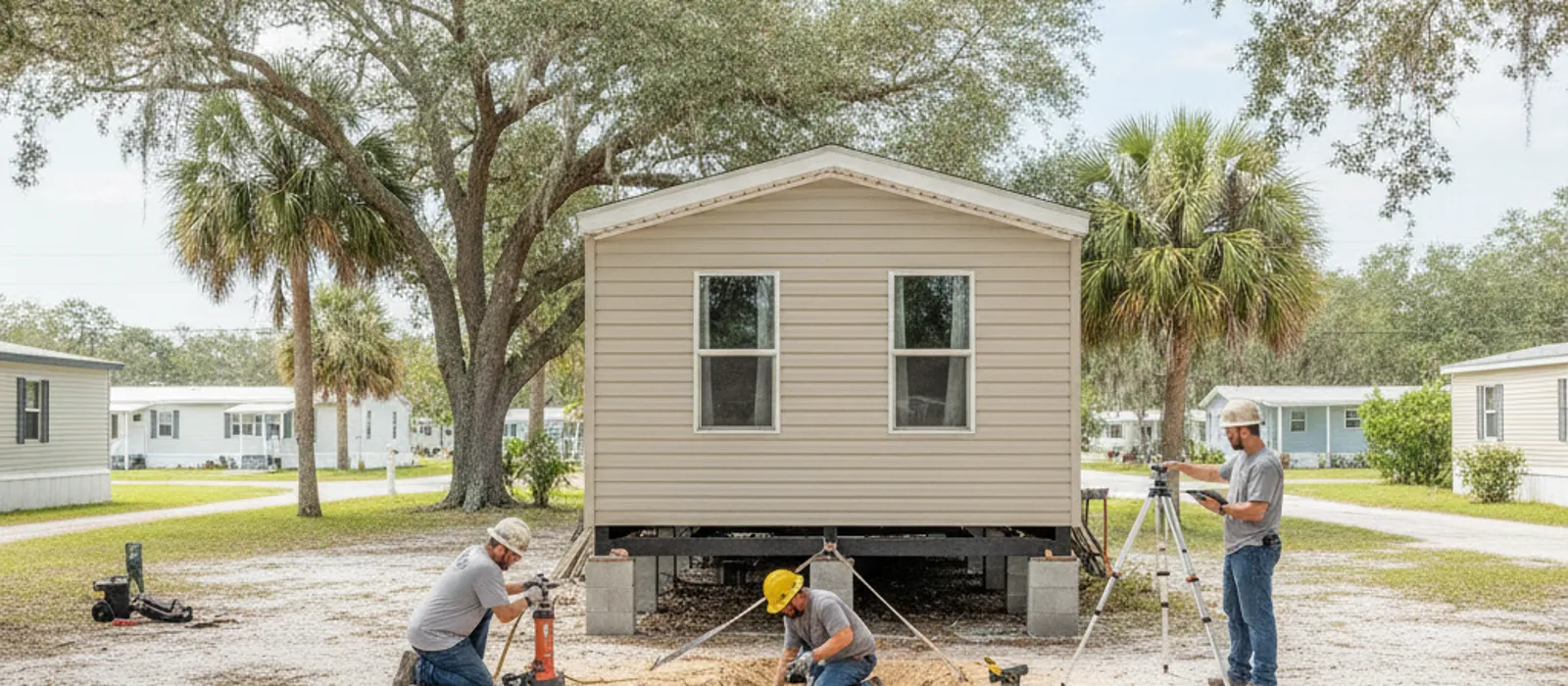
A professional relevel is a different process entirely. We shoot the whole frame with a water level or laser, map every pier’s height, then raise and shim in a planned sequence so the frame comes up evenly. Most jobs take a morning. If you’re curious about the step-by-step, we walk through it in how mobile home leveling works.
While we’re under there, we also look at your tie-downs and anchors, because settling and strap tension go hand in hand. An unlevel home often has slack straps on the low side, and slack straps are what inspectors and insurers flag. If yours haven’t been looked at in years, our tie-down inspection and anchoring service pairs naturally with a relevel visit, and our main mobile home leveling page covers everything included in a standard job.
The Bottom Line on Releveling Frequency
Check yearly. Get a professional level check every 2 to 3 years. Expect to actually relevel every 3 to 5 years on typical Marion County soil, sooner on wet or sandy lots, and any time the doors and floors start acting up between checkups.
The homeowners who follow that rhythm spend a few hundred dollars every few years and never deal with cracked subfloors, stressed plumbing, or failed inspections. The ones who wait for obvious damage spend thousands. It’s one of the clearest cases in home maintenance where a small, boring habit beats an expensive rescue.
If you can’t remember the last time anyone put a level on your home’s frame, that’s your answer. Get your free written estimate or call (352) 820-4441 and we’ll tell you exactly where your home stands.
Frequently Asked Questions
How often should a mobile home be leveled in Florida?
Most Florida mobile homes need releveling every 3 to 5 years because sandy soil and heavy summer rains cause faster settling than in most states. Homes on low or poorly drained lots may need it every 2 to 3 years. The key is a professional level check every 2 to 3 years so small drift gets corrected before it causes damage.
How do I know if my mobile home needs to be releveled?
The most common early signs are doors that stick or won’t latch, windows that drag, new cracks around door and window frames, sloping or bouncy floors, and skirting that buckles or pulls away. If two or more of these show up, especially on the same side of the home, get a professional check. Catching it at this stage usually means a simple, inexpensive relevel.
How much does it cost to relevel a mobile home near Ocala?
A standard relevel typically runs $450 to $750 for a single-wide and $600 to $1,000 for a double-wide in the Ocala area. Prices go up if piers, pads, or shims need repair or replacement, which is more likely when leveling has been put off for years. A written estimate after an on-site check is the only way to get a firm number for your home.
Can I relevel a mobile home myself?
We strongly recommend against it. The home can weigh 20,000 to 40,000 pounds or more, and jacking it without the right equipment and sequence risks serious injury and structural damage to the frame, floors, and plumbing. Homeowners can safely do the yearly walk-through checks, but leave the jacking and shimming to an insured professional.