
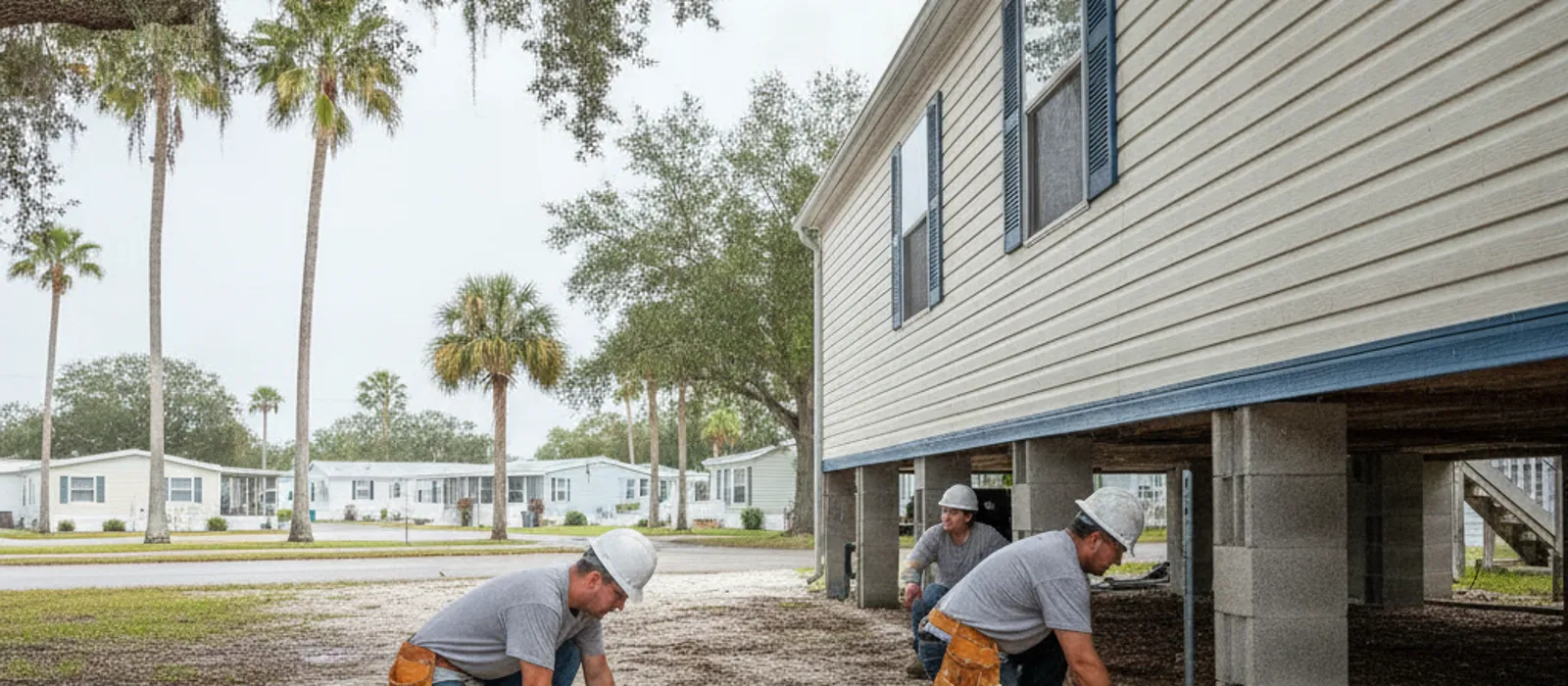
Marion County averages more than 50 inches of rain a year, and most of it falls between June and September. That’s four months of near-daily downpours soaking the ground your home sits on. If you’ve noticed doors sticking or floors dipping every August, you’re not imagining it. Mobile home settling after rain is one of the most common calls we get at Ocala Level Pros, and it always spikes right after a stretch of summer storms.
Here’s the good news. Once you understand why rain speeds up settling, you can catch it early, fix it for hundreds instead of thousands, and set your home up so next summer’s storms don’t move it at all.
What Happens Under Your Home When the Ground Gets Soaked
Your mobile home doesn’t sit on the ground. It sits on a series of piers, usually concrete blocks stacked on ABS pads or poured footers, spaced every 6 to 8 feet along the steel frame. Each pier carries thousands of pounds, and all of that weight presses down on a small footprint of soil.
When that soil is dry, it holds firm. When it’s saturated, everything changes. Central Florida sits on sandy soil over limestone, and sand behaves very differently wet than dry. Water works as a lubricant between sand grains, letting them slide and repack tighter under load. Engineers call it consolidation. You’d call it your pier sinking a half inch in one wet summer.
Rain also moves soil, not just softens it. Water running under your home during a heavy storm can wash fine material right out from under a pier pad. The pad doesn’t sink evenly. It tilts, and now the pier is leaning instead of stacking straight, which is worse than simple settling.
The National Weather Service tracks Florida’s rainy season closely, and you can see the pattern yourself in their data at weather.gov. The wet season delivers roughly 60 to 70 percent of our annual rainfall in about a third of the year. Your piers get hit with months of saturation, then months of drying and shrinking. That cycle, repeated year after year, is why Florida mobile homes need releveling more often than homes up north.
If your floors already feel off after this summer’s storms, don’t wait for it to get worse. Call Ocala Level Pros at (352) 820-4441 for a free written estimate. We’ll measure the whole frame and tell you exactly what moved and what it costs to fix.
Why Mobile Homes Settle Faster After Heavy Rain Than Site-Built Houses
A site-built house spreads its weight across a continuous foundation, either a slab or a stem wall footing that runs the full perimeter. A mobile home concentrates the same kind of weight onto 20 to 40 small pier points. When soil softens, a concentrated point load pushes in much faster than a spread footing does.
There’s a second factor most homeowners never think about. Site-built foundations go down below the loose topsoil layer. Most mobile home piers sit on pads placed at or just below grade, right in the soil zone that rain affects most. The top 12 to 18 inches of Florida sand is exactly where moisture swings hardest.
Then there’s drainage. Many mobile homes in older Marion County parks and rural lots were set on ground that was never properly graded. Water sheets off the roof, lands at the drip line, and flows straight under the home. Every storm sends a small river across your pier pads. Skirting hides it, so nobody sees the problem until the floor tilts.
Poor drainage under the home causes more than settling, by the way. Standing water breeds mold, rusts your frame and anchors, and ruins your belly board. We covered what to look for in our guide on water under a mobile home, and it pairs with this article because the two problems almost always show up together.
One more Florida-specific issue deserves a mention: our limestone bedrock. The U.S. Geological Survey explains how water dissolving limestone creates voids and, occasionally, sinkholes in karst regions like ours (usgs.gov). True sinkholes are rare. Slow soil raveling into small limestone voids is not, and heavy rain accelerates it. If one corner of your home keeps dropping year after year despite releveling, that’s a soil problem worth investigating, not just a pier problem.
Real Stories: What Rainy Season Settling Looked Like for Three Local Homeowners
Ray in Belleview called us in late July after two weeks of afternoon storms. His back door had started dragging so badly he had to shoulder it open. We found four piers along the rear frame rail had settled between a half inch and an inch, all on the side where his gutters dumped water. We releveled the home for $595 and he added a $40 downspout extension himself. The door has closed cleanly ever since.
Carol in Dunnellon waited two summers. Her hallway floor developed a slope she “got used to,” then a soft spot showed up near the bathroom. By the time we got under the home, three pier pads had sunk and tilted, one pier had partially collapsed, and the leak from a strained plumbing joint had damaged the subfloor. Her total came to $3,850: pier replacements, a full relevel, and subfloor repair. The frustrating part is that a $600 relevel after the first wet season would have prevented almost all of it.
Miguel in Summerfield took the preventive route. After reading about wet season settling, he booked an inspection in May, before the rains. We found early settling on six piers plus a torn vapor barrier letting ground moisture rise into his insulation. He paid $1,850 for a relevel and a new vapor barrier, and when the August storms came through, his double-wide didn’t move a quarter inch.
Three homes, three very different bills. The pattern is simple: the earlier you act, the less you pay.
Warning Signs of Mobile Home Settling After a Wet Summer
Settling rarely announces itself with anything dramatic. It shows up in small annoyances that are easy to blame on humidity or an old house. Watch for these, especially from July through October:
- Doors that stick, drag, or swing open on their own
- Windows that suddenly bind or won’t latch
- New cracks around door frames, window corners, or ceiling seams
- Floors that slope, bounce, or feel soft in spots
- Skirting panels that buckle, bow, or pull away from the ground
- Gaps opening between the marriage line of a double-wide
- Cabinet doors that won’t stay shut
Any one of these on its own might be nothing. Two or more showing up in the same season, especially after heavy rain, almost always means the piers moved. Our full rundown of signs your mobile home needs leveling walks through each symptom in detail, and if the doors are your main complaint, see why mobile home doors won’t close.
Here’s a quick check you can do yourself in five minutes. Set a marble or a golf ball on the floor in several rooms and watch which way it rolls. Do it in spring, then again in September. If the roll changes direction or speeds up, the wet season moved your home. That’s your cue to request a free estimate before small movement becomes structural damage.
One safety note: you can look at your skirting and roll marbles all day, but don’t crawl under the home to inspect or adjust piers yourself. A pier that’s tilted or undermined by washout can shift under load with no warning. Leave anything under the frame to a crew with proper jacks and training.
What Rain-Related Settling Costs to Fix in Marion County
Costs depend on how far the settling went before someone caught it. Here’s what we typically see across Ocala, Belleview, Summerfield, Dunnellon, and the surrounding towns:
| Problem Stage | Typical Repair | Typical Cost Range |
|---|---|---|
| Early settling, caught in first season | Relevel single-wide | $450 to $700 |
| Early settling, double-wide | Relevel double-wide | $700 to $1,200 |
| Settling plus washed-out pads | Relevel plus new pier pads | $900 to $1,800 |
| Tilted or crumbling piers | Pier replacement plus relevel | $1,500 to $3,500 |
| Long-term neglect | Piers, relevel, subfloor repair | $3,000 to $6,000+ |
| Moisture damage underneath | Add vapor barrier during repair | $800 to $2,000 |
Two things jump out of that table. First, catching settling in the first wet season keeps you in the cheapest row. Second, the expensive rows aren’t really settling costs. They’re the cost of water damage that piled on while the settling went unfixed. For a deeper breakdown of what drives the price up or down, read our guide to mobile home leveling cost factors.
Insurance is the hidden cost nobody budgets for. Florida insurers routinely require a 4-point inspection or tie-down verification, and an obviously out-of-level home with washout under it can complicate renewals. A few hundred dollars of releveling is cheap compared to scrambling before a policy deadline.
How to Protect Your Home Before Next Rainy Season
You can’t stop the rain, but you can control where it goes and how well your home resists it. These five steps make a real difference:
-
Move roof water away from the home. Gutters with downspout extensions that discharge at least 4 feet from the skirting are the single best dollar-for-dollar upgrade. Most of the washout we find traces straight back to a drip line.
-
Fix the grade. Soil should slope away from the home on all sides. If water ponds against your skirting after a storm, it’s ponding under the home too.
-
Keep a solid vapor barrier down. A 6-mil ground cover blocks rising moisture, protects your insulation and belly board, and keeps the crawl space drier between storms. Our vapor barrier service in Ocala includes an under-home inspection, so you learn about pier problems at the same visit.
-
Check your skirting vents. Blocked vents trap humid air under the home. Good cross-ventilation helps the soil surface dry out between storms instead of staying saturated all summer.
-
Get a professional level check every couple of years. A pro with a water level or laser can spot a quarter inch of movement long before your doors ever stick. In Florida’s climate, every 3 to 5 years is a sensible rhythm, or sooner after an unusually wet year.
None of this requires crawling under the home or touching a jack. The moment a fix involves lifting the frame, shimming a pier, or replacing a pad, that’s professional work. The home weighs 15,000 to 40,000 pounds, and DIY leveling injuries are exactly as bad as you’d imagine.
When to Stop Watching and Make the Call
A reasonable rule: monitor cosmetic stuff, act on functional stuff. A hairline crack in drywall texture can wait for your next scheduled check. A door that won’t latch, a floor that slopes more than it did in spring, skirting that’s visibly buckling, or any soft spot underfoot means the frame has moved enough to strain the structure. That’s the point where waiting costs money.
Our process is straightforward. We come out, measure elevations along the entire frame, inspect every pier and pad, and give you a free written estimate with real numbers. Most mobile home releveling jobs in the Ocala area are done in a single day, and we serve all of Marion, Sumter, and Citrus counties.
If this article sounded uncomfortably familiar, trust that instinct. Call (352) 820-4441 or request your free estimate online. Catching rainy season settling in year one is a few hundred dollars. Catching it in year three is a few thousand. We’d rather help you pay the small bill.
Frequently Asked Questions
How fast can a mobile home settle after heavy rain?
Noticeable movement can happen within a single wet season, and after an unusually heavy stretch of storms we’ve measured piers that dropped a half inch in a matter of weeks. Sudden movement usually means washout under a pad rather than gradual soil compression. Either way, movement you can detect from inside the home is worth a professional look.
Will my mobile home stop settling once the ground dries out?
The soil firms back up as it dries, but it doesn’t lift your piers back to where they were. Settling is one-directional, and each wet season adds a little more. The dry months are actually the best time to relevel, since the soil is stable and the fix holds through the next rainy season.
Does homeowners insurance cover settling from rain?
Usually not. Most Florida policies exclude settling, soil movement, and gradual damage, though sudden sinkhole activity is handled under separate provisions. That’s another reason to fix small settling early, because you’ll likely be paying out of pocket either way and the early fix is far cheaper.
Can I just add more blocks under a sunken pier myself?
No, and we say that as the people you’d eventually call to fix it. Stacking blocks or shims under a loaded frame without proper jacks and load distribution can crack the frame, pop the marriage line on a double-wide, or drop the home on you. Releveling is fast and affordable when done right, so leave the lifting to a licensed crew.