
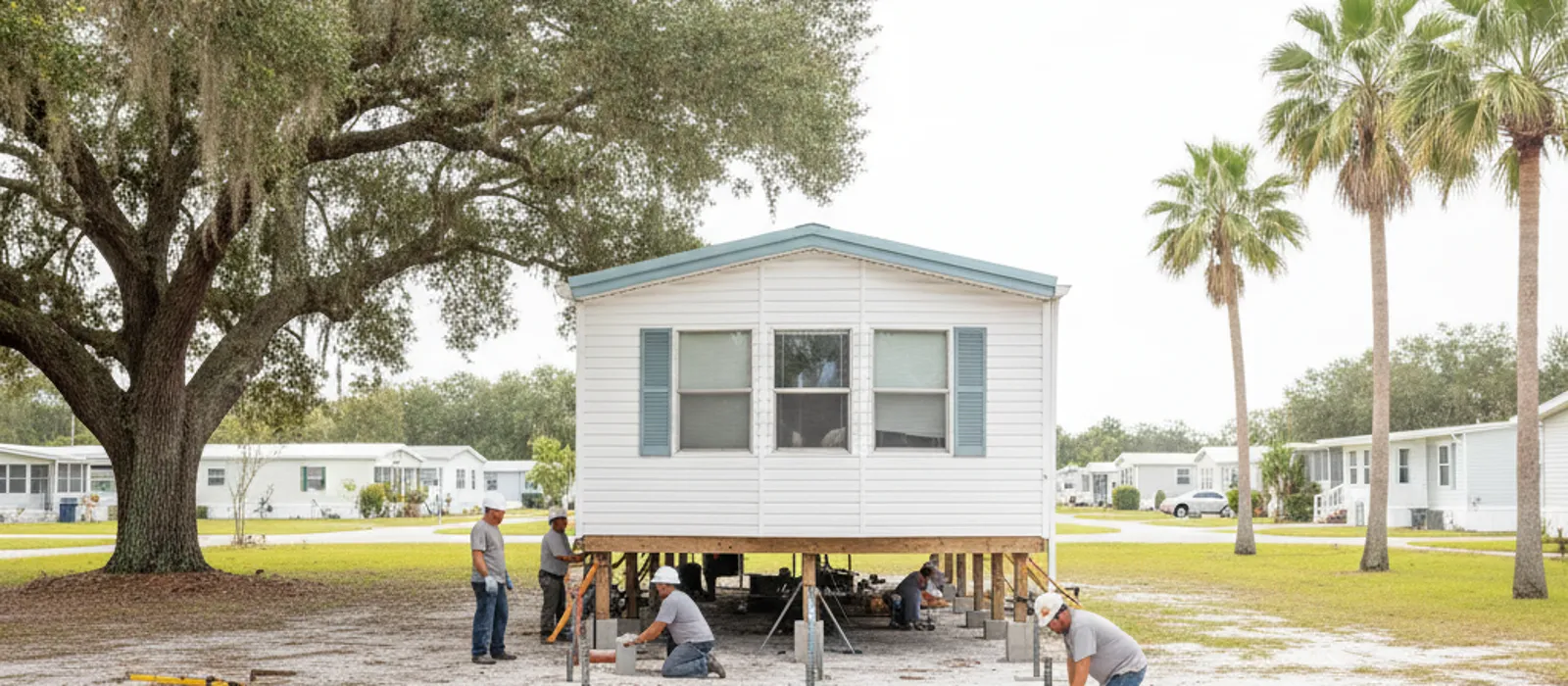
One cracked pier can cost you around $300 to replace today, or a few thousand dollars in floor and wall repairs if you let it sit for a year. That’s the math most homeowners around Ocala never see until it’s too late.
So let’s get straight to it. Mobile home pier replacement cost in Central Florida typically runs $150 to $600 per pier, installed. Most homeowners in Marion County land in the $250 to $400 range for a standard concrete block pier with a new pad and cap. Replace a handful during a releveling job and you’re usually looking at $800 to $2,500 total, not a second mortgage.
In this guide, we’ll break down what you pay per pier, why prices swing so much, and what real jobs in Belleview, Dunnellon, and Citra actually cost. We’ll also cover when a pier can be repaired instead of replaced, because sometimes the answer is a $40 shim adjustment, not a $400 pier.
What Mobile Home Pier Replacement Cost Looks Like Per Pier
Here’s the honest range we see across Ocala and Marion County, plus Sumter and Citrus counties:
- Single pier replacement (standard block): $150 to $400
- Pier with new footing pad: $250 to $500
- Steel or adjustable pier upgrade: $300 to $600
- Re-stacking a tipped pier (no new materials): $75 to $200
- Shim and cap adjustment only: $40 to $100 per pier as part of a leveling job
Why the wide range? A pier isn’t just a stack of blocks. The price includes crawling under the home, jacking the frame safely, removing the failed pier, setting a new footing on stable soil, stacking and capping the new pier, and lowering the home back onto it. Labor and access are most of the bill, not the concrete.
That’s also why replacing five piers doesn’t cost five times as much as replacing one. Once a crew is under the home with jacks set, each additional pier gets cheaper. Expect a minimum service charge of around $300 to $500 for any single-pier visit, because the setup work is the same whether we replace one pier or eight.
If you’re seeing sloping floors or doors that stick along with a bad pier, the smart move is a full inspection first. We check every pier, not just the obvious one, and give you a free written estimate before anything gets jacked up. Call us at (352) 820-4441 or request your free estimate here.
Pier Replacement Cost by Pier Type
Not all piers cost the same to replace. Here’s how the common types compare in our service area:
| Pier Type | Cost Per Pier (Installed) | Best For | Typical Lifespan |
|---|---|---|---|
| Concrete block (dry-stacked) | $150 - $400 | Most single and double wides | 20-30 years |
| Block with poured footing | $250 - $500 | Soft or sandy soil | 30+ years |
| Adjustable steel pier | $300 - $600 | Homes that settle often | 25-40 years |
| ABS plastic pad + block | $200 - $450 | Wet sites, quick installs | 20-30 years |
| Re-stack existing pier | $75 - $200 | Tipped but undamaged blocks | Varies |
A quick note on that last row. If your blocks are sound and the pier just leaned or sank a little, a re-stack with fresh shims and caps costs a fraction of full replacement. A good contractor will tell you which piers truly need replacement and which just need adjustment. If someone quotes full replacement on every pier under your home without showing you the damage, get a second opinion. We wrote about that pattern in our guide to when to replace mobile home piers.
For a deeper look at how block, steel, and ABS systems differ, see our breakdown of mobile home pier types.
Why Piers Fail in Central Florida
Florida is hard on piers, and Marion County soil is a big part of it. Most of our area sits on sandy soil over limestone, and sand moves when it gets wet. Our summer rain pattern means the ground under your home swells and shrinks a little every year.
Here’s what actually kills piers around here:
Settling soil. The number one cause. The footing pad sinks unevenly, the pier tips, and the weight shifts to neighboring piers. That’s why one bad pier often becomes three.
Washout. Poor drainage or a skirting gap lets rainwater channel under the home. Water carries sand away from under the footing, and the pier drops. Homes near retention areas and low lots in Summerfield and Lady Lake see this a lot.
Cracked blocks. Concrete blocks handle compression well, but once a home goes out of level, blocks start carrying weight at an angle. That’s when they crack and crumble.
Bad original installation. We still find piers set on bare sand with no pad, or stacked with the block cores facing sideways. Pre-1976 homes are the usual suspects, but we’ve seen it on homes from the 2000s too.
The good news: pier failure is slow and it announces itself. Doors that won’t latch, cracks at window corners, a bounce in the hallway floor. If you’re seeing those signs, pay attention, because pier problems and leveling problems are usually the same problem.
What Drives Your Pier Replacement Cost Up or Down
Two neighbors can call us the same week and get quotes that differ by $1,000. Here’s why.
Number of piers. The biggest factor, obviously. A single wide typically sits on 12 to 20 piers, a double wide on 24 to 40 plus centerline supports. Replacing 3 piers is a half-day job. Replacing 15 is a full releveling project.
Access under the home. A home with 30 inches of clearance and removable skirting panels is fast. A home sitting 14 inches off the grade with mud underneath takes twice as long, and time is money.
Soil condition. If the old pier failed because of washout or soft soil, we can’t just set a new pier in the same hole. Larger footings, ABS pads, or compacted fill add $50 to $150 per pier but stop you from paying for this again in five years.
Whether leveling is included. Here’s something a lot of homeowners miss: you almost never replace piers without releveling, because the home has already shifted by the time a pier fails. Many contractors, us included, bundle pier replacement into a leveling job. A full mobile home leveling in Ocala with a few pier replacements included often costs less than paying for the two jobs separately. Our post on mobile home leveling cost factors walks through that bundle math.
Tie-down condition. While we’re under the home, we check anchors and straps. Rusted anchors don’t change your pier bill, but replacing them in the same visit saves you a second service charge. It also matters for insurance, since Florida’s four-point inspections look hard at tie-downs. See our mobile home tie-down service in Ocala for what that adds.
Permits. In Florida, structural work on manufactured homes may require a permit and, in some cases, an installer license. Marion County handles mobile home permits through its building department, and the state regulates installers under the Department of Highway Safety and Motor Vehicles. HUD sets the federal construction standards for the homes themselves, which you can read at hud.gov. A legitimate contractor handles permitting for you and includes it in the quote.
Real Pier Replacement Jobs Around Marion County
Numbers on a page are one thing. Here’s what actual jobs look like.
Ray in Belleview: 4 piers, $1,150. Ray noticed his back door dragging and a crack over the kitchen window. Under his 1998 double wide, we found four piers along the marriage line had settled after a wet summer. Two needed full replacement with new pads, two just needed re-stacking and shims. Total came to $1,150 including releveling that section of the home. His door closed right that same afternoon.
Donna in Dunnellon: full releveling with 9 pier replacements, $2,850. Donna’s single wide near the Rainbow River sat on piers with no footing pads, installed sometime in the 1980s. Nine piers had sunk or cracked. We replaced all nine with block piers on ABS pads, adjusted the rest, and releveled the whole home. At $2,850 total, her per-pier cost worked out to far less than piecemeal repairs would have, and the floors stopped bouncing for the first time in years.
Marcus in Citra: 1 emergency pier, $425. Marcus was under contract to sell when the buyer’s inspector flagged a crumbled pier under the master bedroom. Closing was in six days. We got out there in two, replaced the pier with a new footing, and gave him written documentation for the buyer’s lender. $425 total, and the sale closed on time.
If you’ve got an inspection deadline or an insurance issue breathing down your neck, that’s exactly what our emergency line is for. Call (352) 820-4441 any time, day or night.
Can You Replace a Mobile Home Pier Yourself?
Short answer: you can re-shim, but you shouldn’t replace.
Adding or adjusting shims on an existing pier is a reasonable DIY job for a careful homeowner with the right gear. Replacing a pier is not, and here’s why. To remove a pier, you have to jack the steel frame and hold thousands of pounds of home on temporary supports. If a jack kicks out or the frame slips, there is no second chance under there. Crews use multiple jacks, cribbing, and a water level or laser to keep the frame within tolerance while the weight is off.
There’s also the accuracy problem. Set the new pier an eighth of an inch too high and you’ve just transferred stress to the piers on either side. You won’t feel it for months, and then you’ll feel it in your floors and door frames.
The DIY math rarely works anyway. By the time you rent jacks, buy blocks, pads, caps, and shims, you’ve spent $150 to $250 to do one pier, without insurance, without a warranty, and without anyone checking the other 25 piers. Worker safety agencies treat work under supported loads as a serious hazard for good reason; OSHA’s guidance on jacking and cribbing safety at osha.gov applies to pros, and the risks don’t shrink for homeowners.
If you want to understand what a proper crew does step by step, we’ve written about the full process. The short version: let someone with insurance crawl under the house.
How to Keep Pier Costs Down Long Term
The cheapest pier is the one you never have to replace. A few habits make a real difference in Florida:
Fix drainage first. Gutters, downspout extensions, and grading that moves water away from the skirting will do more for your piers than any upgrade. Most washout failures we see were preventable with $200 of drainage work.
Get under the home once a year. Or have someone do it. A 20-minute look catches a tipping pier while it’s still a $100 re-stack instead of a $400 replacement plus subfloor damage.
Recheck level every 3 to 5 years. Florida homes settle. A periodic check with minor shim adjustments keeps weight distributed evenly so no single pier gets overloaded.
Keep skirting sealed but vented. Skirting keeps rushing water and animals out, while vents let moisture escape so your piers, straps, and belly board aren’t sitting in a swamp.
Bundle work. If you need piers, tie-downs, and a vapor barrier, doing them in one visit saves you two extra trip charges and gets everything documented at once for your insurer.
We give free written estimates everywhere in Marion, Sumter, and Citrus counties, from Silver Springs to Lady Lake. No pressure, real numbers, and we’ll tell you which piers can wait. Get your free estimate or call (352) 820-4441.
Frequently Asked Questions
How much does it cost to replace all the piers under a mobile home?
Full pier replacement on a single wide typically runs $3,000 to $8,000, and a double wide can run $6,000 to $15,000 depending on pier count and access. That said, full replacement is rare. Most homes need a handful of piers replaced and the rest adjusted, which usually lands between $1,000 and $3,000 including releveling.
How do I know if a pier needs replacement or just adjustment?
Cracked, crumbling, or shifted blocks mean replacement, and so does a footing that has sunk into the soil. A pier that has tipped but still has sound blocks can usually be re-stacked and shimmed for much less. A contractor should show you photos or walk you under the home so you can see the difference yourself before you approve anything.
Does homeowners insurance cover mobile home pier replacement?
Usually not for normal settling, since insurers treat that as maintenance. Coverage sometimes applies when a covered event like a storm or a plumbing leak caused the damage, so it’s worth a call to your agent with photos in hand. Keep written documentation of any pier work, because it helps at four-point inspection time and when you sell.
How long does pier replacement take?
Replacing one to four piers is typically a half-day job, and most homes are done in a single day even with releveling included. Larger jobs with poor access or many footings can take two days. You can stay home during the work, though you’ll hear some creaks as the home comes back to level.