Your entire home is sitting on a couple dozen stacks of blocks, and most owners have never crawled under to look at a single one. That’s not a scare tactic, it’s just how manufactured housing works. The piers under your frame carry every pound of your home, your furniture, and your family, and the type of pier down there decides how often you’ll need releveling, how you’ll do on a 4-point inspection, and what repairs will cost you over the next 20 years.
If you’re comparing mobile home pier types because you’re buying a used home, fixing a sagging floor, or replacing piers an inspector flagged, this guide covers the three you’ll actually see in Marion County: concrete block, steel, and ABS plastic systems. We’ll walk through what each one costs, how long it lasts in Florida’s sandy, wet soil, and which one we’d put under our own homes.
Quick note before we dig in: if your floors are already sloping or doors are sticking, the pier type conversation can wait. Get the home stabilized first. Call us at (352) 820-4441 and we’ll come take a look, free written estimate, no pressure.
The Three Main Mobile Home Pier Types in Florida
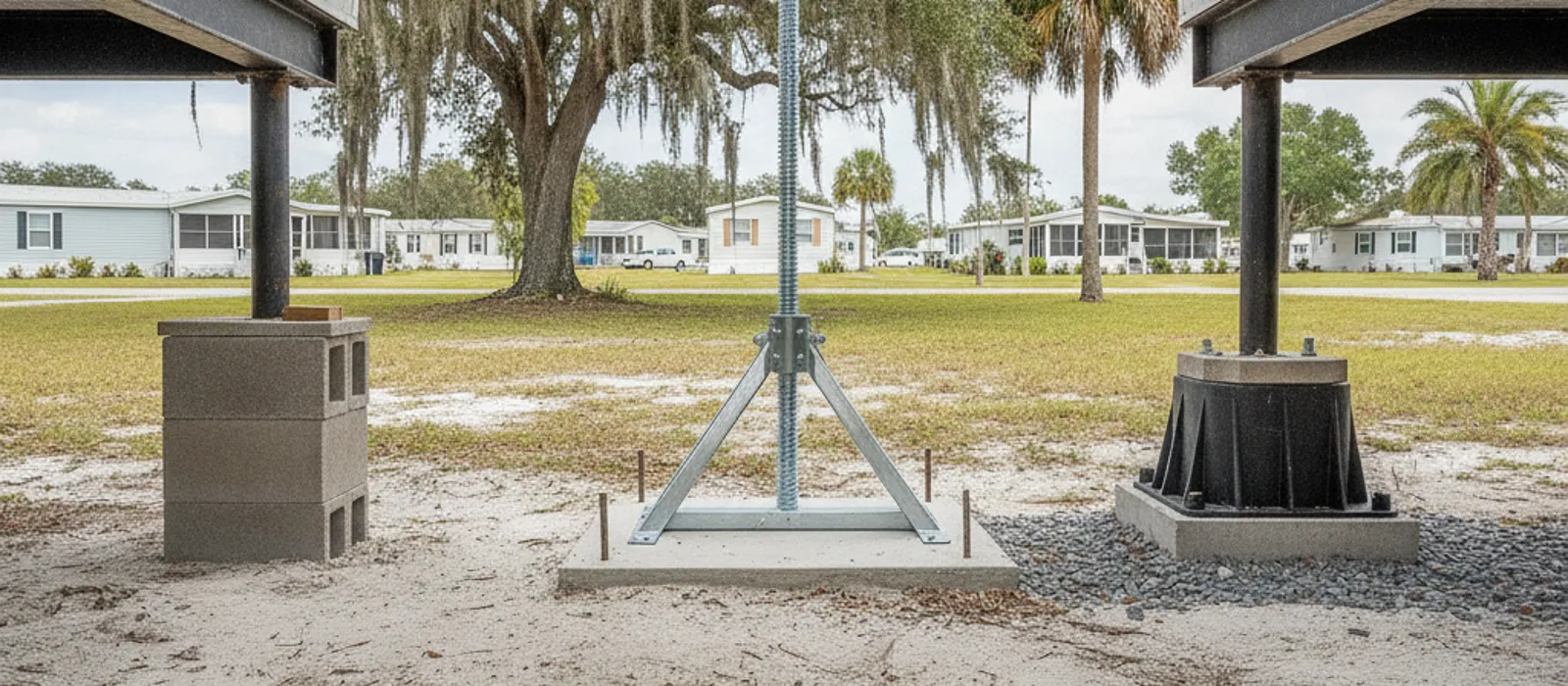
Walk under any manufactured home in Ocala and you’ll find one of three support systems holding up the steel frame.
Concrete block piers are stacks of 8x8x16 concrete masonry units (CMUs), usually set on a poured concrete pad or ABS base pad, capped with a wood or concrete cap and hardwood shims. This is the standard install in Florida and what roughly nine out of ten homes around here sit on.
Steel piers come in two flavors: adjustable steel jack stands (sometimes called pier jacks) and heavier engineered steel pier systems used for permanent foundation conversions. The adjustable ones have a threaded screw head that lets an installer fine-tune height without restacking anything.
ABS piers and pads are molded plastic components. Most often you’ll see ABS used as the base pad under a block pier, but there are also full ABS pier systems, plastic pyramid-style stands designed to replace blocks entirely in lighter applications.
All three are legal in Florida when installed to spec. The state follows HUD’s federal installation standards, and 24 CFR Part 3285 spells out pier spacing, load capacity, and footing requirements. Florida layers its own installer licensing and tie-down rules on top through the FLHSMV mobile home program. So the question isn’t which pier type is allowed. It’s which one fits your home, your soil, and your budget.
Concrete Block Piers: The Marion County Workhorse
There’s a reason block piers dominate. They’re cheap, strong, and every licensed installer in Florida knows how to set them correctly.
A standard single-stack block pier handles homes up to about 36 inches of frame height. Go taller and code requires double-stacked, interlocked blocks, and past roughly 67 inches you’re into engineered territory. For a typical single wide sitting 24 to 30 inches off grade, single stacks on proper footings do the job for decades.
What they cost. Materials for one block pier run $30 to $75 depending on height and footing. Installed as part of a releveling or replacement job, figure $75 to $250 per pier. A full pier set for a single wide (12 to 15 piers) usually lands between $1,000 and $3,000 installed.
How they fail. Blocks themselves rarely crush. What actually happens in Florida is the ground moves under them. Our sandy soil settles unevenly, especially after heavy rain seasons, and a pier that was plumb in 2020 is leaning by 2026. Blocks can also crack when a home settles onto one corner of the stack and point-loads it. That’s why we tell folks the pier is only as good as the footing and the soil prep under it. If you want the full picture of how settling starts, our post on why mobile homes settle in Florida breaks it down.
Here’s a real one. Robert in Belleview called us after his hallway doors started swinging open on their own. Under the home we found three block piers cracked and one leaning about 15 degrees where a gutter downspout had been dumping water against the skirting for years. We replaced the four bad piers, reshimmed the rest, and releveled the home for $1,850 total. The blocks weren’t the problem. The water was. Fix the drainage and block piers in that spot will outlive the home.
Verdict: Best all-around value for most homes in our area. Not adjustable, so releveling means jacking the home and reshimming, but that’s routine work.
Steel Piers for Mobile Homes: Adjustable but Watch the Rust
Steel jack stands look like a smart upgrade on paper. The adjustable head means an installer can dial in height precisely, and future releveling is faster since there’s no restacking. Some brands are rated for serious loads and carry engineering approvals for permanent foundation setups, which matters if you’re chasing an FHA foundation certification.
What they cost. Quality adjustable steel piers run $50 to $150 each in materials, and $125 to $350 per pier installed. Engineered steel systems for foundation conversions cost more, often $200 to $400 per point once you include the certified installation.
The Florida problem: corrosion. Central Florida humidity is brutal on unprotected steel. Cheap jack stands with thin galvanizing will show surface rust within a few years under a home with poor ventilation or a torn vapor barrier. And a rusted, frozen adjustment screw gives up the one advantage steel had. We see the same story with anchors, which is why we wrote up rusted mobile home anchors as its own topic. Moisture under the home attacks everything metal at once.
Maria in Summerfield learned this during a sale. Her buyer’s 4-point inspection flagged “corroded, non-code supplemental supports” under her 1998 double wide. A previous owner had scattered twelve light-duty steel stands, the kind sold for RVs, between the block piers. None were rated for the load. We pulled them, set eight proper double-stacked block piers under the marriage line and heavy points, and releveled both halves for $2,400. The sale closed two weeks later. Cheap steel stands under a home aren’t a support system. They’re a future inspection finding.
Verdict: Good choice when you need adjustability or an engineered permanent foundation, but only hot-dipped galvanized or coated piers rated for manufactured housing, and only with a dry, ventilated crawl space. Pair them with a solid moisture plan, because a wet underside will eat them. Our vapor barrier service exists partly to protect exactly this kind of hardware.
ABS Pier Pads and Plastic Systems: Light, Cheap, and Misunderstood
ABS gets a bad reputation it only half deserves. The confusion comes from lumping two different products together.
ABS pads are the flat plastic footing pads that go between the soil and the pier stack. These are excellent. They won’t rot like wood pads, won’t wick moisture like some concrete, and they spread the load over more soil surface. We use them constantly. They run $15 to $40 each and add almost nothing to install cost. We cover sizing and stacking rules in our guide to mobile home pier pads.
Full ABS pier systems, the stackable plastic pyramid stands, are where you need to be careful. Quality ones are load-rated and code-legal for specific applications. But they’re lighter duty than block, they can creep or deform under long-term point loads in hot climates, and bargain versions sold online often aren’t rated for primary home support at all. In our sandy soil, a small-footprint plastic pier that isn’t sized right will punch down into the ground after a wet summer.
Donna in Dunnellon found that out the slow way. Her lanai addition sat on eight budget ABS stands the previous owner installed himself, no pads, right on the sand. After two rainy seasons the addition had dropped almost two inches on one side and pulled at the main roofline. We set proper footings with block piers under the addition and releveled it for $1,600. The plastic stands weren’t defective. They were just the wrong tool, undersized and installed on bare ground.
Verdict: ABS pads under any pier type, yes, almost always. Full ABS piers as your home’s primary support, only if they’re load-rated, installed on proper footings, and approved for your home’s weight. When in doubt, block wins.
Mobile Home Pier Cost and Performance Comparison
Here’s how the three pier types stack up side by side, using prices we actually see on Marion County jobs.
| Factor | Concrete Block | Steel (Rated) | ABS Systems |
|---|---|---|---|
| Material cost per pier | $30 to $75 | $50 to $150 | $20 to $60 |
| Installed cost per pier | $75 to $250 | $125 to $350 | $60 to $200 |
| Full single wide set (installed) | $1,000 to $3,000 | $1,800 to $4,500 | $900 to $2,500 |
| Typical lifespan in FL | 30+ years | 15 to 30 years (coating dependent) | 10 to 25 years |
| Adjustable after install | No (reshim required) | Yes | Limited |
| Rust or rot risk | None | Moderate to high if wet | None |
| Heat and creep risk | None | None | Some, on cheap units |
| Best use | Primary support, most homes | Foundation conversions, precision releveling | Footing pads; light-duty support |
Two things to keep in mind reading that table. First, per-pier prices drop when they’re part of a bigger job, since the crew and equipment are already under the home. Second, the pier is maybe a third of the real cost equation. Footings, soil condition, home weight, and access drive the rest, which is why our pier replacement cost guide is worth a read before you budget.
If you’d rather skip the spreadsheet and just get a number for your home, request a free written estimate through our contact page. We’ll crawl the home, count and grade every pier, and put real figures on paper.
Which Pier Type Should You Choose?
For most homes in Ocala, Belleview, Summerfield, and the surrounding towns, here’s the honest decision tree.
Choose concrete block if: you want the lowest lifetime cost, your home sits at normal height, and you’re fine with standard releveling every 5 to 10 years. This is the right answer for probably 85 percent of homes we work on. Set them on ABS or poured pads, keep water away from the skirting, and they’re nearly maintenance-free.
Choose rated steel if: you’re converting to a permanent foundation for FHA or VA financing, your home needs frequent height adjustment because of active soil movement, or an engineer has specified them. Budget for quality galvanized units and fix any moisture problem under the home first.
Choose ABS pads under whatever you pick, and consider full ABS piers only for light loads like porches, sheds, or as rated supplemental supports, never as a bargain substitute for primary piers.
A few situations change the math. Homes with heavy roof loads or additions may need extra piers regardless of type. Homes in flood-prone spots near the Withlacoochee or in low areas of Citra and Lady Lake need extra attention to footings, since saturated sand loses bearing strength fast. And if your piers are failing young, the real issue might be drainage or a missing vapor barrier, not the pier material. Whatever sits under the home, it also has to work with your anchoring system, since piers carry the weight down while tie-downs hold the home against wind uplift. They’re two halves of one system.
One more thing worth saying plainly: swapping piers is not a DIY job. Inspecting them with a flashlight and a level, absolutely, go do that this weekend. But lifting a 15,000-pound home on jacks to change what’s under it can kill you if a jack kicks out, and Florida requires licensed installers for this work anyway. Know your limits, then hand it off.
Not sure whether your current piers need replacing or just a relevel and reshim? That’s exactly what a free inspection sorts out. Our mobile home leveling crew in Ocala checks every pier, every shim, and the frame itself, then gives you a written scope with prices before any work starts. Call (352) 820-4441, we answer the emergency line 24/7 for pre-closing and insurance deadlines.
Frequently Asked Questions
What is the most common pier type under mobile homes in Florida?
Concrete block piers on poured concrete or ABS footing pads are by far the most common, and they’re the default for new installs across Marion County. They’re inexpensive, code-approved under HUD’s installation standards, and hold up well in our climate since there’s nothing to rust or rot. Most homes we service in Ocala sit on single-stacked or double-stacked block piers.
Are ABS plastic piers legal in Florida?
Yes, when they’re load-rated for the application and installed per the manufacturer’s approval and HUD installation standards. The trouble starts with cheap, unrated plastic stands sold online, which inspectors will flag as non-code supports. ABS footing pads, on the other hand, are widely accepted and used under most pier types, including by our own crews.
How many piers does a mobile home need?
A typical single wide needs 12 to 16 piers spaced no more than 8 feet apart along each main frame beam, and a double wide needs roughly 20 to 30 once you count the marriage line supports. The exact number depends on your home’s weight, beam spacing, and the soil’s bearing capacity. Your home’s installation manual or 24 CFR 3285 spacing tables give the specific requirement.
Can I mix pier types under one home?
Yes, and it’s common. Plenty of homes run block piers along the main beams with rated steel piers at heavy points like the marriage line, fireplace, or porch posts. What matters is that every pier is load-rated, properly footed, and installed to code, not that they all match. An installer flags trouble when they see unrated hardware mixed in, not mixed materials done right.