Grab a flashlight, pull back a skirting panel, and look at one anchor head under your home. If it’s orange, flaky, or the strap wiggles when you push on it, you’re looking at the single most common reason mobile homes around Ocala fail a tie-down inspection.
Rusted mobile home anchors are one of those problems that hides in plain sight. The anchors sit behind skirting, half buried in sandy soil, and most owners never look at them between the day the home is set and the day an inspector crawls under there. Then a 4-point inspection, an insurance renewal, or a home sale forces the issue, and suddenly you’ve got a deadline and a repair bill at the same time.
Here’s the honest answer to “how bad is it?” It depends on where the rust is, how many anchors are affected, and how loose they’ve gotten. Some rusted anchors are cosmetic. Others have lost half their strength right at the soil line where you can’t see it. This article walks you through how to tell the difference, what repairs actually cost in Marion County, and where the DIY line is.
Why Rusted Anchors Are a Bigger Problem in Florida
An anchor is just a steel rod, usually 30 to 48 inches long, augered into the ground with a head on top that connects to a galvanized steel strap. That strap runs to your home’s frame and holds the whole structure down when the wind blows. Simple system, but every part of it is steel sitting in one of the harshest environments in the country for steel.
Central Florida gives anchors three problems at once. First, humidity under the home stays high most of the year, especially if your vapor barrier is torn or missing. Second, our sandy soils drain fast but hold moisture right at the surface after our summer rains, which means the anchor shaft gets a wet-dry cycle almost daily. Third, some soils in Marion County run acidic, and acidic soil eats galvanized coating faster than the manufacturer ever planned for.
The dangerous part is where the rust concentrates. Anchors usually corrode worst in the two to three inches right at the soil line, the exact spot you can’t see without digging. An anchor head can look dull but solid while the shaft below it has thinned out like a rusted fence post. That’s why “it looks fine from the access panel” doesn’t mean much.
Marion County sits in Wind Zone II under Florida’s installation rules, so your anchoring system isn’t optional equipment. It’s the thing standing between your home and a very bad afternoon in storm season. We’re not going to fearmonger about hurricanes here. The practical point is simpler: the state, your insurer, and any future buyer all expect that system to work, and rust is the main reason it doesn’t. If you want the full rundown of what Florida requires, our guide to Florida mobile home tie-down requirements covers the details.
Not sure what shape your anchors are in? Request a free written estimate and we’ll crawl under, count every anchor, and tell you exactly which ones pass and which ones don’t. No guesswork, no pressure.
How to Tell If Your Anchors Are Rusted, Loose, or Just Dirty
Surface discoloration alone isn’t a death sentence. Galvanized steel often develops a dull gray or lightly speckled look with age, and that’s normal. What you’re checking for is deep corrosion and movement. Here’s a quick owner-level check you can do in twenty minutes with gloves, a flashlight, and a screwdriver.
Look at the anchor head and the top of the shaft. Light orange staining is early rust. Flaking, scaling, or pitting you can catch a fingernail on is advanced rust. If you can chip rust off with a screwdriver and see the metal getting thinner underneath, that anchor is losing strength.
Check the straps too. Straps rust faster than anchors because they’re thinner. A strap with rust bleeding through at the buckle or at the frame connection is suspect. A strap you can twist easily by hand, or one that’s visibly slack and drooping, isn’t doing its job no matter what condition the anchor is in.
Now test for movement. Grab the anchor head and push and pull firmly. A properly set anchor shouldn’t move at all. If the head rocks in the soil, the anchor has lost its grip, which happens a lot in loose sandy ground and after heavy rain seasons. Loose anchors and rusted anchors are two different failures, and plenty of homes around here have both.
Marlene, who owns a single-wide outside Dunnellon not far from the river, called us after she noticed two straps hanging slack behind her skirting. When we checked, six of her anchors rocked in the sand and two had pulled up almost two inches. The anchors themselves weren’t badly rusted, but the wet, loose soil near the river had let them creep. We reset and re-tensioned the system and added stabilizer plates for $1,400. Cheaper than replacing everything, because she caught it while the steel was still good.
While you’re under there, note anything else that looks off. Slack straps sometimes point to a home that’s settled out of level, which shows up as doors that won’t close inside the house. If the frame moves, the strap geometry changes with it.
What Rusted Mobile Home Anchors Cost to Fix in Marion County
Here’s the part most articles dodge: real numbers. Costs vary with soil, access, and how many anchors are involved, but these are the ranges we see across Ocala, Belleview, Summerfield, and the surrounding towns.
| Situation | Typical Fix | Typical Cost Range |
|---|---|---|
| Surface rust only, anchors tight | Clean, treat, re-tension straps | $150 to $400 total |
| A few loose anchors, steel still sound | Reset, stabilizer plates, re-tension | $400 to $900 |
| Replace individual rusted anchors | New anchor installed and strapped | $50 to $85 per anchor |
| Replace rusted straps | New galvanized strap and hardware | $25 to $50 per strap |
| Full anchor and strap replacement, single-wide | New system, 12 to 18 anchors | $1,500 to $2,600 |
| Full anchor and strap replacement, double-wide | New system, 20 to 30 anchors | $2,400 to $4,200 |
| Engineer’s tie-down certification letter | Inspection and signed letter | $150 to $350 |
A couple of notes on those numbers. Per-anchor pricing drops when you do more at once, because the crew and equipment are already on site. And if your home also needs leveling, it’s smart to do that first, since releveling changes strap tension anyway. We break down the full pricing logic in our mobile home tie-down cost guide.
Dale in Belleview learned the timeline lesson the hard way. His insurance company ordered a 4-point inspection at renewal, and the inspector flagged 11 corroded anchor heads and four slack straps on his 1998 double-wide. He had 30 days to show proof of repair or lose coverage. We replaced 14 anchors, swapped every compromised strap, re-tensioned the rest, and got him documentation for $1,850. He renewed on time. The stressful part wasn’t the money, it was the deadline. Don’t wait for an insurer to set your schedule.
If you’re staring at an inspection deadline right now, call us at (352) 820-4441. We keep a 24/7 line specifically for insurance deadlines and pre-closing crunches, and we put every estimate in writing.
The Insurance and Inspection Side of Corroded Anchors
For most owners, the first real consequence of rusted anchors isn’t structural. It’s paperwork. Florida insurers lean hard on 4-point inspections for older manufactured homes, and the tie-down system is a standard checkpoint. An inspector who sees heavy corrosion, missing anchors, or slack straps will note it, and underwriters treat those notes seriously. We’ve covered what inspectors look for in our guide to the 4-point inspection for mobile homes.
Selling your home? Same story, earlier in the process. Buyers’ inspectors crawl underneath, and lenders on manufactured homes often want evidence the anchoring system meets state standards. Rusted anchors become a negotiating chip against your sale price, usually at a bigger discount than the repair would’ve cost.
Ray, who was selling his place in Citra last spring, got a buyer’s inspection report listing “widespread anchor corrosion, system near end of life.” The buyer wanted $4,000 off the price. Ray called us instead. Full replacement on his single-wide came to $2,300, done in one day, with photos and documentation for the buyer’s lender. He kept the extra $1,700 and the sale closed on schedule.
One more paperwork angle worth knowing: Florida’s manufactured home installation standards are set at the state level, and the Florida Highway Safety and Motor Vehicles department oversees mobile home regulation, while federal construction standards come from HUD’s manufactured housing program. When a contractor tells you an anchor layout “meets code,” those are the codes they should be able to point to. If they can’t, keep shopping.
Can You Fix Rusted or Loose Anchors Yourself?
Some of this is genuinely DIY-friendly, and we’ll tell you which parts. If your anchors are tight and the rust is surface-level, you can wire-brush the heads, hit them with a cold galvanizing spray, and slow the corrosion down considerably. Keeping your skirting vented and your vapor barrier intact does even more, because dry steel rusts slowly. A torn barrier that keeps the crawl space humid will quietly eat your anchor system, which is one more reason vapor barrier repair pays for itself.
Re-tensioning a slightly slack strap is borderline. It looks easy, but straps are under real load, and over-tensioning on one side of the home can actually pull a home out of level. If you do it, work gradually and alternate sides.
Here’s where DIY should stop. Don’t replace anchors yourself. Setting an anchor isn’t just screwing a rod into the ground. The anchor type has to match your soil, which is why a soil test probe comes first. In much of Marion County’s sand, anchors need stabilizer plates to hit their rated holding power, and an anchor set without them can pass a visual check while holding a fraction of its rating. Angle, depth, and strap alignment all matter, and every one of them is invisible once the job is buried. Our post on mobile home anchor types explains why the same anchor that works in Ocala clay can fail in Dunnellon sand.
Also, never crawl under a home that’s showing signs of pier failure to work on anchors. If the home is rocking on its piers, that’s a leveling problem first and an anchor problem second, and you don’t want to be underneath while it’s unstable. Check our list of signs your mobile home needs leveling if you’re not sure which problem you have.
The honest rule of thumb: cleaning and prevention are yours. Anything that involves pulling, setting, or certifying an anchor belongs to someone with the tools, the soil probe, and the liability insurance.
What Professional Anchor Replacement Looks Like
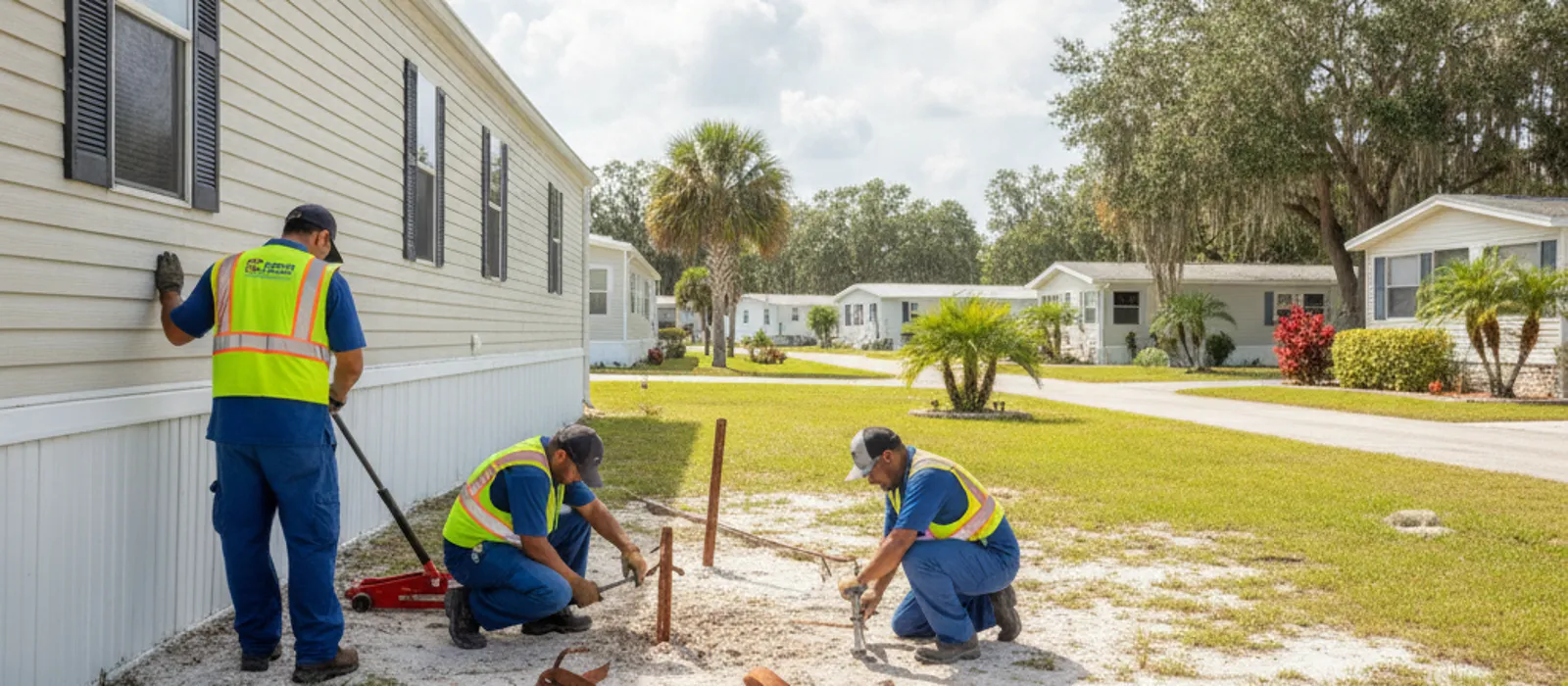
If you’ve never watched a tie-down crew work, here’s what you’re paying for when you hire it out. A good crew starts with a full count and map of your existing system, then probes the soil to confirm which anchor class it calls for. Anchors that fail get extracted or abandoned, new ones get augered in at the correct angle and depth, stabilizer plates go on where soil requires them, and every strap gets tensioned to spec in a sequence that doesn’t torque the frame.
On a typical single-wide, that’s a one-day job. A double-wide with 25 to 30 anchors usually runs a day to a day and a half. You should get photos of the finished work and written documentation you can hand to an insurer, an inspector, or a buyer. If your contractor doesn’t offer documentation, that’s a red flag, because the paperwork is half the value.
Timing matters more than most people expect. Summer rains soften our soil, which makes extraction easier but means fresh anchors need proper plates to hold. Dry season firms everything up. There’s no bad season for the work, but there is a bad season to discover you need it, and that’s the week before an insurance deadline or a closing date.
While the crew is under the home, a good contractor will also flag related problems while the skirting is open: pier issues, moisture problems, sagging belly board. It costs nothing to look, and catching a $300 problem before it becomes a $3,000 one is the whole point of getting eyes under there.
If you’re in Ocala, Silver Springs, Belleview, Summerfield, Dunnellon, Lady Lake, Citra, or anywhere in Marion, Sumter, or Citrus counties, we do this every week. Our mobile home tie-down service covers inspection, repair, full replacement, and the certification letters insurers ask for. Get your free written estimate here or call (352) 820-4441, and you’ll get a straight answer about what needs replacing and what doesn’t.
Frequently Asked Questions
Can I just spray paint over rusted mobile home anchors?
Paint over surface rust slows corrosion but doesn’t restore lost steel. If the anchor has pitting, flaking, or a thinned shaft at the soil line, coating it just hides the problem from you, not from an inspector who knows where to look. Wire-brush and cold galvanize anchors that are still structurally sound, and replace the ones that aren’t.
How many anchors does my mobile home need in Florida?
It depends on the home’s length, width, wind zone, and whether it uses frame ties, over-the-top ties, or both. Most single-wides in Marion County need somewhere in the range of 12 to 18 anchors, and double-wides commonly need 20 to 30. The exact count comes from the state installation standards for your home and soil, which is why a professional layout matters more than a rule of thumb.
How long do mobile home anchors last in Central Florida?
Galvanized anchors in well-drained, neutral soil can last 20 to 30 years. In wet, acidic, or poorly drained soil, we’ve seen significant corrosion in under 15. The strap and its connection points usually fail before the anchor shaft does, so plan on inspecting the whole system every few years rather than waiting for a round-number birthday.
Will my insurance really drop me over rusted anchors?
Insurers rarely cancel over one rusty anchor head, but a 4-point inspection that reports a compromised tie-down system can lead to non-renewal or a demand for proof of repair within a set window, often 30 days. The good news is that repairs are usually straightforward and documentation satisfies the underwriter. Handle it before renewal season and it never becomes a fight.