Your entire home is held to the ground by steel rods, and most of them were screwed into loose Florida sand by someone you never met. That’s not a scare line. It’s just how manufactured housing works, and it’s why the anchor type under your home matters more here than almost anywhere else in the country.
The three main mobile home anchor types are auger anchors, rock anchors, and concrete anchors. Each one is built for a different kind of ground, and Central Florida has all three kinds of ground, sometimes on the same street. Pick the right anchor and your tie-down system does its job for 20 years or more. Pick the wrong one and it can pull out of the soil like a tent stake in a sandbox.
Here’s how each type works, what it costs, and how to figure out which one belongs under your home in Ocala and Marion County.
Why Florida Soil Decides Your Anchor Type
Anchors don’t hold your home down by themselves. The soil holds your home down. The anchor is just the connection point, and it’s only as strong as the ground gripping it.
Central Florida throws three very different soil situations at installers:
Deep sand. Most of Marion County sits on sandy soil that runs many feet deep. Sand drains fast and it’s easy to screw an anchor into, but it also gives up its grip faster when it’s saturated. After a wet week, the same anchor that tested fine in April can wiggle in September.
Shallow limestone. Parts of Dunnellon, Citra, and the areas near Rainbow Springs have limerock sitting just a foot or two below the surface. A standard auger anchor physically can’t screw into that. Installers either hit refusal and stop short, which leaves the anchor weak, or they switch to a rock anchor designed for it.
Existing concrete. Homes on poured slabs, runners, or permanent foundations don’t use soil anchors at all. They use hardware that bolts or epoxies into the concrete itself.
Florida also regulates this more tightly than most states. The state requires anchors rated for at least 4,725 pounds of working load, and homes in Wind Zone 2 and Zone 3 need more anchors, spaced closer together, than older installs typically have. You can read the state’s installer and installation rules through the Florida Department of Highway Safety and Motor Vehicles, which oversees mobile home installation licensing in Florida.
If you’re not sure what’s under your home right now, that’s a five minute crawl for us and a free written estimate after. Call (352) 820-4441 and we’ll take a look, no pressure and no invented problems.
Auger Anchors: The Standard for Central Florida Sand
Auger anchors are what you’ll find under probably nine out of ten mobile homes in Marion County. Picture a four to five foot steel rod with a helix, basically a big screw blade, welded near the bottom. The installer turns it into the ground with a machine until the head sits at or just below grade, then connects the tie-down strap to it.
Where they work: sand, sandy loam, clay, and most mixed soils. Which is most of Ocala, Belleview, Summerfield, Silver Springs, and Lady Lake.
Where they fail: soil that’s too soft or too wet, and soil that’s too hard. In loose wet sand, an auger anchor can creep upward under repeated storm loading. In shallow rock, it can’t reach full depth, and an anchor that’s only halfway in has nowhere near its rated holding power.
Two details separate a good auger install from a bad one:
- Stabilizer plates. Florida requires stabilizer devices on most anchor installs because a bare anchor shaft can slice sideways through sand under load. The plate is driven in against the shaft and stops that lateral movement. Older installs often skipped them. Inspectors notice.
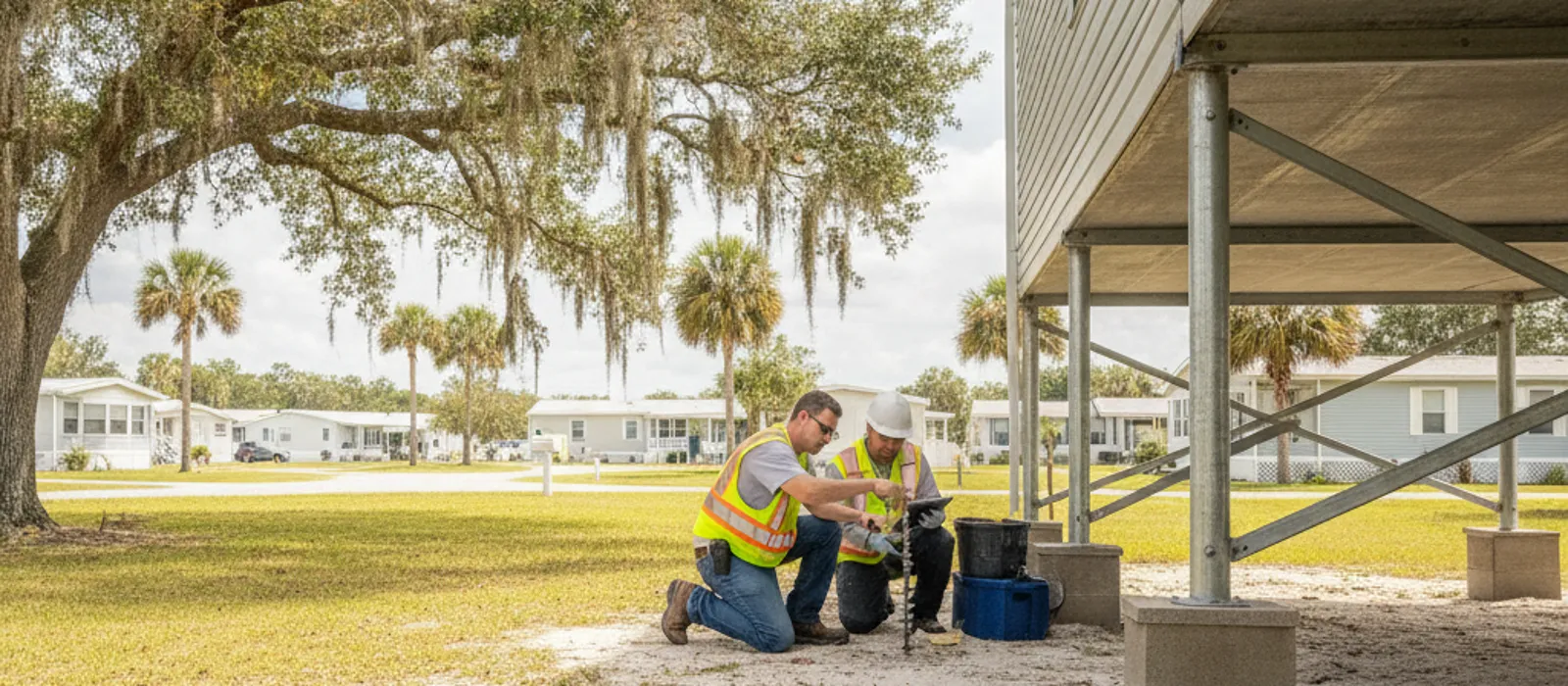
- The probe test. A licensed installer is supposed to test the soil with a torque probe and match the anchor to the reading. If nobody probed your soil, your anchors were guessed at, not engineered.
Ray in Belleview found this out during a 4-point inspection last spring. His 1998 double wide had 22 auger anchors, all original, and the inspector flagged rust-through on 14 of them plus missing stabilizer plates on every single one. His insurance carrier gave him 30 days. We replaced the 14 failed anchors, added plates throughout, and re-tensioned all his straps for $1,850. His agent accepted the certification the same week. If your anchor heads look scaly or flake when you tap them, read our guide to rusted mobile home anchors before your insurer finds them first.
Expect to pay roughly $50 to $85 per auger anchor installed as part of a larger job, more for one-off replacements.
Rock Anchors: For Limerock, Hardpan, and Coquina
Drive west toward Dunnellon or north toward Citra and the ground changes. Limerock can sit 12 to 24 inches below the surface, and no amount of machine torque will screw a standard helix through it.
Rock anchors solve this two ways:
Drive-in rock anchors are shorter anchors with hardened points, driven into a pilot hole drilled in the rock. Once seated, expanding fins or the shape of the shaft locks them into the stone.
Cross-drive anchors use two steel stakes driven at opposing angles through the anchor head, so the stakes cross underground. The crossed pair resists pullout even in shallow soil over rock, because you’d have to drag both stakes through each other’s path to remove them.
Rock anchors typically cost more per point, usually $75 to $120 installed, because of the drilling time. But when the rock is solid, holding power is excellent. Rock doesn’t get soggy in a tropical storm.
Donna in Dunnellon had the classic version of this problem. A previous installer had put standard auger anchors under her single wide, and half of them had hit refusal at about 18 inches. They looked installed from above. Underneath, they were barely bit into the ground. During her pre-sale inspection the tester pulled two of them by hand with a strap and a pry bar. We drilled and set 16 rock anchors and re-strapped the home for $2,400, and her sale closed on schedule.
That’s the trap with mobile home anchor types on rocky lots: an anchor that couldn’t reach depth looks identical to one that did. Only a pull test or an experienced eye under the home tells the difference. If your home is prepping for a sale or an insurance renewal, our mobile home tie-down service in Ocala includes checking every anchor for depth and movement, not just counting heads.
Concrete Anchors: For Slabs, Runners, and Permanent Foundations
If your home sits on a poured slab or concrete runners, soil anchors are the wrong tool entirely. Concrete anchor hardware bolts the tie-down system directly to the concrete:
- Wet-set anchors are cast into the concrete when it’s poured. Strongest option, but only possible on new pours.
- Expansion bolts are drilled into cured concrete and expand as they’re tightened, wedging against the hole walls.
- Epoxy (adhesive) anchors are set into drilled holes with structural epoxy. They spread load well and handle older, slightly weathered concrete better than expansion bolts.
Concrete anchoring is common on homes being converted to real property, and it’s required hardware for an engineer-certified permanent foundation. If you’re weighing that route for financing or insurance reasons, our post on permanent foundations vs piers walks through when the conversion actually pays off.
One honest caution: concrete anchors are only as good as the concrete. A cracked 4 inch runner poured in 1985 won’t develop the strength the bolt is rated for. We test-drill and sound the concrete before we trust it, and sometimes the right answer is soil anchors beside the runner instead of bolts into it.
Installed cost runs about $60 to $110 per point depending on hardware and concrete condition.
Mobile Home Anchor Types Compared: Cost and Holding Power
Here’s the whole picture in one table. Prices reflect what we typically see for installed anchors in Marion County as part of a multi-anchor job. Single-anchor service calls cost more per point.
| Anchor type | Best soil | Typical installed cost per anchor | Holding strength | Weak spot |
|---|---|---|---|---|
| Auger (4 ft to 5 ft) | Sand, loam, clay | $50 to $85 | Strong when full depth with stabilizer plate | Creeps in saturated sand, can’t penetrate rock |
| Rock / drive-in | Limerock within 2 ft of surface | $75 to $120 | Excellent in solid rock | Useless in deep sand, needs drilling |
| Cross-drive | Shallow soil over hardpan | $70 to $110 | Very good in mixed shallow ground | Labor intensive, needs room to drive stakes |
| Concrete (wet-set, expansion, epoxy) | Slabs, runners, foundations | $60 to $110 | Excellent in sound concrete | Only as strong as the concrete itself |
A full re-anchor on a double wide in our area usually lands between $1,500 and $3,500 depending on anchor count, soil, and how much strapping needs replacement along with the anchors. Wind zone matters too. A Zone 2 home needs more anchor points than an identical home graded for Zone 1, and all of Marion County is Zone 2. Our breakdown of Florida wind zones for mobile homes explains how to read the data plate and count what your home actually requires.
For a written quote on your specific home, request a free estimate and we’ll put the anchor count, type, and price on paper before you commit to anything.
Which Mobile Home Anchor Type Do You Actually Need?
You usually don’t get to choose based on preference. The ground chooses. But here’s the decision path we follow on every job:
Step 1: Probe the soil. A torque probe reading tells us the soil class at anchor depth. Class 2 or 3 soil takes standard augers. A refusal reading within a couple feet means rock hardware.
Step 2: Check the wind zone and anchor spacing. The data plate inside your home lists the wind zone. That plus the home’s length sets how many anchors and where. The National Hurricane Center’s wind hazard resources are a good reminder of why Florida’s spacing rules are tighter than Georgia’s.
Step 3: Match anchors to the tie-down style. Frame ties, over-the-top straps, and longitudinal stabilizing systems each load anchors at different angles, and anchor angle matters. An anchor installed vertical but loaded diagonally needs a stabilizer plate or it will rotate through the soil. If you’re not sure which strap style your home has, our explainer on frame ties vs over-the-top ties shows the difference with the home’s skirting off.
Step 4: Fix the level first. Anchors and straps assume the home is sitting square on its piers. Strapping down an unlevel home locks the problem in place. We check level on every anchor job, and if the home needs correction, mobile home leveling in Ocala happens before the straps get tensioned, not after.
A quick word on DIY. Swapping a visible strap buckle or clearing debris from anchor heads is fine homeowner territory. Installing or replacing the anchors themselves is not. Florida requires a licensed installer for anchoring work, the torque equipment isn’t rental-store gear, and a mis-set anchor fails exactly when you need it most. This is one of those jobs where doing it yourself can void the insurance benefit you were trying to protect.
Mike in Summerfield learned the cheap version of that lesson. He’d bought a dozen anchors online for $340 and got four of them partway in with a hand tool before hitting soil he couldn’t turn through. He called us, we probed the lot, and it turned out his soil needed 5 foot anchors with plates, not the 30 inch ones he’d bought. We installed the correct set for $1,680, and he returned what he could of the online order. His words: “I saved money right up until I didn’t.”
What This Means for Your Insurance and Your Next Inspection
Anchors are one of the four things a Florida 4-point inspection and every tie-down certification looks at, and they’re the item homeowners can least see for themselves. The heads sit at dirt level behind skirting. Rust, missing plates, and short-set anchors all hide down there for years.
If your home is more than 15 years old, has never had its anchors inspected, or is heading into a sale or a policy renewal, get eyes under it before the inspector’s. We check anchor type, depth, corrosion, plate presence, and strap tension, then give you a written report and a fixed price for anything that needs correcting. Free estimates, licensed and insured, and a 24/7 line for pre-closing and insurance deadline crunches: (352) 820-4441.
Frequently Asked Questions
How many anchors does a mobile home need in Florida?
It depends on the home’s length, width, and wind zone, but a typical double wide in Marion County (Wind Zone 2) needs anchors spaced roughly every 5 feet 4 inches along the frame, which usually works out to 20 to 36 anchor points. Older installs done under looser rules often come up short of today’s count. The data plate inside your home plus a measurement of its length gives the real number.
Can auger anchors be reused if I move my mobile home?
No. Removing an auger anchor disturbs the soil column that gave it holding power, and reinstalling a used anchor in new ground is not an accepted practice under Florida installation rules. Anchors also corrode from the bottom up, so a pulled anchor may look fine at the head and be badly pitted at the helix. Plan on new anchors at any new site.
How long do mobile home anchors last in Florida?
Galvanized anchors in well-drained Central Florida sand commonly last 20 to 30 years. Wet, low-lying lots and fertilizer-heavy soil shorten that considerably, sometimes to 10 or 15 years. The straps and connection hardware usually fail before the anchor shaft does, which is why an inspection looks at the whole system, not just the anchor heads.
Do I need a permit to replace mobile home anchors in Florida?
Anchoring and tie-down work in Florida must be done by a licensed mobile home installer, and most Marion County jobs involving anchor replacement are permitted and inspected. That paper trail works in your favor, since insurers and buyers want proof the work was done to code. A contractor who offers to skip the permit to save you money is creating a problem you’ll pay for at your next inspection.