Crawl under ten mobile homes in Marion County and you’ll find ten different anchoring setups, and at least half the owners above them couldn’t tell you which kind they have. That gap matters, because the frame ties vs over the top tie downs question decides whether your home passes a 4-point inspection, keeps its insurance, and stays put when a summer storm rolls through Ocala.
Here’s the short version. Frame ties are steel straps that run from ground anchors up to the steel I-beams under your home. Over-the-top ties run all the way over the roof structure and down the other side. Some homes need both. Many newer homes only need frame ties. And a surprising number of homes around here have the wrong setup, too few ties, or straps so rusted they’d fail the first real test.
This guide walks through what each system does, which one your home actually needs under Florida rules, what it costs in Marion County, and how to check what you’ve got without guessing. If you’d rather skip straight to a straight answer about your own home, call us at (352) 820-4441 and we’ll take a look. The written estimate is free.
Frame Ties vs Over the Top Tie Downs: The Core Difference
Both systems do the same basic job. They connect your home to ground anchors screwed deep into the soil so wind can’t slide it sideways or lift it off its piers. The difference is where the strap grabs the home.
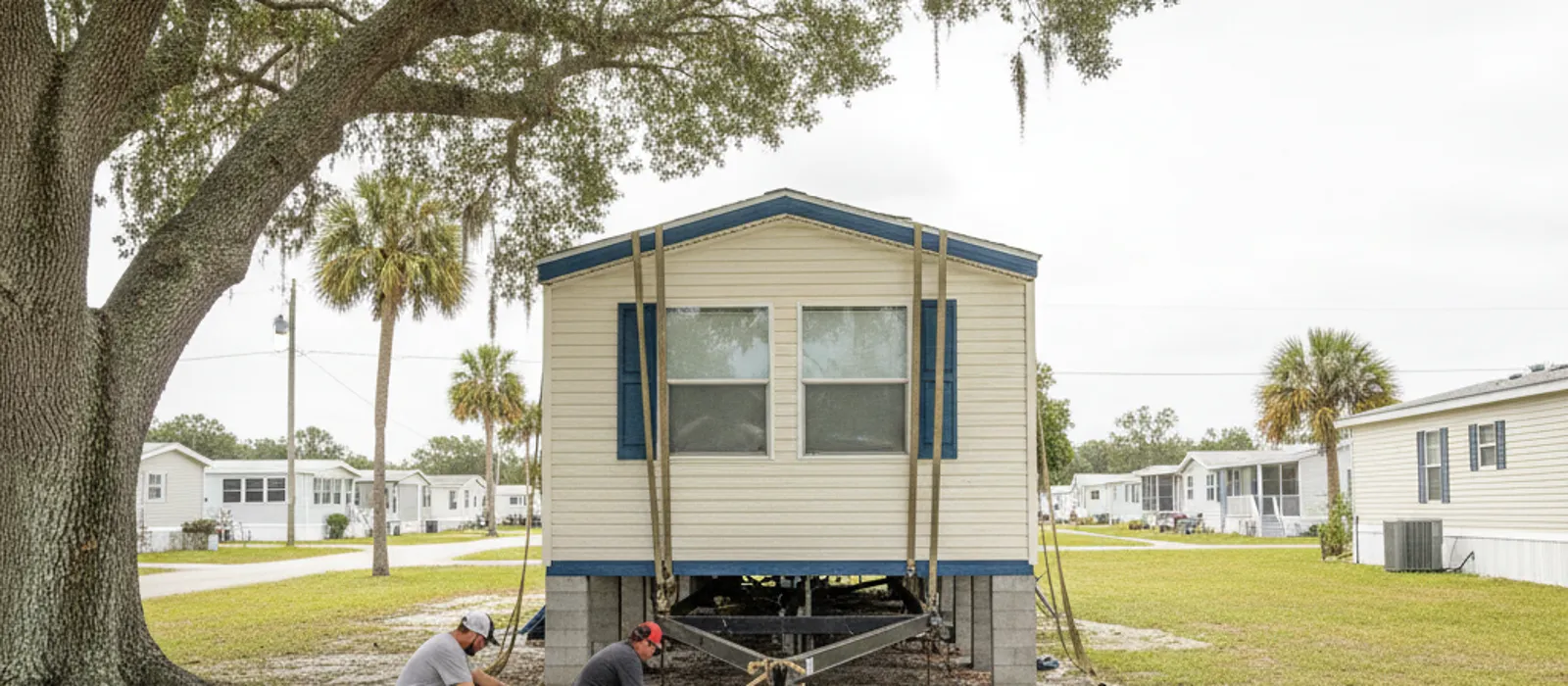
Frame ties (also called diagonal ties) attach to the main steel frame, the two I-beams that run the length of the home. The strap comes off the anchor head at an angle, hooks or bolts to the beam, and gets tensioned tight. Their main job is resisting sideways movement. Wind pushes on the wall, the home wants to slide off the piers, and the frame ties hold the frame in place.
Over-the-top ties do what the name says. The strap starts at an anchor on one side, runs up the wall, across the roof (usually over the roof structure itself, sometimes buried under the metal roofing on older homes), and back down to an anchor on the other side. Their job is resisting uplift. When wind moves fast over a roof, it creates suction that tries to peel the whole home upward. Over-the-top straps clamp the home down against that lift.
Think of it this way. Frame ties keep the home from sliding. Over-the-top ties keep it from flying. A complete anchoring system handles both forces, but not every home needs separate over-the-top straps to get there, and that’s where most of the confusion starts.
Why Some Homes Need Over-the-Top Ties and Others Don’t
The dividing line is roughly 1976, when the federal HUD code took effect for manufactured homes. You can read about the HUD manufactured housing program at hud.gov.
Pre-1976 mobile homes were built before uniform construction standards. Most of them don’t have the internal strapping that ties the roof, walls, and floor together into one unit. On these homes, a frame tie only protects the frame. The box sitting on top of that frame can still lift off in high wind. That’s why older single wides generally need over-the-top ties in addition to frame ties. The strap over the roof is doing the job the home’s own structure can’t.
Post-1976 HUD code homes are built with continuous connections from roof to wall to floor to frame. When the frame is held down, the whole home is held down. For most of these homes, properly spaced frame ties alone meet the requirement, because the over-the-top function is built into the structure. Many newer homes also have vertical ties that attach to sidewall brackets instead of straps over the roof, which accomplishes the same uplift resistance without running steel across your shingles.
Double wides almost never use over-the-top straps. Running a strap over the peak of a 26-foot-wide home isn’t practical, and HUD code double wides are engineered so frame and vertical ties handle uplift. If a contractor quotes you over-the-top ties on a 2005 double wide, ask hard questions, because that’s a common upsell.
Florida also layers wind zone requirements on top of the age question. Marion County sits in Wind Zone II, which sets how many anchors you need and how close together they go. Our breakdown of Florida wind zones for mobile homes covers the map in detail.
How to Tell Which System Your Home Has
You don’t need to army-crawl the full length of your home to get a basic answer. Here’s the ten-minute version.
First, walk the outside. Over-the-top ties are usually visible. Look for steel straps coming out of the ground near the base of the wall and running up and over the roofline, or disappearing under the roof edge on older metal-roof homes. If you see straps on the walls, you have over-the-top or vertical ties.
Second, pull a skirting panel and look under the home with a flashlight. Frame ties run at an angle from anchor heads in the dirt up to the I-beams. Count how many you can see along one side and note their condition. Shiny galvanized steel is good. Orange flaking rust is not. Rust is the number one reason tie-down systems fail inspection around here, and we covered what to look for in our guide to rusted mobile home anchors.
Third, check spacing. In Wind Zone II, frame ties are generally required at 5 feet 4 inches on center or closer, depending on the home and installation instructions. If your ties are 8 or 10 feet apart, the system is short even if every strap looks perfect.
A word of caution. Look, count, and photograph all you want, but don’t crawl under a home that feels unstable, don’t dig around anchor heads, and never release tension on a strap yourself. A loaded tie-down strap stores real energy, and anchors under tension can pull out violently. Checking is DIY-friendly. Adjusting is not. If anything you find looks loose, rusted, or missing, that’s the point where you stop and request a free inspection.
Here’s what two of those inspections looked like recently. Ray, who owns a 1972 single wide in Belleview, got a nonrenewal notice after a 4-point inspection flagged his home for having frame ties only. His home predates HUD code, so it needed over-the-top protection too. We added eight over-the-top straps, replaced five rusted frame anchors, and re-tensioned the rest for $2,150. His insurer reinstated the policy with the new certification.
Then there’s Denise in Citra, who bought a used 1998 double wide listed as fully anchored. It was anchored, just not enough. The frame ties were spaced almost 8 feet apart when the setup called for 5 feet 4 inches. Adding six anchors and ties ran her $1,680, which she negotiated back from the seller because she caught it before closing.
Cost Comparison: Frame Ties vs Over-the-Top Ties in Marion County
Here’s what these systems typically cost installed in the Ocala area. Prices assume normal soil and reasonable access under the home.
| Item | Frame Ties | Over-the-Top Ties |
|---|---|---|
| What they resist | Sideways sliding | Roof uplift |
| Attach to | Steel I-beam frame | Over the roof structure |
| Typical cost per tie, installed | $45 to $75 | $70 to $110 |
| Typical full set, single wide | $1,200 to $2,400 | $900 to $1,600 (added to frame ties) |
| Who usually needs them | Every mobile home | Mostly pre-1976 homes |
| Common failure | Anchor rust, lost tension | Strap corrosion at roof edge |
A few notes on those numbers. Most jobs we do aren’t a full system from scratch. They’re partial work, replacing the rusted third of the anchors, adding ties to fix spacing, or re-tensioning straps that have gone slack as the home settled. Partial jobs commonly land between $600 and $1,500. Full anchoring for an older single wide that needs both systems usually runs $2,000 to $3,500.
Soil matters too. Sandy Marion County soil sometimes needs longer anchors or stabilizer plates to hit the required holding power, which adds cost per anchor. And if the home has settled out of level, we fix that first, because tensioning straps on an unlevel home locks the problem in place. You can see how that work is priced on our mobile home leveling in Ocala page.
One more real example. Marcus in Summerfield got a $4,800 quote from another outfit for over-the-top ties on his 2004 double wide. The home didn’t need them and couldn’t practically take them. What it actually needed was twelve new frame ties and four anchor replacements, which we did for $1,850. Getting a second opinion cost him a phone call and saved him about $2,950.
If you want real numbers for your home instead of ranges, call (352) 820-4441. We’ll count what you have, tell you what’s missing, and put the price in writing.
What Inspectors and Insurance Companies Actually Check
Most tie-down conversations in Florida start with an insurance letter, not a storm. When a 4-point or wind mitigation inspector crawls under your home, here’s what they’re looking at.
They check that ties exist at the required spacing for your wind zone and home type. They check strap condition, because a rusted-through strap counts the same as a missing one. They check tension, since a slack strap does nothing until the home has already moved. And on pre-1976 homes, they specifically look for over-the-top or vertical protection, not just frame ties.
The result often shows up as a tie-down certification, which many insurers now require before writing or renewing a policy on a manufactured home. We covered how that document works and who can issue it in our post on tie-down certification and insurance.
Two things trip up homeowners most. First, additions. That screen room or carport bolted to the side of your home usually needs its own anchoring, and inspectors flag unanchored additions constantly. Second, past repairs done on the cheap. We regularly find straps nailed to wood instead of connected to anchors, or anchors driven a foot into the sand instead of four feet. It held until someone looked.
Florida’s installation standards for anchors and tie-downs are set at the state level, and you can find the Bureau of Mobile Home and RV Construction under the Florida Department of Highway Safety and Motor Vehicles at flhsmv.gov.
So Which One Does Your Home Actually Need?
Boil it all down and the answer follows a short decision path.
If your home was built before 1976, plan on both. Frame ties for sliding, over-the-top or an engineered vertical system for uplift. There’s no shortcut on this one, and insurers know it.
If your home is a post-1976 single wide, you most likely need frame ties at proper Wind Zone II spacing, plus vertical ties if the home’s installation instructions call for them. Over-the-top straps usually aren’t required, though some owners add sidewall vertical ties for extra margin.
If your home is a double wide, frame ties at correct spacing are the core of the system, along with the connections at the marriage line. Over-the-top straps are almost never part of the answer.
Whatever the age, condition beats configuration. The right system with rusted anchors and slack straps protects you less than a modest system that’s tight and sound. That’s why we treat every tie-down job as inspect first, then quote. Sometimes the honest answer is that you only need eight straps re-tensioned, and that’s a small job.
Our crews handle inspection, anchor replacement, added ties, and certification paperwork across Marion, Sumter, and Citrus counties. Start on our mobile home tie-downs in Ocala page, or request your free written estimate and we’ll schedule a look, usually within a couple of days. If you’re up against an insurance deadline or a closing date, our emergency line runs 24/7.
Frequently Asked Questions
Do double wide mobile homes ever need over-the-top tie downs?
Almost never. Double wides are too wide for practical over-the-roof strapping, and HUD code double wides are engineered so frame ties and vertical connections handle uplift. If someone quotes you over-the-top straps on a double wide, get a second opinion before you sign anything.
How many tie downs does my mobile home need in Marion County?
Marion County is in Florida Wind Zone II, where frame ties generally go at 5 feet 4 inches on center or tighter, based on the home’s length and installation instructions. A typical single wide ends up with somewhere around 10 to 14 frame ties per side. Pre-1976 homes add over-the-top straps on top of that count.
Can I install or tighten tie downs myself?
We don’t recommend it. Straps under tension store serious energy, anchors have to reach proper depth and holding capacity to count, and insurance certifications require the work to meet state installation standards. Checking and photographing your setup is a great DIY step, but leave the wrench work to a licensed installer.
How do I know if my existing tie downs would pass inspection?
Look for three things: straps at the required spacing, no significant rust or fraying, and firm tension with no slack. If you see gaps wider than about 5 feet between ties, orange corrosion, or straps you can wiggle by hand, the system likely won’t pass. A professional tie-down inspection is quick and tells you exactly what an insurer’s inspector will find.