Your insurance renewal letter shows up with one line that changes everything: “Proof of tie-down compliance required within 30 days.” Now what?
If you own a manufactured home anywhere in Marion County, there’s a good chance you’ll face this exact request at some point. A mobile home tie down certification is the document insurers use to confirm your home is anchored the way Florida law says it should be. Without it, carriers can raise your premium, exclude wind coverage, or drop the policy altogether.
The good news is that getting certified is usually simple and affordable. The bad news is that a lot of homeowners wait until a deadline is breathing down their neck, then find out their anchors need work too. This guide walks you through what the certification is, who can issue it, what inspectors actually look at under your home, and what it all costs in real dollars around Ocala.
Why Florida Insurers Care So Much About Tie-Downs
Florida carriers have paid out billions in wind claims over the past two decades, and manufactured homes sit at the center of a lot of those claims. The data is pretty clear: homes that are properly anchored survive high winds far better than homes that aren’t. So insurers now treat tie-down proof the same way they treat roof age or electrical panels. It’s a box that has to be checked before they’ll carry the risk.
Here’s what that looks like in practice:
- New policies. Many carriers won’t bind wind coverage on a manufactured home without documentation that the tie-down system meets state standards.
- Renewals. Older policies are getting re-underwritten. A home that was grandfathered in for years can suddenly get a compliance letter.
- Home sales. Lenders and insurers both want proof before closing. A missing certificate can delay or kill a deal.
- After storms. Some carriers request updated certifications after a named storm passes through the region, even if your home had no damage.
Florida sets the actual anchoring standards through the Department of Highway Safety and Motor Vehicles, which regulates mobile home installation statewide. You can read the state’s own overview at flhsmv.gov. The federal baseline comes from HUD’s manufactured housing program, which you can find at hud.gov.
The short version: your home needs the right number of anchors, in the right condition, with straps at the right tension, matched to the wind zone where the home sits. The certification is simply a licensed professional putting their name on paper saying your home meets that bar.
If you’ve already got a compliance letter in hand and the clock is ticking, don’t wait on it. Request a free written estimate and we’ll get eyes under your home fast, usually within a couple of days.
What a Mobile Home Tie Down Certification Actually Includes
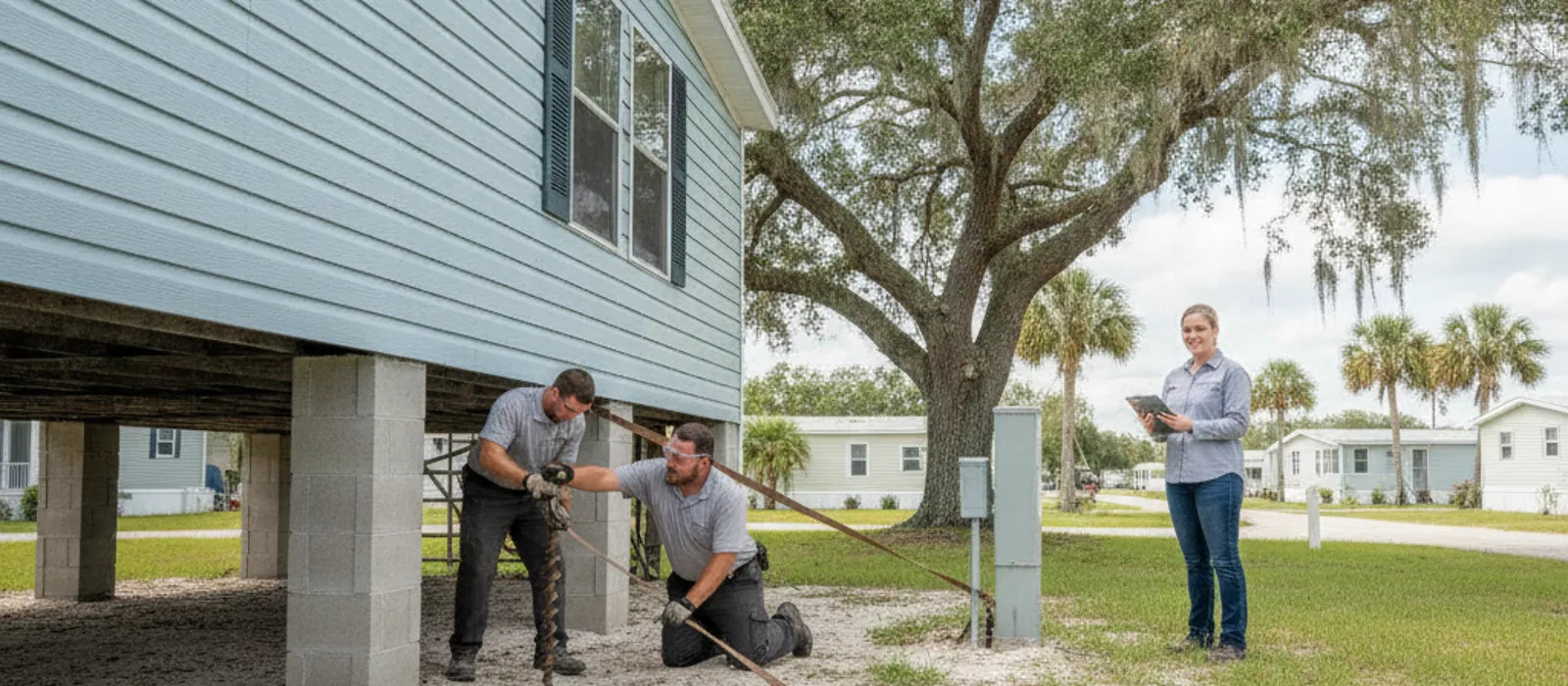
The certification itself is a short document, but the inspection behind it is thorough. A qualified inspector or licensed installer crawls the full perimeter and underside of your home and documents the anchoring system. A proper certificate typically includes:
- The home’s address, make, model, and year
- The wind zone the home sits in (most of Marion County is Wind Zone II)
- The number and type of ground anchors present
- The condition of straps, buckles, and anchor heads
- Whether frame ties and, where required, over-the-top ties are present
- Longitudinal and centerline anchoring for newer installations
- A statement that the system does or doesn’t meet current state standards
- The inspector’s license number, signature, and date
Insurers usually want the certificate dated within the last year or two, so an old certificate from a previous owner may not fly. If you’re not sure what your carrier will accept, ask them in writing before you schedule anything. Carriers vary, and it’s cheaper to ask one question than to pay for the wrong document.
One thing worth understanding: a tie down certification is not the same as a four point inspection, though the two often travel together. A four point covers roof, electrical, plumbing, and HVAC. The tie-down piece looks only at the anchoring and support system. If your carrier asked for both, budget for both. Our guide to the four point inspection for mobile homes breaks down how that side works.
It’s also different from an engineer’s foundation certification for FHA lending, which is a separate document with its own rules. Don’t pay for an FHA foundation cert if all your insurer wants is tie-down compliance.
Who Can Issue a Tie Down Certification in Florida
Not just anyone with a flashlight and a clipboard. Florida generally recognizes certifications from:
- Licensed mobile home installers. The state licenses installers specifically for manufactured home setup and anchoring. This is the most common route for insurance certifications.
- Licensed general, building, or residential contractors with manufactured home experience, depending on what the carrier accepts.
- Professional engineers. Required for FHA foundation certifications and sometimes requested for unusual setups, but overkill for a routine insurance certificate.
Some home inspectors will note tie-down condition in a general report, but many carriers won’t accept a generic inspection report as compliance proof. The document needs a license number tied to installation or engineering work behind it.
A practical tip: hire someone who can both certify and repair. If the inspection finds two rusted anchors and a loose strap, a certify-only inspector hands you a failed report and a goodbye. An installer can quote the fix, do the work, and issue the passing certificate in one visit or two. That matters when you’re working against a 30 day deadline.
Watch out for the other extreme too. If someone fails your home and quotes a full replacement of every anchor without showing you the corrosion or the pull test results, get a second opinion. We wrote about this pattern in our post on mobile home repair scams, and tie-down work is one of the areas where scare tactics show up most.
What the Inspector Checks Under Your Home
Knowing what the inspection covers helps you guess where you stand before anyone crawls under the home. Here’s the checklist most of us work from:
Anchor count and spacing. Florida standards set maximum spacing between anchors based on wind zone and home size. A single wide in Wind Zone II typically needs frame anchors spaced no more than about 5 feet 4 inches apart along each side. Older installations were often set at wider spacing under old rules, which is the number one reason homes fail today.
Anchor condition. Anchors are steel rods augered into the soil, and steel in Florida ground rusts. The inspector looks at the anchor head and shaft at grade level. Surface rust is normal. Flaking, pitting, or a head that wiggles by hand is not. Our post on rusted mobile home anchors shows what failure looks like up close.
Strap condition and tension. Galvanized straps should be tight, straight, and free of kinks, tears, or heavy corrosion. A strap you can push a fist of slack into isn’t doing its job in a storm.
Stabilizer plates. Anchors in most Florida soils need stabilizer plates to resist sideways pull. Missing plates are a common write-up on older setups.
Frame ties versus over-the-top ties. Homes built after mid 1994 to HUD wind standards generally rely on frame ties. Some older homes need over-the-top straps as well. If you’re curious about the difference, see frame ties vs over-the-top ties.
Piers and support. Anchoring and support work together. If piers are leaning or the home has settled out of level, straps end up loaded unevenly. Inspectors note it, and carriers sometimes ask for releveling as part of compliance. That’s a service call of its own, covered on our mobile home leveling in Ocala page.
Real Numbers: What Certification and Repairs Cost in Marion County
Here’s the part everyone actually wants. These are typical ranges we see around Ocala, Belleview, Summerfield, and the surrounding towns. Your home’s size, age, and soil conditions move the needle, so treat these as planning numbers, not quotes.
| Service | Typical Cost Range | Notes |
|---|---|---|
| Tie-down inspection with certification | $125 to $250 | Often credited toward repairs if work is needed |
| Replace a single ground anchor | $50 to $90 each | Includes stabilizer plate |
| Replace or re-tension straps | $25 to $60 per strap | Tension-only adjustments run less |
| Add anchors to meet current spacing | $400 to $1,200 | Single wide, partial upgrade |
| Full tie-down retrofit, single wide | $1,500 to $3,000 | Older home with wide spacing or heavy rust |
| Full tie-down retrofit, double wide | $2,500 to $4,500 | Includes centerline anchoring where required |
| Re-certification after repairs | Often free to $100 | Ask up front, many installers include it |
Two real-world examples show how this plays out.
Ruth in Belleview got a non-renewal notice on her 1989 single wide last spring. Her carrier wanted tie-down proof within 30 days. The inspection ran $150 and found six anchors with heavy corrosion and four straps with no meaningful tension. Repairs came to $1,400, the passing certificate was issued the same week, and her carrier reinstated the policy. Her agent later told her the alternative was the surplus lines market at roughly double her old premium.
Then there’s Manny in Summerfield, who was buying a 1998 double wide near Stonecrest. The four point looked fine, but the tie-down inspection found the centerline anchors that current standards call for on that setup were never installed. The fix was $2,300. He negotiated $1,500 of it off the purchase price, the work took one day, and closing happened on schedule. Without the certificate, his lender’s insurance requirement would have stalled the whole deal.
And a quick cautionary one: Dale in Citra ignored a compliance letter for four months, figuring it was a bluff. It wasn’t. His policy lapsed, and getting new coverage required the certification anyway, plus a $2,100 retrofit, plus higher premiums as a lapsed-coverage customer. The paperwork he avoided cost him far more than the paperwork would have.
If your deadline is tight, call us at (352) 820-4441. We keep a 24/7 line specifically for insurance deadlines and pre-closing crunches, and a written estimate costs you nothing.
How to Pass Your Tie Down Certification the First Time
You can’t retrofit your own anchors safely, and honestly you shouldn’t try. Anchor installation involves pull tension, soil torque ratings, and working under a jacked structure. That’s professional territory. But there’s plenty you can do before the inspector shows up to avoid surprises:
- Find your paperwork. The original installation certificate, prior tie-down certificates, or permit records from Marion County give the inspector a head start and sometimes satisfy the carrier outright.
- Look at what you can see safely. Walk the perimeter. Peek behind the skirting at a few access points. Obvious slack straps or orange, flaking anchor heads tell you repairs are likely, so budget for them.
- Check for water under the home. Standing water accelerates anchor rust and can signal grading problems. Our post on water under a mobile home covers why it matters and what to do.
- Confirm your wind zone. Marion County sits in Wind Zone II. If you moved a home here from elsewhere in Florida or out of state, its original anchoring may have been built for a different standard. See our full breakdown of Florida mobile home tie down requirements.
- Ask your carrier exactly what they want. Get the request in writing. Some want a specific form, some want photos, some accept a simple signed letter with a license number.
- Schedule early. After a named storm or during spring renewal season, installers book out weeks. A certification you get in February is a lot less stressful than one you need in September.
One more thing worth saying plainly: don’t let anyone talk you into skipping the certification by “self-certifying” or using a form without a real license number behind it. If a claim ever gets denied because the compliance document wasn’t legitimate, the few hundred dollars you saved will look very small.
Tie-downs also don’t work alone. Straps anchor the frame, but piers carry the weight, and a home that’s settled out of level puts stress on both systems. If doors have started sticking or floors feel off since your last hurricane season, it’s worth having the whole support system looked at in one visit. Our mobile home tie-down service in Ocala covers inspection, repair, and certification together, so you’re not paying two contractors for one crawlspace.
Ready to get it handled? Reach out for a free written estimate and tell us your insurance deadline. We’ll work backward from it.
Frequently Asked Questions
How long is a mobile home tie down certification good for?
There’s no single statewide expiration, but most insurers want a certificate dated within the past one to two years. Some carriers accept older documents if nothing about the home has changed. Ask your specific carrier in writing, because their underwriting rules control what they’ll accept.
Will my insurance really drop me without a tie down certification?
They can, and in Florida’s current market many will. Carriers commonly respond to missing compliance proof by excluding wind coverage, surcharging the premium, or issuing a non-renewal. Getting the certificate before the deadline is almost always cheaper than shopping for replacement coverage afterward.
Can I install or tighten tie-downs myself to pass the inspection?
Light tasks like clearing debris away from anchor heads are fine, but installing anchors, tensioning straps, or working under a supported home is professional work. Anchors have soil torque requirements and straps have tension specs that get verified during certification. DIY work that doesn’t meet spec just fails the inspection, so put the money toward a licensed installer instead.
Is a tie down certification the same as an FHA foundation certification?
No. The tie down certificate confirms your anchoring meets Florida standards and is usually issued by a licensed installer for insurance purposes. An FHA foundation certification is an engineer’s document required for certain government-backed loans, and it evaluates the home against HUD’s permanent foundation guide. If you’re refinancing or the buyer is using an FHA loan, you may need both documents.