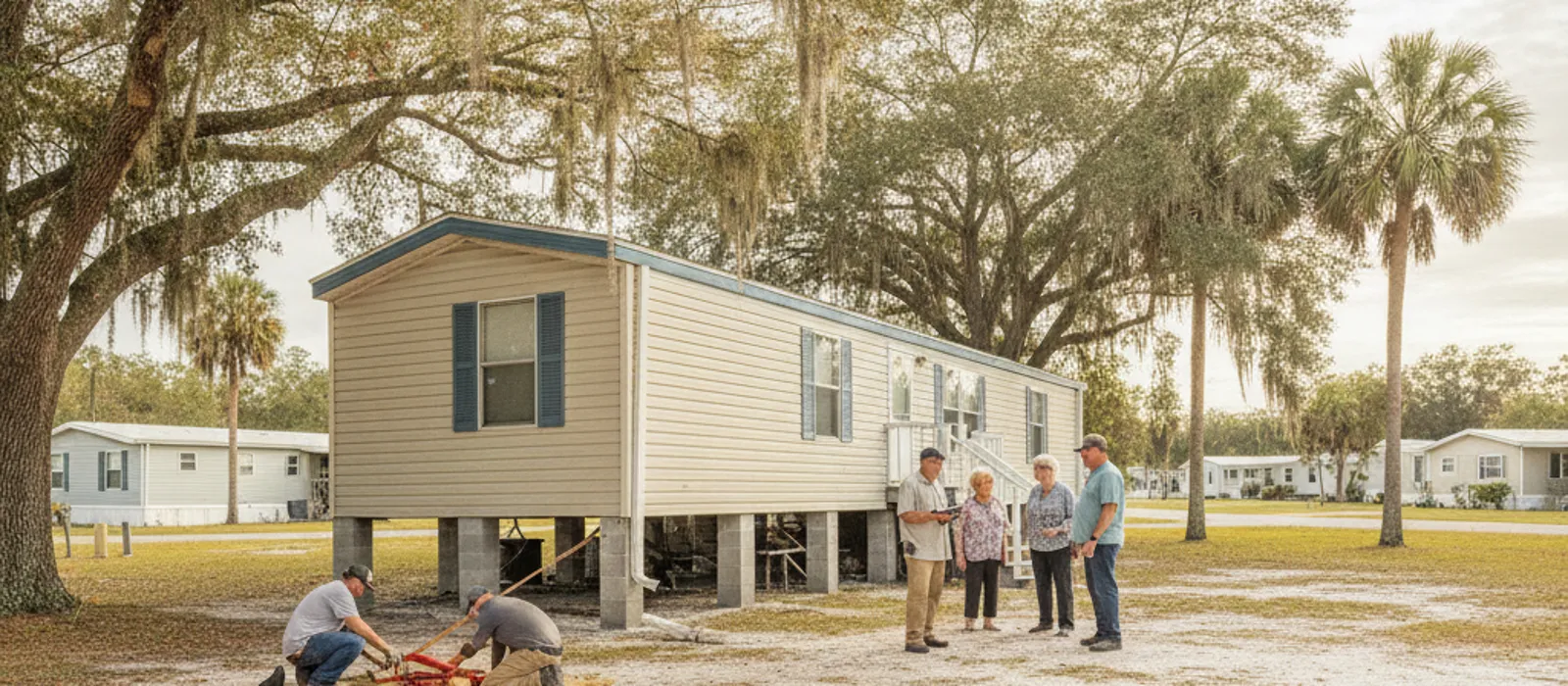
A stranger knocks on your door, says he “noticed your home looks a little off level from the road,” and offers a free look underneath. Twenty minutes later he’s showing you photos of rotted wood and telling you the whole house could collapse if you don’t hand over a deposit today.
That pitch, or some version of it, is behind most of the mobile home repair scams we hear about in Ocala and Marion County. Manufactured home owners get targeted more than almost anyone else, because the crawl space under your home is a place you probably never look. A scammer can point a flashlight down there, say whatever he wants, and most folks have no way to check his story.
Here’s the good news. These scams follow patterns, and once you know the patterns, they’re easy to spot. This guide walks through the red flags, the common cons, what honest work actually costs, and what to do if you’ve already been burned.
Why Mobile Home Repair Scams Hit Marion County So Hard
Scammers go where the targets are, and our area checks every box on their list.
First, we have one of the largest concentrations of manufactured homes in Florida. Drive through Summerfield, Belleview, or the parks off Highway 441 and you’ll pass thousands of homes with piers, tie-downs, skirting, and vapor barriers that all need attention eventually. That’s a big pool of potential victims.
Second, a lot of owners here are retirees on fixed incomes. Scammers love that combination: real equity in the home, real fear of losing it, and often nobody nearby to say “hold on, let’s get a second opinion.”
Third, Florida weather gives scammers a built-in script. After every named storm, out-of-state trucks roll into Marion County looking for hail, wind, and “foundation damage.” Some are legitimate. Plenty aren’t. The Federal Trade Commission has a whole guide on hiring contractors and avoiding home repair fraud, and storm-chasing door knockers are one of the biggest complaint categories.
Finally, the work itself is invisible. If someone repaves your driveway badly, you can see it. If someone “relevels” your home by turning a few pier caps and leaving, you might not notice anything wrong for a year. That delay is what lets bad actors move from park to park without getting caught.
If something under your home genuinely worries you, get a second set of eyes before you sign anything. Ocala Level Pros gives free written estimates, and we’ll tell you straight if the first guy was right. You can also just call us at (352) 820-4441 and describe what you were told. We’ve heard most of the scripts.
The 9 Biggest Red Flags of a Mobile Home Repair Scam
You don’t need to be an expert on piers or tie-downs. You just need to recognize these warning signs.
1. They came to you. Legitimate leveling and repair companies in this area stay busy from referrals and phone calls. They don’t cruise neighborhoods knocking on doors. An unsolicited “I was just working down the street and noticed…” is the single most reliable red flag there is.
2. The problem is urgent and invisible. “Your home could shift off its piers any day now.” Real settling problems show symptoms you can verify yourself: doors that stick, cracks at corners, sloping floors. If your doors close fine and your floors feel solid, be very skeptical of anyone claiming hidden catastrophe. Our guide to the signs your mobile home needs leveling lists what you can check on your own in ten minutes.
3. Cash only, big deposit, today’s price. Honest contractors take checks and cards, put deposits in writing, and don’t punish you for thinking it over. Anyone who wants 50 percent or more in cash before work starts is a walk-away situation. So is any “price that expires when I leave your driveway.”
4. No written estimate. In Florida, you should get a written estimate that spells out the scope, the materials, the price, and the timeline. A number scribbled on a business card is not an estimate.
5. No license, no insurance, or excuses about both. Ask for a license number and proof of liability insurance. A pro will hand these over without blinking. A scammer will tell you licensing “doesn’t apply to mobile homes” or that his insurance card is “in the other truck.”
6. Photos that might not be your home. The rotted subfloor photo trick is everywhere. The guy crawls under your home, comes out with alarming pictures, and asks for thousands. Ask him to show you exactly where each photo was taken, then look yourself or have someone you trust look. Scammers reuse the same photo library at every stop.
7. They discourage second opinions. Any pressure against getting another estimate is a confession. Honest companies welcome comparison because their numbers hold up.
8. Out-of-state plates right after a storm. Not every traveling contractor is a crook, but the combination of a storm, a door knock, and an unfamiliar area code deserves extra caution. Florida requires contractors to be licensed here, not just wherever the truck is registered.
9. The price makes no sense, high or low. A $9,000 quote for a routine relevel is a scam. So is a $300 quote for full pier replacement, because that bid exists only to get a foot in the door before the “surprise problems” appear.
Three Local Stories, Three Expensive Lessons
These are the patterns we hear about most often, told through composite examples based on the kinds of calls we get. Names and details are illustrative, but the dollar amounts and tactics are exactly what happens around here.
The vanishing deposit in Summerfield. Earl, a retired truck driver off Highway 42, had a door-knocker point out that his skirting was bowing. The man quoted $2,400 to relevel the home and fix the skirting, but needed $800 in cash that day “to order materials.” Earl paid. The man never came back, the phone number went dead, and the business name didn’t exist anywhere. Skirting that bows is often just a symptom of normal settling, and our post on mobile home skirting buckling explains why it’s rarely an emergency.
The inflated inspection in Belleview. Gloria got a “free 21-point underside inspection” from a company that cold-called her park. The verdict: cracked piers, failed anchors, and a quote of $9,500 to “save the home.” She called for a second opinion before signing. The actual finding was minor settling on one corner that needed a standard relevel, done for $650. The piers were fine. The anchors were fine. The only thing failing was the first company’s honesty.
The recycled photos in Dunnellon. Marta let a storm-chaser crew inspect under her double-wide after a tropical system passed through. They showed her photos of soaked insulation and a shredded vapor barrier and quoted $4,200 for emergency repairs. Her son-in-law crawled under the home that weekend and found dry insulation and an intact barrier. The photos were of somebody else’s house. Real water problems under a home do matter, and our article on water under a mobile home covers what actual damage looks like.
Three different towns, one common thread: nobody who got scammed had a trusted local number to call first. Save ours now: (352) 820-4441. A five-minute phone call is free, and it would’ve saved these three homeowners over $5,000 combined.
What Honest Mobile Home Repairs Actually Cost
Scam quotes work because most owners have no baseline. Here’s a realistic range for common under-home work in the Ocala area. Every home is different, so treat these as sanity checks, not promises.
| Service | Typical fair range | Scam version usually looks like |
|---|---|---|
| Standard relevel (single-wide) | $450 to $900 | $2,500+ or a $200 teaser bid |
| Standard relevel (double-wide) | $700 to $1,500 | $4,000+ “structural emergency” |
| Pier repair or replacement (per pier) | $100 to $300 | $500+ per pier, dozens “failing” |
| Tie-down/anchor replacement (per anchor) | $50 to $150 installed | Whole-home “anchor failure” at $6,000+ |
| Vapor barrier replacement | $800 to $2,500 | $5,000+ with fake moisture photos |
| Skirting repair or replacement | $500 to $3,000 | Bundled into inflated “foundation” package |
If a quote lands way outside these ranges, that alone isn’t proof of a scam, but it’s your cue to slow down and compare. The factors that legitimately move prices up or down are covered in our breakdown of mobile home leveling cost factors, and our mobile home leveling in Ocala page explains exactly what a proper relevel includes.
How to Vet Any Contractor in 15 Minutes
Before anyone touches your home or takes a dollar, run this checklist. It filters out nearly every scammer.
Verify the license. Look the company up by name and license number. If they claim mobile home work doesn’t require credentials, that’s false for structural and installation work in Florida. The state regulates manufactured home installation, and HUD sets federal construction and safety standards you can read about on the HUD manufactured housing program page.
Ask for proof of insurance. Liability insurance protects you if a worker damages your home or gets hurt on your property. No proof, no job.
Demand a written estimate. Scope, materials, price, timeline, and payment schedule, all on paper with a real business name, address, and phone number.
Check the physical footprint. A local address, a listed phone number, and a truck with a company name are simple things scammers rarely bother with.
Get a second estimate on anything over $1,000. No honest contractor will resent this. The dishonest ones will pressure you, which tells you everything.
Ask how they’ll verify the work. A real leveling crew checks with a water level or laser and can show you readings before and after. If you’re curious what that looks like, we wrote up how pros check mobile home level. Vague answers about “eyeballing it” are a red flag from crooks and hacks alike.
One more tip: photograph under your home once a year, or have someone do it for you. Piers, anchors, straps, and the belly board. When a stranger shows you scary photos, you’ll have your own to compare against. Tie-downs matter for insurance and storm safety, and our mobile home tie-down service in Ocala includes a straightforward condition report you keep.
Already Paid a Scammer? Do These 5 Things Now
Getting conned feels awful, and a lot of folks stay quiet out of embarrassment. Don’t. Acting fast improves your odds and protects your neighbors.
1. Stop all payments. If you paid by check, call your bank about a stop payment. If you paid by card, dispute the charge. Cash is harder to recover, which is exactly why they asked for cash.
2. Write everything down today. Names, phone numbers, truck description, license plate if you caught it, what was said, what was paid. Memory fades fast and details are what investigators need.
3. Report it. File with the Florida Attorney General’s consumer protection division, the FTC at ReportFraud.ftc.gov, and your local sheriff’s office. Marion County deputies take contractor fraud seriously, especially in the 55-plus communities where it clusters.
4. Get the actual condition documented. Have a legitimate company inspect and give you a written report on what’s really under your home. This tells you whether you have a real problem, and the report is useful if you pursue the scammer in small claims court.
5. Warn your park. Scam crews work one community at a time. A note on the park bulletin board or a word with the manager can stop the same crew from hitting six more homes that week.
If your home does need real work after a scam, don’t let one bad experience keep you from fixing genuine problems. Settling, loose anchors, and torn vapor barriers get more expensive the longer they wait. Request a free written estimate and we’ll show you exactly what we see under there, with your own photos, not stock ones.
Frequently Asked Questions
Are door-to-door mobile home repair offers always scams?
Not always, but the odds are bad enough that you should treat every unsolicited offer with heavy skepticism. Established local companies get their work through referrals and phone calls, not cold knocks. If a door-knocker spots something real, thank him, take no action that day, and call a company you found yourself for a second opinion.
How much should a deposit be for mobile home repair work?
For most leveling and under-home jobs, expect little or no deposit, since materials costs are modest. Larger jobs like full skirting or vapor barrier replacement might reasonably involve a deposit of 10 to 30 percent, in writing, paid by check or card. Anyone demanding half or more in cash before starting is showing you a red flag, not a payment schedule.
Do mobile home leveling contractors need a license in Florida?
Yes, structural work on manufactured homes falls under state licensing requirements, and installers are regulated through Florida’s mobile home installer program. Anyone telling you licenses “don’t apply to trailers” is either untrained or lying, and both are reasons to end the conversation. Always verify the license number yourself rather than taking a photocopy at face value.
How do I know if my home actually needs releveling?
Look for symptoms you can verify: doors and windows that stick or won’t latch, cracks appearing at wall corners, floors that slope or bounce, and skirting that bows or pulls away. If you have none of those, a stranger’s claim of urgent hidden damage deserves serious doubt. When symptoms are real, a legitimate relevel is a routine job, usually done in a day, and we’re happy to walk you through it at (352) 820-4441.