
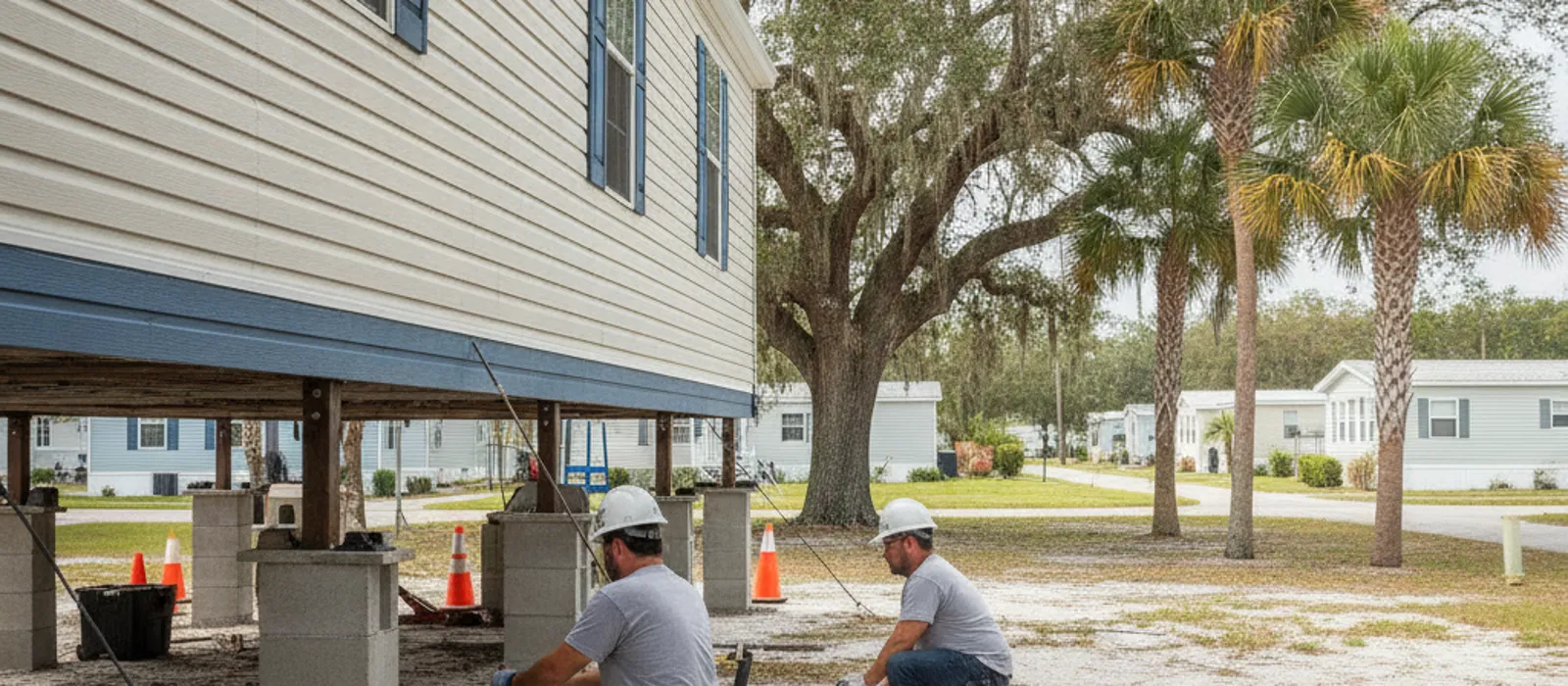
Here’s a number that surprises most homeowners: the average releveling job in Marion County is done in about four hours. Not four days, not a week with your yard torn up. Four hours.
So how long does it take to level a mobile home in your specific situation? For most single wides, plan on 1 to 3 hours. For most double wides, 3 to 6 hours. Bigger jobs with pier repairs or bad soil can stretch to a full day, and a small percentage need two visits. In this guide we’ll walk through real timelines from jobs around Ocala, what makes one home a quick morning and another an all-day project, and how to make sure your crew shows up ready to finish in one trip.
If you’d rather just get a real answer for your home, call us at (352) 820-4441 and we’ll give you a time and cost estimate over the phone, then confirm it in writing after we look under the home. Estimates are free.
The Short Answer: 2 to 6 Hours for Most Homes
A standard releveling job breaks down into three phases, and none of them take as long as people expect.
First is the inspection. A tech crawls the full length of the home with a water level or laser level and maps every pier. That takes 30 to 60 minutes on a single wide, closer to 90 on a large double wide. If you want to know exactly what the tech is doing under there, we covered it in how pros check if a mobile home is level.
Second is the lift and shim work. The crew works pier by pier with hydraulic jacks, raising low spots a fraction of an inch at a time and setting new hardwood or composite shims. This is the bulk of the job, usually 1 to 4 hours depending on how many piers are off.
Third is the recheck. The tech runs the level readings again, tests a few doors, and walks the floors with you. Twenty to thirty minutes, and you’re done.
Here’s what that looks like across the jobs we see most often:
| Job type | Typical time | Typical cost range |
|---|---|---|
| Single wide, minor relevel (a few low piers) | 1 to 3 hours | $450 to $900 |
| Single wide, full relevel | 2 to 4 hours | $700 to $1,500 |
| Double wide, minor relevel | 2 to 4 hours | $600 to $1,200 |
| Double wide, full relevel | 3 to 6 hours | $1,000 to $2,500 |
| Relevel plus pier replacement (3 to 8 piers) | 4 to 8 hours | $1,800 to $3,500 |
| Severe settling, soil problems, or storm damage | 1 to 2 days | $3,000 and up |
Those costs track with what we break down on our mobile home leveling cost page, so if your quote lands way outside these ranges, ask questions.
One thing worth saying early: you don’t need to move out. Leveling happens under the home, the lifts are measured in fractions of an inch, and most homeowners just go about their day while we work.
What Affects How Long Mobile Home Leveling Takes
Two homes the same size can take wildly different amounts of time. Here’s what moves the needle.
Number of piers that are off. A single wide might sit on 12 to 20 piers, a double wide on 30 or more. If four piers dropped, that’s a quick morning. If two thirds of them are off, the crew is working every jack point down the line.
Access under the home. This is the big one people don’t think about. If the crawl space is 30 inches tall with dry sand, the crew moves fast. If the home sits 14 inches off the ground, or there’s standing water, old debris, or a sagging belly board in the way, every pier takes twice as long. Homes with water pooling underneath almost always run long, and the water itself is usually part of why the home settled.
Skirting removal. Vinyl skirting panels pop out in minutes. Brick or block skirting mortared in place has to be opened up carefully, and that can add an hour or two on its own.
Pier condition. If the crew finds cracked blocks, crushed pier pads, or piers that have sunk past the point of shimming, those get rebuilt or replaced on the spot. Each pier replacement adds roughly 20 to 40 minutes. When a home needs more than a handful, we’re honest that it’s a pier job with leveling included, not the other way around.
Soil and moisture. Marion County’s sandy soil drains well, which is good, but it also shifts after heavy rain. We wrote about why mobile homes settle in Florida if you want the full picture. Wet ground can also mean the crew has to wait, because lifting a home on saturated soil just sets up the next settling cycle.
Tie-downs and straps. Leveling changes the tension on your anchor straps, so they get checked and adjusted as part of the job. If the anchors themselves are rusted out, that’s a separate tie-down repair, and it’s one your insurance company cares about a lot more than the leveling.
Robert in Belleview is a good example of a job that ran exactly as quoted. His double wide off Baseline Road had six low piers on one side, doors dragging, and a hump in the hallway floor. We quoted $1,150 and told him to expect about four hours. The crew started at 8:30, found decent access and dry ground, and had him signed off by 12:45. His front door latched properly for the first time in two years.
Compare that with Denise in Citra. Her single wide looked like a simple relevel from the driveway, but under the home we found nine piers sitting on crumbled pads and a torn vapor barrier holding moisture against the frame. The relevel alone would’ve been about $800. With the pier pad replacements it came to $1,975, and the job took most of a day instead of three hours. She was glad we caught it, because shimming piers on failed pads is a repair you end up paying for twice.
How Long to Level a Single Wide vs a Double Wide
Size matters, but not the way most people assume. A double wide isn’t just twice the home, it’s a different structure.
A single wide sits on two beam lines. The crew levels each beam end to end, checks crossways, and they’re done. With good access, an experienced two-man crew can knock out a full single wide relevel in a morning.
A double wide has two halves joined at a marriage line, and that center line carries piers of its own. Get the marriage line wrong and you’ll see it fast: gaps in the ceiling seam, cracks spidering out from doorways, and interior doors that swing on their own. So a double wide isn’t leveled side to side, it’s leveled as two structures that have to land in perfect agreement. That’s why it takes 3 to 6 hours instead of 1 to 3, and why we always send the extra time to the marriage line piers. We compare the two jobs in more detail in leveling a single wide vs a double wide.
Triple wides and homes with additions add another layer. Site-built additions like Florida rooms and carports usually sit on their own footers, and they don’t move when the home does. The crew has to level the home without stressing the connection points, which is slow, careful work.
If you’re not sure yet whether your home even needs leveling, run through the signs a mobile home needs leveling first. Doors that won’t latch, cracks at the corners of windows, and floors that slope toward one end are the classics. Catching it early is the single best way to keep the job in the two-to-three-hour range instead of the all-day range.
Want us to tell you which category your home falls in? Request a free written estimate and we’ll give you a firm time window along with the price.
When Leveling Takes Longer Than a Day
Most jobs finish in one visit. Here are the situations where they don’t, so none of this surprises you.
Widespread pier failure. If more than about a third of the piers need replacement, the job becomes a rebuild of the foundation system. That can take one to two full days, and on older homes it’s sometimes paired with new pads and fresh soil compaction.
Saturated ground. After a tropical system parks over Marion County for a week, the smart move is often to wait. Lifting a home on soaked sand gives you a level home for a month and a callback in six. A good contractor will tell you that up front instead of taking your money twice.
Severe settling on one corner. When one corner has dropped several inches, the home can’t be brought up in one lift without cracking drywall and stressing plumbing. The crew raises it in stages, sometimes over two visits a few weeks apart, so the structure adjusts gradually.
Permit situations. Routine releveling and shimming in Florida generally doesn’t require a permit, but structural pier work, foundation changes, and anything tied to an FHA foundation certification can. Mobile home installers in Florida are licensed through the state, and you can verify a license through the Florida Department of Highway Safety and Motor Vehicles, which regulates mobile home installation in the state. Federal construction standards for the homes themselves come from HUD’s Manufactured Housing Program. If a contractor shrugs off licensing questions, that’s your cue to keep shopping.
Miguel in Summerfield hit the staged-lift scenario last spring. The back corner of his 1998 double wide near Stonecrest had dropped almost three inches after years of gutter runoff soaking that side of the lot. We raised it in two visits three weeks apart, replaced four piers, and had him extend his downspouts between visits. Total came to $2,850 across both trips. One big lift would’ve been faster, and it probably would’ve cracked half the drywall seams in the back two rooms.
The pattern in all of these: the timeline stretches when the leveling uncovers a second problem. Piers, pads, drainage, anchors. That’s also why a written scope matters. You want the estimate to say what’s included, what was found, and what a second visit would cost before anyone starts jacking.
How to Make Leveling Day Go Faster
You can shave real time off the job with an hour of prep. None of this is required, but crews finish faster when they can get straight to work.
Clear a path around the full perimeter of the home. Move planters, hoses, firewood, and anything leaning against the skirting. If you have removable skirting panels near the access door, popping a couple out ahead of time helps, but don’t crawl under the home yourself.
Note your symptoms and where they are. Which doors stick, which floors slope, where the cracks are. That list helps the tech confirm the level readings match what you’re living with. If your main complaint is doors that won’t close, say so, because door frames are one of the first things we recheck after the lift.
Keep pets inside and let the crew know about sprinkler lines or shallow utilities near the skirting.
And here’s the one piece of prep advice that matters more than all the others: don’t try to pre-level anything yourself. Every season we get calls from homeowners who rented a bottle jack, lifted a beam without cribbing, and turned a $700 job into a $2,000 one. A mobile home frame carries thousands of pounds per pier point, and a jack kicking out under load can be deadly. Checking your own level with a marble on the floor is fine. Getting under the home with a jack is not.
Leveling day itself is simple on your end. Someone 18 or older should be home at the start and finish, but you don’t need to hover. Water and power stay on. The crew does the walkthrough with you at the end, and you get the pier map and readings with your paperwork, which is exactly the documentation a 4-point inspection or insurance renewal will ask for later.
Ready to get on the schedule? Call (352) 820-4441 or send us your info and we’ll usually have an estimator out within a couple of days anywhere in Marion, Sumter, or Citrus County. If you’re up against a closing date or an insurance deadline, say so. That’s what our 24/7 line is for.
Frequently Asked Questions
How long does it take to level a double wide mobile home?
Most double wides take 3 to 6 hours for a full relevel, including the inspection and final recheck. The marriage line where the two halves join adds pier points and precision work that a single wide doesn’t have. If piers need replacement or access under the home is tight, plan on a full day.
Can I stay in my mobile home while it’s being leveled?
Yes, almost always. The lifts are small and gradual, measured in fractions of an inch, and the work happens under the home. You’ll hear some creaks and feel minor movement, which is normal. The only common exception is a severely settled home that needs a staged lift, where the crew may ask you to step out during the heaviest jacking.
How often will my mobile home need to be leveled again?
In Central Florida, most homes need attention every 3 to 5 years, though a well-drained lot with good pier pads can go much longer. Sandy soil, heavy rain seasons, and drainage problems shorten that cycle. An annual walk-around checking doors, floors, and skirting gaps catches settling early, when it’s still a small, cheap fix.
Does leveling a mobile home in Florida require a permit?
Routine releveling and shimming generally doesn’t require a permit in Florida, but structural work like replacing piers or modifying the foundation can, depending on the county. Mobile home installers are licensed through the Florida Department of Highway Safety and Motor Vehicles, so ask for a license number and verify it. Any contractor who won’t put the scope in writing shouldn’t be under your home.