If your home rolled off the factory line before June 15, 1976, insurance companies put it in a separate category the second you call for a quote. That one date decides more about your premiums, your inspection results, and your resale options than almost anything else about the home.
Owning a pre-1976 mobile home in Florida isn’t a lost cause, though. Here in Marion County we crawl under these homes every week, and plenty of them are solid, dry, and worth keeping. The owners who struggle are usually the ones who never got straight answers about what the 1976 line actually means, what insurers really look for, and which repairs are worth the money.
This article gives you those answers, with real numbers from real jobs around Ocala.
Why June 15, 1976 Changed Everything
On that date, the federal HUD Code took effect. Every manufactured home built afterward had to meet national standards for structural design, wind resistance, fire safety, plumbing, and electrical systems. You can read the actual standards on the HUD manufactured housing page.
Homes built before that date are technically “mobile homes” rather than “manufactured homes,” and they were built to whatever standard the factory chose. Some 1970s builders did good work. Others used 2x2 wall studs, aluminum wiring, and frames that were never meant to last fifty years in Florida humidity.
Insurers can’t tell the good ones from the bad ones over the phone. So they treat the whole pre-1976 group as higher risk, and that shows up three ways:
- Fewer carriers will write a policy at all
- The ones that will often require inspections and certifications first
- Coverage is usually actual cash value, not replacement cost
None of that means you can’t get insured. It means you need to know the game before you play it. If you want someone to look at your home’s foundation and tie-downs before you start calling agents, reach out for a free written estimate. It’s a lot cheaper to fix problems before an inspector documents them.
Insuring a Pre-1976 Mobile Home in Florida
Let’s be honest about the market. Most standard carriers won’t touch a pre-1976 mobile home in Florida. Your realistic options are specialty mobile home insurers, surplus lines carriers, and in some cases Citizens Property Insurance, the state-backed insurer of last resort.
Almost all of them will want documentation before they bind coverage. The usual requests are:
- A 4-point inspection covering roof, electrical, plumbing, and HVAC
- Proof of tie-downs, often a signed tie-down certification
- Photos of the home, skirting, and any additions
- Sometimes a wind mitigation inspection
The 4-point is where older homes get flagged. Aluminum branch wiring, polybutylene pipes, a roof past its service life, or a rusted-out anchor system can each sink an application. We wrote a full breakdown in our guide to the 4-point inspection for mobile homes, and it’s worth reading before you schedule one.
Here’s the part most owners miss: the tie-down and foundation items are usually the cheapest to fix and the fastest to verify. Electrical and plumbing rework can run five figures. Bringing anchors and piers up to standard often costs a tenth of that, and it’s frequently the difference between “declined” and “approved with conditions.”
A real example from Citra
Earl owns a 1972 single wide off Highway 318 in Citra. His carrier dropped him after a portfolio review, and every new quote required a current tie-down certification. His inspection found eleven anchors rusted past the point of certification and three piers leaning from years of settling.
We replaced the anchors, reset the piers, releveled the home, and had him certification-ready for $3,150 total. His new policy costs more than his old one, that’s just Florida right now, but he’s covered. Without the cert he had exactly zero offers.
If you’re staring at a similar deadline, call us at (352) 820-4441. We keep a 24/7 line specifically because insurance deadlines and closings don’t wait for business hours.
What Inspectors Actually Look For Under an Older Home
When an inspector crawls under a pre-1976 home, they’re checking the same core systems we check. Knowing the list ahead of time lets you fix things on your schedule instead of an underwriter’s.
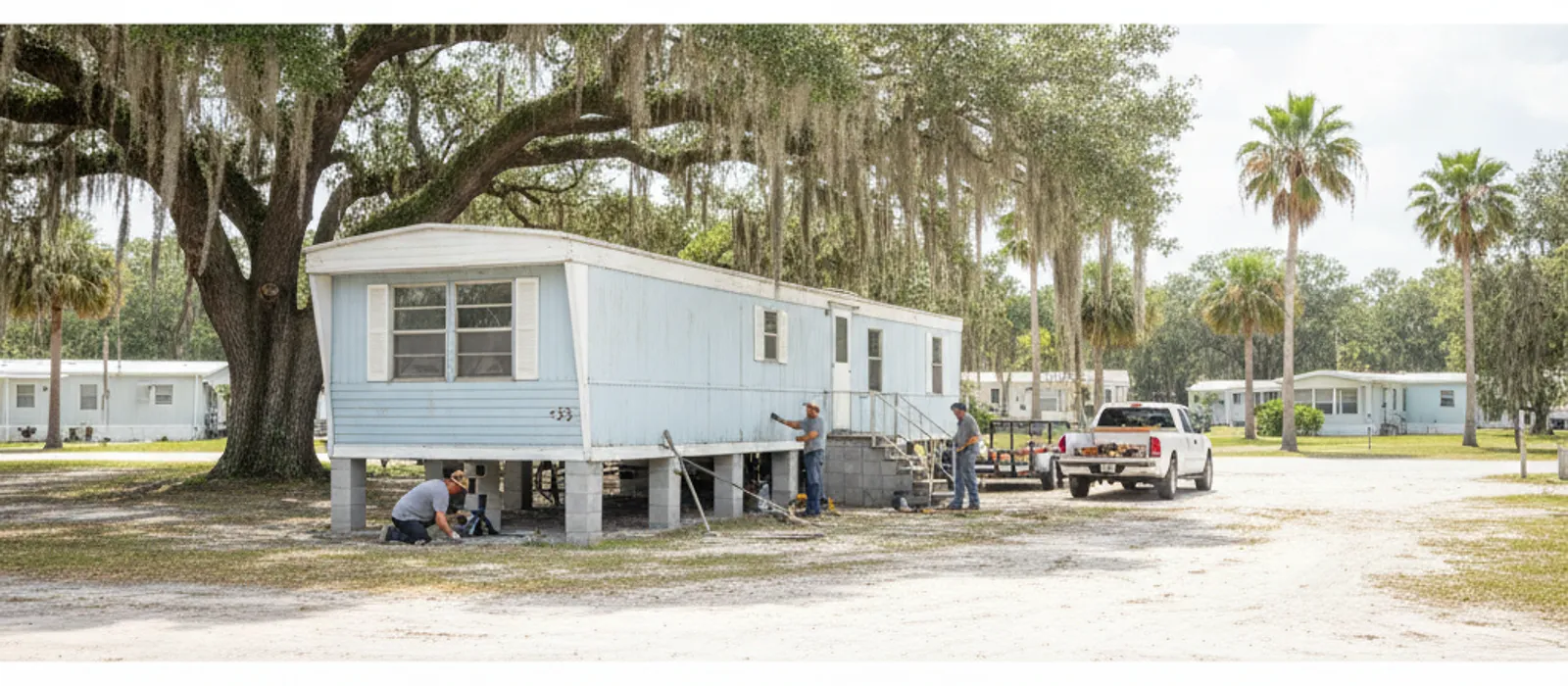
Piers and leveling. Older homes have had fifty years to settle into Florida sand. Inspectors look for leaning piers, crushed blocks, gaps between the pier cap and the frame, and shims that have slipped. If your doors stick or your floors slope, the inspector will find the reason. Our page on mobile home leveling in Ocala covers what a relevel involves.
Tie-downs and anchors. Pre-1976 homes often have too few anchors, the wrong type for the soil, or straps so rusted they’d fail in a strong thunderstorm, never mind a hurricane. Florida’s current standards call for specific anchor spacing and both frame ties and, for many homes, over-the-top or stabilization systems. See our tie-down service page for what compliant looks like.
The belly and vapor barrier. Torn belly board and missing vapor barrier let ground moisture attack the subfloor and insulation from below. On a 1970s home, that moisture has often been working for decades. A new vapor barrier is one of the highest-value upgrades an older home can get in our climate.
Signs of past trouble. Soft floors, water stains on the frame, mold on the belly fabric, and DIY repairs done with whatever was in the garage. Inspectors photograph all of it.
You can do a rough version of this check yourself with a flashlight and old clothes. What you shouldn’t do is start jacking the home or replacing piers on your own. A single wide can weigh 15,000 pounds or more, and a slipped jack under a fifty-year-old frame is how people get killed. Look, take photos, then call a pro.
Real Repair Costs for Pre-1976 Mobile Homes
Here’s what the common jobs actually run in Marion County. Every home is different, so treat these as planning numbers, not quotes.
| Repair | Typical Range (Ocala area) | Why Older Homes Need It |
|---|---|---|
| Full relevel | $450 - $1,500 | Decades of settling in sandy soil |
| Pier replacement | $150 - $400 per pier | Original blocks crushed or sunk |
| Anchor and strap replacement | $50 - $125 per anchor | Rust, undersized originals |
| Tie-down certification | $150 - $350 | Required by most insurers |
| Vapor barrier install | $800 - $2,500 | Original barrier missing or shredded |
| Belly board repair | $300 - $1,200 | Torn fabric, fallen insulation |
| Subfloor repair | $400 - $2,000 per area | Long-term moisture from below |
| Skirting replacement | $1,200 - $3,500 | Cracked, missing, or non-vented |
Two patterns show up over and over on pre-HUD homes.
First, problems come in chains. A torn vapor barrier leads to a damp belly, which leads to soft floors, which often shows up alongside settling piers. Fixing the floor without fixing the moisture source means you’ll pay twice. Our post on soft spots in mobile home floors walks through that chain in detail.
Second, the structural work is cheaper than people fear. Owners put off a relevel for years expecting a five-figure bill, then find out the whole job costs less than their annual insurance premium. Meanwhile the delay warps door frames and cracks walls, and those cosmetic repairs cost more than the relevel would have.
Donna’s math in Belleview
Donna bought a 1974 double wide in a Belleview co-op park for $52,000 last year. Her 4-point flagged the underside: no vapor barrier, four failed piers, and straps the inspector called “decorative rust.” Her agent gave her 30 days to fix it or lose the binder.
The full package, four piers, relevel, new vapor barrier, anchor upgrades, and the certification letter, came to $5,400. She was angry about it, understandably. Then her floors stopped bouncing, her back door latched for the first time since closing, and her summer power bill dropped because the belly insulation wasn’t hanging in wet sheets anymore. A year later she calls it the best money she put into the house.
Repair, Upgrade, or Walk Away: Running the Numbers
At some point every pre-1976 owner asks the same question: is this home worth putting money into?
Here’s the honest framework we give people. Add up three numbers: what the home would sell for as-is, what the needed repairs cost, and what the home is worth to you fixed. That last one matters because for a lot of our customers, the alternative isn’t a nicer home. It’s rent at $1,400 a month, or a new manufactured home at $90,000 plus.
Repairs usually make sense when:
- The frame is straight and sound, with surface rust only
- Moisture damage is localized, not home-wide
- The repair list is mostly underside work: piers, anchors, barrier, leveling
- You plan to stay three or more years, or need insurance to keep a mortgage
Walking away starts to make sense when:
- The frame has rusted through or been cut and patched badly
- Wiring and plumbing both need full replacement
- The roof structure is failing, not just the covering
- Repair totals approach the cost of a decent used HUD-era home
One more Florida wrinkle: title and taxes. Mobile homes here are titled through the state like vehicles unless they’ve been converted to real property. Before you spend big money, confirm the title situation on the FLHSMV mobile home page, especially if you’re buying or selling.
Ray’s call in Dunnellon
Ray inherited his mother’s 1969 single wide outside Dunnellon. He wanted to fix it up and rent it. We crawled it and gave him the bad news straight: the frame rails had rusted through in two spots near the rear axle area, and the repair estimate from a welder started at $6,000 before we could even relevel it. Add the electrical panel and plumbing, and he was looking at $18,000 into a home worth maybe $25,000 finished.
He sold it as-is to a neighbor for $9,500 cash and kept the lot. Sometimes the right repair plan is no repair plan, and a company that only tells you what you want to hear isn’t doing you any favors.
How to Protect a Pre-1976 Home Going Forward
If your home passes the “worth keeping” test, protect the investment with a simple routine.
Crawl the perimeter twice a year and after any major storm. Look for leaning piers, standing water, torn skirting, and daylight through the belly. Our underside inspection checklist gives you the full walkthrough.
Keep water away from the home. Gutters, grading, and vented skirting do more for a fifty-year-old mobile home than almost any other maintenance. Wet sand under piers is why these homes settle unevenly in the first place.
Get a professional relevel check every few years. Older homes settle faster than HUD-era homes because the original site prep was often minimal. Catching a quarter-inch of drift early is a shim job. Catching it three years late is a pier job plus drywall repair.
Keep your paperwork. Tie-down certifications, relevel invoices, and inspection reports make every future insurance renewal and sale easier. Buyers and underwriters both relax when they see a documented history.
And know when to stop DIYing. Skirting repairs, gutter work, and visual checks are fair game for any homeowner. Anything involving jacks, piers, anchors, or the frame belongs with a licensed pro. The money you save doing it yourself isn’t worth what a 15,000 pound home can do in half a second.
If you own a pre-1976 mobile home anywhere in Marion, Sumter, or Citrus County and you want a straight answer about what it needs, request a free written estimate or call (352) 820-4441. We’ll tell you what’s worth fixing and what isn’t, in writing, with no pressure.
Frequently Asked Questions
Can I even get insurance on a pre-1976 mobile home in Florida?
Yes, but your options are limited to specialty mobile home carriers, surplus lines, and sometimes Citizens. Nearly all of them require a 4-point inspection and current tie-down certification first. Fixing foundation and anchor issues before you apply dramatically improves your odds and your rate.
What does a tie-down certification cost and how long is it good for?
In the Ocala area, the certification itself typically runs $150 to $350 if your system passes. If anchors or straps fail, replacement usually costs $50 to $125 per anchor before the cert can be issued. Most insurers want a certification dated within the last few years, and some require a new one at each policy change.
Is it worth releveling a mobile home that’s over 50 years old?
Usually yes, if the frame is sound. A relevel runs $450 to $1,500 and stops the progressive damage that settling causes to doors, walls, and plumbing. The homes where releveling isn’t worth it are the ones with rusted-through frames, and an honest contractor will tell you that before taking your money.
Do pre-1976 mobile homes have to meet current Florida tie-down codes?
When tie-down work is performed, it has to be done to current state standards, and insurers generally expect older homes to be brought up to those standards regardless of what was required in 1975. That’s actually good news, because a properly anchored pre-1976 home performs far better in storms than one sitting on its original 1970s straps. An inspection will tell you exactly where your system stands.