
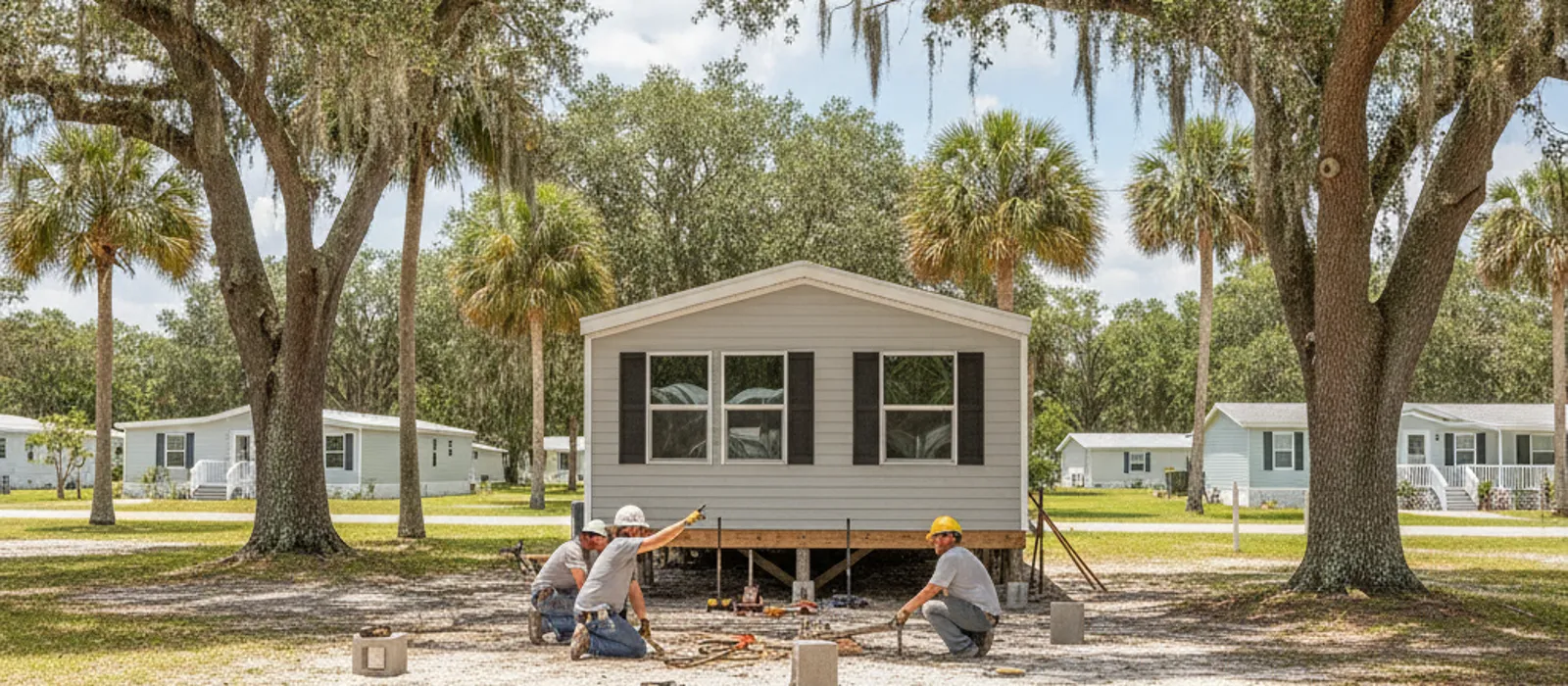
Last month a homeowner in Belleview paid $6,800 to a guy with a magnetic sign on his truck, and her doors still won’t latch. That whole mess could have been avoided with about ten minutes of questions before anyone crawled under her home.
If you’re searching for questions to ask a mobile home leveling contractor, you’re already ahead of most people. Releveling a manufactured home in Marion County usually runs $450 to $1,500 for a straightforward job, so the price of hiring the wrong person isn’t just money. It’s cracked drywall, stressed plumbing, and a 4-point inspection you might fail when it’s time to renew your insurance.
Here are the ten questions we’d want our own family to ask, plus the answers a good contractor should give you. Ask them all. A legitimate leveling company will respect you more for it, not less.
Why the Right Questions Beat the Lowest Bid
Mobile home leveling looks simple from the outside. Jack up the frame, adjust some piers, slide in some shims, done. That’s exactly why the trade attracts people who bought a bottle jack on Saturday and printed business cards on Sunday.
The problem is that leveling touches everything. Your plumbing connections, your ductwork, your tie-down tension, your wall panels, and your roofline all move when the frame moves. Lift one section too fast or in the wrong order and you can crack a drain line under the floor without ever knowing it, until the smell shows up.
Florida also regulates this work more than most states. Mobile home installers here are licensed through the Florida Department of Highway Safety and Motor Vehicles, and structural standards for manufactured homes come from HUD’s federal construction and safety rules. A contractor who shrugs at either of those is telling you something important.
If you’d rather skip the interview process, we’ll make it easy. Ocala Level Pros answers every one of these questions in writing before we touch a jack. Request a free written estimate or call (352) 820-4441 and ask us anything on this list.
The First Five Questions to Ask a Mobile Home Leveling Contractor
1. Are you licensed for mobile home work in Florida, and can I verify it?
Not “are you licensed” in general. Licensed for this. A general handyman license doesn’t cover structural work on a manufactured home. Ask for the license number, then actually look it up through the state before you sign anything.
A good answer sounds like: “Here’s our license number, here’s where you verify it, and here’s our insurance certificate.” A bad answer sounds like: “We’ve been doing this forever, don’t worry about it.”
2. Do you carry liability insurance and workers’ comp?
If a worker gets hurt under your home and the contractor has no workers’ comp, that claim can land on you as the property owner. If they drop your home off a jack and they’re uninsured, you’re paying for the damage.
Ask for a certificate of insurance sent directly from their insurance agent, not a photocopy from the contractor. That one step filters out most of the pretenders.
3. How will you measure the level, before and after?
This one exposes amateurs fast. A pro uses a water level or a laser level to shoot elevations at multiple points across the frame, and they should be able to tell you the readings. A four-foot bubble level sitting on your kitchen floor is not a measurement plan.
You want to hear something like: “We’ll take readings at every pier point, show you where it’s out and by how much, then show you the same readings after.” We wrote up the full process in how pros check if a mobile home is level if you want to know exactly what to expect.
4. What’s included in the price, and what costs extra?
Leveling quotes go sideways when the crawl space has surprises. Wet soil, sunken pads, rusted piers, or a shredded vapor barrier can all change the scope. The question isn’t whether extras exist. It’s whether the contractor tells you about them before or after the jacks go up.
Get the base price, the per-pier cost for replacements, and the shim and pad pricing in writing. Our guide to mobile home leveling cost factors breaks down what actually drives the number up or down.
5. Will you inspect my piers, pads, and tie-downs while you’re under there?
Anyone leveling your home is already looking at every pier. A good contractor documents what they see, with photos, because your piers and tie-downs are what your insurance company cares about at 4-point inspection time.
Hector in Summerfield learned this the good way. His leveling crew flagged four rusted anchor heads during a $675 relevel and photographed them. He fixed the anchors for $580 before his insurance renewal, instead of scrambling after a failed inspection with a deadline hanging over him.
Five More Questions to Ask Before You Sign Anything
6. How do you protect my plumbing and ductwork during the lift?
Lifting a frame is easy. Lifting it without snapping a drain line or separating a duct joint takes patience. The right answer involves small, incremental lifts, working in a planned sequence, and checking utility connections as they go.
If a contractor says they just “jack it up until it’s level,” thank them for their time and keep looking. Fast lifting is the number one cause of leveling damage we see.
7. What does your warranty cover, and for how long?
Homes settle. Florida sand, clay pockets, and heavy summer rain all move soil, which is why mobile homes settle so much here. A serious contractor stands behind the work for at least a year and puts it on paper.
Read the fine print, too. A warranty that excludes “settling” on a leveling job is a warranty that excludes leveling. It should cover workmanship: shims placed correctly, piers seated properly, and the home holding the elevations they recorded.
8. Can I get the estimate, scope, and readings in writing?
Every time, yes. Verbal quotes are how a $500 job becomes a $2,000 invoice. The written estimate should name the price, the number of piers being adjusted or replaced, materials, timeline, and warranty terms.
This is also your protection if there’s ever a dispute. No paper, no proof. We covered the classic tricks in mobile home repair scams to watch for, and almost every one of them starts with “we don’t really do paperwork.”
9. Who is actually doing the work?
Some outfits sell the job, then hand it to whoever answers the phone that morning. Ask if the crew works for the company, how experienced the lead tech is, and who you call if something’s wrong a month later.
Louise in Dunnellon got burned by exactly this. She hired a company with great reviews, but a subcontracted crew did the work, over-lifted one corner, and cracked her wall panels in two rooms. The repair quote came to $1,900, and the original company said “talk to the crew.” The crew’s phone was disconnected.
10. Do you handle permits if my job needs one?
Simple releveling in Marion County usually doesn’t need a permit, but pier replacement, foundation changes, or work tied to an FHA foundation certification can. The right answer is a contractor who knows the local rules cold and pulls permits when they’re required, not one who says permits never apply. We keep a current breakdown in do you need a permit to level a mobile home in Florida.
If you want these answers without the runaround, that’s how we operate every day. Call Ocala Level Pros at (352) 820-4441 and we’ll walk you through all ten before you commit to anything.
What Honest Pricing Looks Like in Marion County
Prices vary with the home and the soil under it, but the ranges below reflect what we see across Ocala, Belleview, Summerfield, and the surrounding towns. Use them as a sanity check against any quote you get.
| Job | Typical Range | Red Flag Price |
|---|---|---|
| Single-wide relevel | $450 - $900 | Under $250 or over $2,000 |
| Double-wide relevel | $700 - $1,500 | Under $400 or over $3,500 |
| Pier replacement (each) | $150 - $350 | ”We’ll figure it out later” |
| Shims and pad adjustments | Often included | Big separate line item |
| Post-level inspection report | Included | Extra charge for photos |
| Written estimate | Free | Any charge at all |
Two warnings on this table. A price way under the range usually means the contractor plans to “find” problems once they’re underneath, and a price way over it, with pressure to sign today, is a classic scare tactic. Either direction, slow down.
Also know your baseline before anyone quotes you. If your doors stick, floors slope, or skirting is buckling, read the signs your mobile home needs leveling so you can compare what you see with what the contractor claims to find.
Red Flags That Should End the Conversation
Some answers aren’t just weak. They’re deal-breakers. Walk away if you hear any of these:
- “I don’t need a license for this.” In Florida, structural work on manufactured homes is regulated. This statement is either ignorance or a lie, and both cost you money.
- “Cash only, and I need it up front.” Reasonable deposits exist. Full payment before work starts does not, at least not from anyone legitimate.
- “I was in the neighborhood and noticed your home looks unlevel.” Door-knockers who diagnose your foundation from the street are running a script, not an inspection.
- “No need for a written estimate, I’ll take care of you.” He will take care of someone. It won’t be you.
- “We can skip the level readings, I can eyeball it.” Nobody can eyeball a 76-foot frame to within a quarter inch. That’s what instruments are for.
One more from right here at home. Marge in Silver Springs had a door-knocker tell her the home would “shift off its piers within a month” without an emergency $3,200 repair, payable that afternoon. She called us for a second opinion instead. The actual fix was a standard relevel with two new pier pads: $840 total, done in a day, readings documented before and after.
And a note on doing it yourself: checking your home with a level is fine, and so is looking under the skirting with a flashlight. But never get under a mobile home supported only by jacks, and never try to lift a frame without training. Homes weigh 15,000 pounds and up. If anything needs to move, that’s the moment to stop and call a professional.
When you’re ready for straight answers and a documented job, start with our mobile home leveling service in Ocala or request your free written estimate. Every quote comes with elevation readings, photos, and pricing on paper.
Frequently Asked Questions
How much should mobile home leveling cost in the Ocala area?
Most single-wides in Marion County run $450 to $900, and double-wides typically run $700 to $1,500. Pier replacements add $150 to $350 per pier when they’re needed. Get every number in writing before work starts, and be suspicious of quotes far outside those ranges in either direction.
How do I verify a mobile home contractor’s license in Florida?
Ask for the license number and check it through the Florida Department of Highway Safety and Motor Vehicles, which licenses mobile home installers in the state. You can also ask for a certificate of insurance sent directly from the contractor’s insurance agent. A legitimate contractor hands this information over without hesitation.
How long does releveling take, and do I have to leave my home?
Most relevels take two to six hours, and you can usually stay home during the work. You’ll hear some creaks and pops as the frame settles into position, which is normal. Bigger jobs involving multiple pier replacements can stretch to a full day.
What should the contractor give me when the job is done?
You should receive final elevation readings compared against the starting readings, photos of the piers and any replaced materials, an itemized invoice, and the written warranty. That paperwork matters later for insurance inspections and resale. If a contractor can’t produce it, the job isn’t really finished.