A Category 1 hurricane pushes winds of 74 to 95 mph across Marion County, and a mobile home with loose tie-downs can start shifting on its piers in gusts well below that. The good news? Most of the damage we see after a storm was preventable for a few hundred dollars and a weekend of attention.
That’s what this guide is for. It’s a practical, no-panic approach to hurricane preparation for mobile homes, built from what we actually see under homes in Ocala, Belleview, Summerfield, and the rest of Marion, Sumter, and Citrus counties. We’ll cover what to check 30 days out, what to do the week before landfall, what it all costs, and when to stop DIYing and pick up the phone.
If you’d rather have a professional look things over before the season heats up, request a free written estimate or call us at (352) 820-4441. We check anchors, straps, piers, and skirting in one visit.
Why Hurricane Prep for Mobile Homes Starts Under the Home
Most hurricane checklists tell you to buy water and flashlights. That’s fine advice, but it skips the part that actually determines whether a mobile home rides out a storm: the anchoring system underneath it.
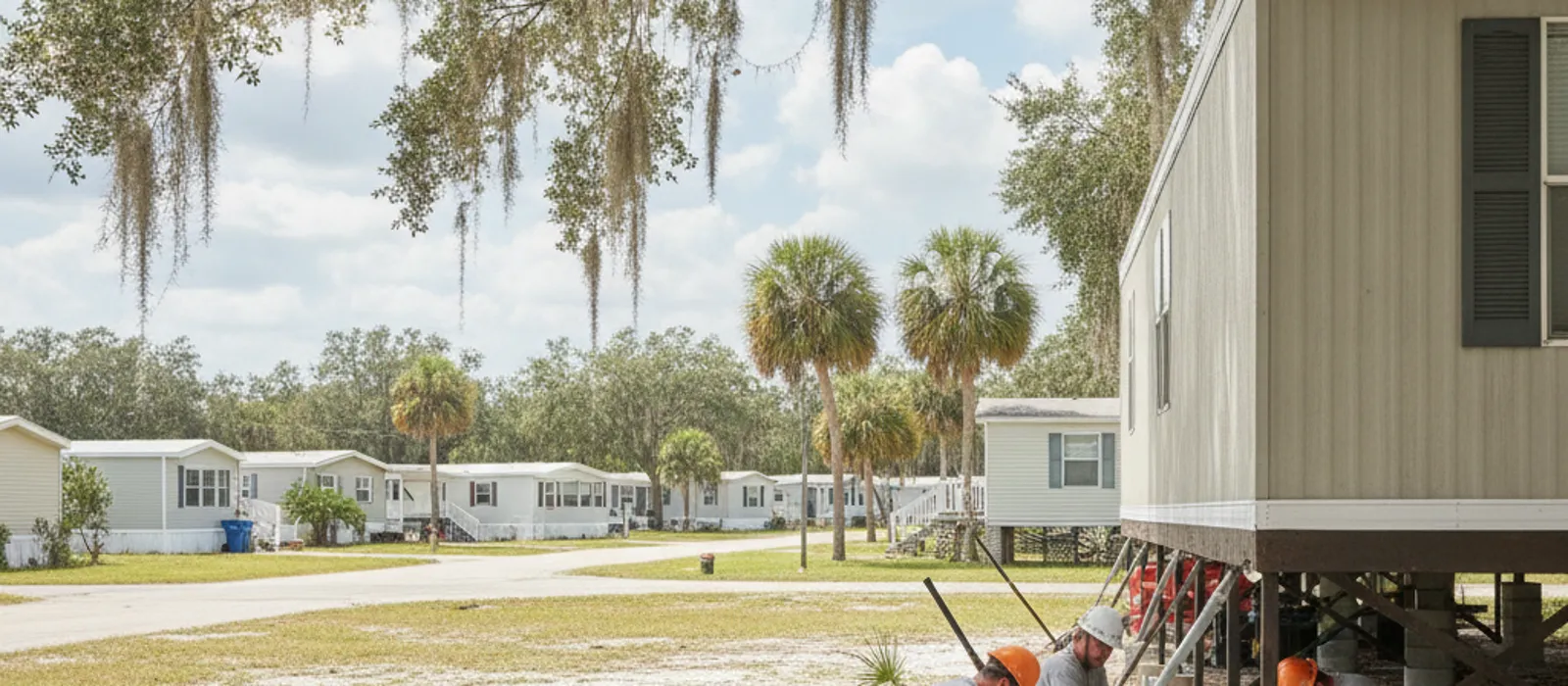
Your home sits on piers and is held down by ground anchors connected to steel straps. In a hurricane, wind doesn’t just push on the walls. It creates uplift, the same force that makes an airplane wing fly. The straps and anchors are what resist that uplift. If they’re rusted, loose, or missing, the wind does the rest.
Florida takes this seriously enough to regulate it. Homes here fall under state wind zone requirements, and Marion County sits in Wind Zone II, which means the anchoring system is supposed to handle sustained winds of 100 mph. We wrote a full breakdown of Florida wind zones for mobile homes if you want the details.
Here’s the problem. Anchors rust. Straps stretch. Soil shifts after wet summers, and an anchor that was tight in 2015 can wiggle free by hand today. A quick crawl-around before June tells you more about your storm risk than any weather forecast.
Carl in Summerfield learned this the easy way, which is the way we recommend. He called us in May for a routine check before closing on a refinance. We found 9 of his 22 anchors rusted through at the soil line, straps you could deflect with two fingers. Replacing them cost him $1,850. His neighbor two streets over skipped the check, lost partial roof attachment in a tropical storm that same year, and spent over $11,000 on repairs plus a hotel stay. Same storm, same street, very different bills.
Your 30-Day Checklist: Inspect Before the Forecast Turns
Do this work early in the season, ideally by the start of June. Once a storm has a name and a cone, contractors book up fast and supplies vanish from shelves.
Walk the perimeter and check your skirting. Loose or buckling skirting panels become projectiles in high wind, and gaps let wind get under the home where it can push up on the floor. If panels are warping or pulling away, that’s sometimes a sign the home itself has shifted. Our post on skirting that’s buckling explains how to tell cosmetic damage from a leveling problem. If it’s beyond a few loose screws, our skirting service in Ocala can repair or replace it.
Check every anchor you can reach. Open an access panel and look at the anchor heads where they meet the soil. Surface rust is normal. Flaking, scaling rust that comes off in chunks is not. Grab each strap and push. It should feel like a guitar string, not a clothesline. We covered what failure looks like in our guide to rusted mobile home anchors.
Look at your piers and check for settling. Sight down the length of the home from each corner. Doors that stick, cracks over window frames, and a floor that slopes toward one end are all signs the home has settled off level. An unlevel home puts uneven load on the anchoring system, which is exactly what you don’t want in 100 mph wind. Our article on signs your mobile home needs leveling walks through the full symptom list.
Inspect the roof and any add-ons. Carports, screen rooms, and awnings that were added after the home was set are often anchored to almost nothing. These are the first things to peel off in a storm. Check their connections and be honest about whether they’d hold.
Photograph everything. Walk the home inside and out with your phone. Date-stamped photos of the home’s pre-storm condition make insurance claims dramatically easier, and they cost you ten minutes.
One safety note before you crawl under anything: never go under a home that feels unstable, shows leaning piers, or has straps under visible strain. That’s professional territory. A pier failure with someone underneath is a life-safety emergency, not a repair bill.
The Week-Before Hurricane Preparation Checklist for Mobile Homes
A storm is named and the cone includes Marion County. Here’s your working list, roughly in order.
- Confirm your evacuation plan first. Florida officials are blunt about this: mobile and manufactured homes are under evacuation orders in virtually every hurricane scenario, regardless of how well anchored they are. Know your zone and your route at floridadisaster.gov. Prep protects your property. Evacuation protects you.
- Clear the yard. Furniture, grills, planters, and trampolines all fly. Bring in what you can, tie down or sink what you can’t.
- Trim what hangs over the roof. Small limbs only. Leave big limbs and anything near power lines to a tree service.
- Tighten what you found loose in your 30-day check. If straps just need a turnbuckle adjustment and you can reach them safely from an access panel, that’s reasonable DIY. If anchors are pulling out of the ground, stop. Re-driving or replacing anchors takes equipment and has to meet state spec.
- Protect windows and doors. Plywood or panels beat taped glass every time. Tape does nothing.
- Shut off propane, secure the tank. An unsecured tank is both a projectile and a fire hazard.
- Bag your documents. Insurance policy, title, tie-down certification if you have one, photos. Waterproof bag, and it goes with you when you evacuate.
- Top off the basics. Water, meds, fuel, cash, phone batteries. The federal checklist at ready.gov/hurricanes covers the household side well.
Rita in Dunnellon ran this exact list before a storm two seasons back. Her one splurge was calling us four days out to re-tension 14 straps and replace 3 anchors, a $700 same-week job. The storm wobbled inland as a strong tropical storm. Her home didn’t move a quarter inch. Her park had two homes shift on their piers, and the cheaper of those two releveling and repair jobs ran about $4,200.
If you’re inside that one-week window and something under your home doesn’t look right, don’t wait in line behind everyone else. Call our line at (352) 820-4441. We run a 24/7 emergency schedule for exactly these deadline situations.
What Prep Costs vs. What Storm Damage Costs
People put off hurricane prep because it feels expensive. Here’s what the numbers actually look like in our service area.
| Prep item | Typical cost range | What skipping it can cost after a storm |
|---|---|---|
| Professional anchor and strap inspection | $150 to $300 | Unknown risk riding on rusted steel |
| Re-tensioning loose straps | $25 to $50 per strap | Home shifting on piers: $2,500 to $6,000+ |
| Replacing failed anchors | $50 to $150 per anchor | Partial uplift damage: $8,000 to $25,000+ |
| Skirting repair | $200 to $800 | Wind under the home, floor and belly damage |
| Releveling before season | $450 to $1,500 | Uneven strap loads, doors, plumbing stress |
| Full skirting replacement | $1,200 to $3,500 | Projectile panels, exposed underside |
Every home is different, so treat these as honest ballparks, not quotes. Our tie-down cost guide breaks down the anchoring numbers in more detail.
Dave and Sharon in Belleview are the case study we cite most. In 2024 they spent $2,400 total: an inspection, 11 new anchors, full re-tensioning, and two skirting sections. The next season, a hurricane passed close enough to bring sustained tropical storm winds through Belleview for six hours. Their claim afterward was $0. Two homes in their community that skipped prep filed claims of $19,000 and $31,000, and one of those owners was displaced for almost four months.
There’s an insurance angle too. Many Florida carriers ask for proof of a compliant tie-down system, especially during 4-point inspections on older homes. A documented inspection can be the difference between keeping coverage and scrambling for it. Our post on tie-down certification and insurance covers what carriers actually want to see.
Want a real number for your home instead of a range? Get a free written estimate. No pressure, no scare tactics, just what we find and what it costs to fix.
Day Of the Storm and the First 48 Hours After
When an evacuation order comes for your zone, you leave. That’s the whole plan for the day of the storm. No amount of anchoring changes that, and we’ll never tell you otherwise.
After the storm, resist the urge to rush back and crawl under the home. Downed lines, shifted piers, and displaced wildlife make the first hours dangerous. When officials clear your area, start with a slow walk-around: look for skirting damage, gaps between the home and its steps or decking, doors that suddenly stick, and any new lean or tilt.
Photograph damage before you touch anything, then call your insurance carrier and, if the home has shifted or the underside took water, call us. Standing water under a mobile home leads to soil washout, pier settling, and eventually mold in the belly. Our post on water under a mobile home explains why that puddle matters more than it looks like it does.
We keep a full post-storm walkthrough in our after-hurricane mobile home checklist, so save that link now, while your internet still works.
And a heads-up from experience: storm recovery brings out door-knocking “repair crews” who want cash up front. Anyone offering to relevel or re-anchor your home should show a license, insurance, and a written scope. If your gut says something’s off, it probably is.
Make Prep a Habit, Not a Panic
The homes that come through hurricane season fine are almost never the newest ones. They’re the ones whose owners do the same boring things every year: check the anchors in spring, fix small problems while they’re small, keep the paperwork in one bag, and leave when told to leave.
Put the 30-day checklist on your calendar for late May. Do the crawl-around, or have us do it. Handle the yard and documents the week a storm is named. That’s the whole system, and it costs a fraction of what a single strap failure does.
We’re local, we’re licensed and insured, and we look at the undersides of mobile homes across Marion, Sumter, and Citrus counties every working day. If you want a second set of eyes before the season peaks, reach out for a free estimate or call (352) 820-4441.
Frequently Asked Questions
How do I know if my mobile home tie-downs will hold in a hurricane?
You can do a basic check yourself: straps should be tight like a guitar string, and anchor heads shouldn’t show flaking rust or lift when you pull on them. But the only real answer comes from a professional inspection, since anchors fail below the soil line where you can’t see. In Marion County we recommend an inspection every 2 to 3 years, or before any named storm season if the home hasn’t been checked in memory.
Should I stay in my mobile home during a hurricane if it’s well anchored?
No. Florida emergency officials order mobile home residents to evacuate in essentially every hurricane scenario, and anchoring doesn’t change that. Tie-downs and prep exist to protect your property while you’re safely somewhere else. Know your evacuation zone at floridadisaster.gov before the season starts.
How much does it cost to get a mobile home hurricane-ready in Ocala?
For most homes that are in decent shape, a professional inspection plus minor re-tensioning runs a few hundred dollars. Homes needing anchor replacement typically land between $1,000 and $3,000 depending on how many anchors have failed. Compare that to post-storm repairs, which regularly run $10,000 to $30,000, and prep is the cheapest insurance you’ll ever buy.
Can I replace mobile home anchors myself before a storm?
We don’t recommend it. Anchors have to be sized to your soil type, driven to the correct depth, and installed to Florida’s wind zone specs, and a mis-installed anchor gives false confidence that’s worse than a known problem. Tightening an accessible turnbuckle is reasonable DIY, but anchor replacement, pier work, and anything requiring you to go under an unstable home should go to a licensed professional.