The most expensive storm damage in Marion County usually isn’t the tree on the roof. It’s the pier that shifted two inches under the master bedroom while nobody was looking.
If you evacuated and you’re headed back, a careful mobile home inspection after hurricane winds and flooding pass through is the single best hour you’ll spend all year. Roofs and windows get all the attention because you can see them from the street. But manufactured homes take storm damage in a different spot: underneath, where saturated ground, wind uplift, and running water work on your piers, anchors, and belly board.
This guide walks you through exactly what to check, in what order, before you unpack a single box. It’s built for homes in Ocala, Marion County, and the surrounding area, where sandy soil and summer storms make settling problems worse after every big blow.
Before You Even Pull Into the Driveway
Don’t rush the reunion. The first checks happen from the road, before you or the kids set foot on the property.
Look for downed power lines. If any line is touching your home, skirting, or metal steps, stay in the car and call the utility. A mobile home’s steel frame can energize the whole structure.
Smell for gas. If you have propane, check that the tank is upright and the line is intact before you go inside. If you smell gas, back away and call your supplier from a distance.
Check for standing water around the home. Water against the skirting means water under the home, and possibly softened soil under your piers. Note where it’s pooling. You’ll want that information later.
Photograph everything before you touch anything. Wide shots of all four sides, the roof line, the skirting, and any debris. Your insurance adjuster will thank you, and so will your wallet. FEMA’s guidance on returning home after a disaster is worth reading before you make the trip back; you can find it at Ready.gov’s returning home page.
If anything in this first pass looks off, especially a visible lean, a sagging roof line, or skirting bulging outward, don’t go inside yet. Call us at (352) 820-4441 and describe what you’re seeing. We run a 24/7 line for exactly this situation, and a five-minute phone call is free.
Your Step-by-Step Mobile Home Inspection After a Hurricane
Once the obvious hazards are cleared, work through the home in this order. Outside first, then underneath, then inside. The order matters because problems underneath explain what you’ll find inside.
Walk the perimeter
Circle the home slowly and look at the bottom edge where the wall meets the skirting. That line should be dead straight. Any dip, hump, or wave in that line means something moved underneath.
Check every piece of skirting. Missing panels are obvious, but also look for panels that are buckled, bowed, or pulled away from the track. Skirting that suddenly won’t sit right is often the first visible sign of a shifted foundation, not just cosmetic wind damage. We wrote a full breakdown on this in our guide to skirting that’s buckling.
Sight down the roof line
Stand at each corner and look down the length of the roof edge. A straight roof line on Monday that’s wavy on Friday means the frame twisted or a pier dropped. On double-wides, pay extra attention to the marriage line where the two halves meet.
Test the doors and windows
Before you move furniture back in, open and close every exterior door and a few windows on each side of the home. Doors that stuck fine before the storm but now scrape, swing open on their own, or won’t latch are telling you the frame is out of square. This is one of the most reliable early warnings a homeowner gets, and we cover why in our post on doors that won’t close.
Walk the floors
Inside, walk every room slowly, especially along exterior walls and near the bathrooms. You’re feeling for new soft spots, bounce, or slope that wasn’t there before you evacuated. Set a marble or a level on the floor in a few rooms. If it rolls hard in one direction, write down which room and which direction.
Under the Home: Where Hurricane Damage Really Hides
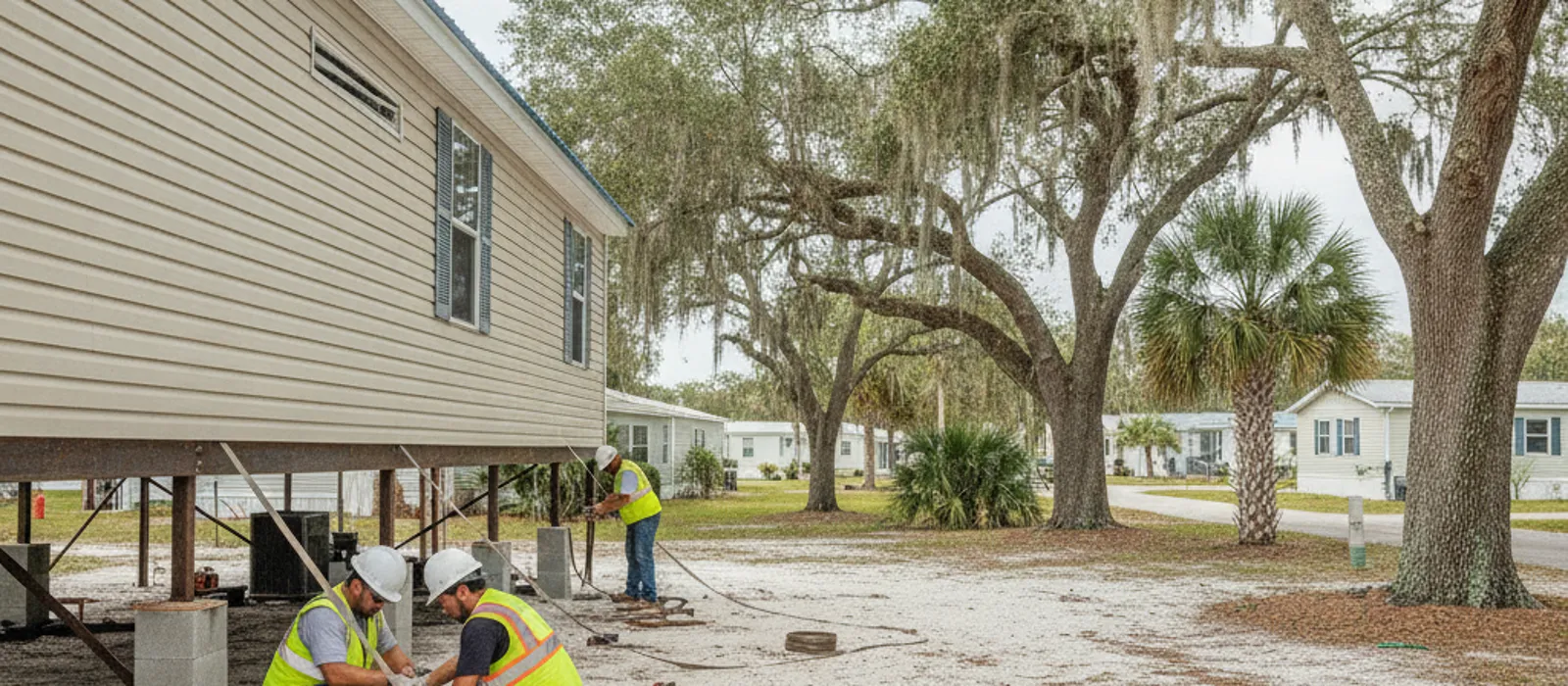
Here’s the part most homeowners skip, and it’s the part that costs them. Pull a skirting panel, grab a flashlight, and look underneath. You don’t have to crawl the whole belly. Even a good look from the access point tells you a lot.
Check the piers. You’re looking for piers that lean, blocks that have cracked, and caps or shims that have slipped or fallen. In our sandy Central Florida soil, a hurricane’s worth of rain can wash fines out from under a footing in a single afternoon. A pier doesn’t have to fall over to cause damage. A half-inch drop under a load point is enough to crack drywall and rack door frames.
Check the tie-downs and anchors. Follow each strap from the frame down to the ground anchor. Straps should be tight enough that they don’t flap or deflect easily when you push on them. Look for straps that snapped, buckles that slipped, and anchor heads that pulled up or now sit at an angle. Wind uplift during the storm loads these components hard, and a strap that stretched or an anchor that walked upward won’t protect you next time. If you see orange-brown flaking on the hardware, read our guide to rusted anchors before the next storm season.
Check for water and wet insulation. Standing water, mud lines on the piers, or belly board insulation hanging down in wet, heavy sags all mean water got where it shouldn’t. Wet insulation under a Florida home doesn’t dry out on its own. It grows mold, rots subfloor from below, and invites every critter in the county.
Check the vapor barrier. If the plastic sheeting on the ground is torn, displaced, or floating on mud, moisture will keep attacking the home’s underside long after the storm. A damaged barrier after flooding is one of those repairs that’s cheap now and expensive later, and our vapor barrier service in Ocala exists mostly because people wait.
Two real-world examples from last storm season show why this crawlspace check matters.
Ray in Summerfield came home to what looked like minor damage: three skirting panels gone, everything else fine. When he pulled a fourth panel to reinstall them, he spotted two piers tilted toward the wash-out where his downspout had dumped storm water. We releveled and reset both piers for $1,400. If he’d skipped that look and lived on it for a year, he’d have been facing cracked ceilings and a likely subfloor repair north of $3,500 on top of the leveling.
Dale in Dunnellon wasn’t so lucky with timing. He moved back in, and it wasn’t until his floors felt spongy in October that he looked underneath. The storm had shredded his vapor barrier and soaked the belly insulation, and by then mold had a two-month head start. Belly repair, new barrier, and treatment ran him about $2,700. The barrier alone, replaced right after the storm, would have been well under half that.
What Post-Storm Repairs Actually Cost in the Ocala Area
Numbers help you plan, so here are honest ranges for the repairs we most often quote after a hurricane in Marion, Sumter, and Citrus counties. Every home is different, so treat these as planning figures, not quotes.
| Post-storm repair | Typical cost range | Urgency |
|---|---|---|
| Releveling (full home) | $500 to $1,500 | High: worsens monthly |
| Pier reset or replacement (per pier) | $150 to $400 | High if load-bearing |
| Tie-down strap or anchor replacement (per unit) | $50 to $150 | High before next season |
| Full tie-down system upgrade | $1,500 to $4,000 | Medium to high |
| Vapor barrier replacement | $800 to $2,500 | Medium: rises with delay |
| Skirting repair or replacement | $500 to $3,000 | Low to medium |
| Belly board and insulation repair | $500 to $2,500 | Medium: mold risk |
Notice the pattern: the structural items at the top of the table are the cheapest ones on the list when caught early, and the most expensive problems on any mobile home when ignored. A $1,000 relevel this month beats a $6,000 subfloor and pier project next year.
Teresa in Belleview is our favorite example of doing this right. She photographed her home the day she returned, found a dropped pier and two snapped straps during her walkthrough, and called us for a written assessment before she called her insurance company. Her documented claim came back approved at $6,200, covering the leveling, six new anchors, and her skirting. Neighbors two streets over with similar damage but no photos and no written assessment got a fraction of that.
Want a set of trained eyes on your home before you file anything? Request a free written estimate and we’ll document what we find, whether or not you hire us for the work.
Insurance, Documentation, and the 4-Point Problem
Florida homeowners know the drill: after a big storm, insurance companies get picky. For manufactured homes, two things matter more than anything else.
Document before you repair. Photos with timestamps, a written list of damage, and a professional assessment carry real weight. Don’t throw away broken straps or damaged skirting panels until your adjuster has seen them or you’ve photographed them thoroughly.
Expect your tie-downs to come up. If your policy renews after a storm year, or you’re buying or selling, a 4-point inspection or tie-down certification is likely in your near future. Storm-damaged anchors that were fine last year will fail that inspection now. Getting your tie-downs inspected and brought up to spec before the insurance paperwork starts saves you from a scramble on someone else’s deadline.
The National Weather Service also publishes solid guidance on post-hurricane safety hazards, from carbon monoxide to contaminated water, at weather.gov’s hurricane safety page. Read it before you fire up a generator or drink from the tap.
When to Stop DIY and Call a Professional
Most of this checklist is looking, smelling, and taking pictures. That part is safe for any homeowner. But know where the line is.
Stop and call a pro if you find any of these:
- A pier that’s visibly leaning, cracked through, or separated from the frame
- The home sitting noticeably off level, or floors that slope more than they did before the storm
- Snapped or badly stretched tie-down straps, or anchors pulled partway out of the ground
- Standing water under the home that isn’t draining after two dry days
- Any sagging in the frame or roof line
Never crawl under a home that has shifted on its piers. A single-wide weighs 15,000 to 20,000 pounds, and a pier that moved once can move again with you under there. Jacking a mobile home is not a floor-jack-from-the-truck job, either. It takes rated equipment, proper cribbing, and someone who knows how the frame carries its loads.
The same goes for tie-down work. Anchor tension and strap placement are specified by Florida code, and getting it wrong means your home is no better protected than it was with the broken straps.
The good news: professional help here is cheaper than most people expect, and a lot cheaper than guessing wrong. Our crews handle mobile home leveling across the Ocala area, tie-down repair and certification, vapor barriers, and skirting, and every estimate is free and in writing. If you’re staring at something under your home right now and aren’t sure what you’re looking at, call (352) 820-4441. We answer 24/7 for storm and deadline emergencies, and we’d rather talk you out of an unnecessary repair than sell you one.
One last tip: whatever you find this time, write it down and keep the photos. A record of your home’s condition after each storm makes the next inspection faster, makes insurance claims stronger, and helps you spot slow-moving problems like gradual settling before they get expensive.
Frequently Asked Questions
How soon after a hurricane should I inspect my mobile home?
Do the exterior and drive-by checks the day you return, before anyone moves back in. The underside check can wait a day or two if water is still standing, but don’t push it past the first week. Soil keeps shifting as it dries, and insurance claims get harder the longer you wait to document damage.
Can my mobile home be off level even if it looks fine from outside?
Yes, and it happens all the time after heavy rain events. A half-inch pier drop won’t show from the street, but you’ll feel it in sticking doors, new wall cracks, and floors that slope toward one corner. That’s why the door test and the marble test matter, and why pros check with water levels at multiple points along the frame.
Will insurance cover releveling and tie-down repairs after a storm?
Often yes, if you can tie the damage to the storm event with photos and a professional assessment. Coverage varies a lot by policy, so document everything before repairs start and get a written estimate to submit with your claim. A dated, itemized assessment from a licensed contractor is much harder for an adjuster to dispute than a verbal description.
Is it safe to stay in my mobile home while repairs are scheduled?
Usually yes for minor settling, skirting, and vapor barrier issues. If the home has visibly shifted on its piers, has snapped multiple tie-downs, or has sagging frame or roof lines, stay elsewhere until a professional looks at it. When in doubt, call and describe what you see. We’ll tell you honestly whether it can wait.