
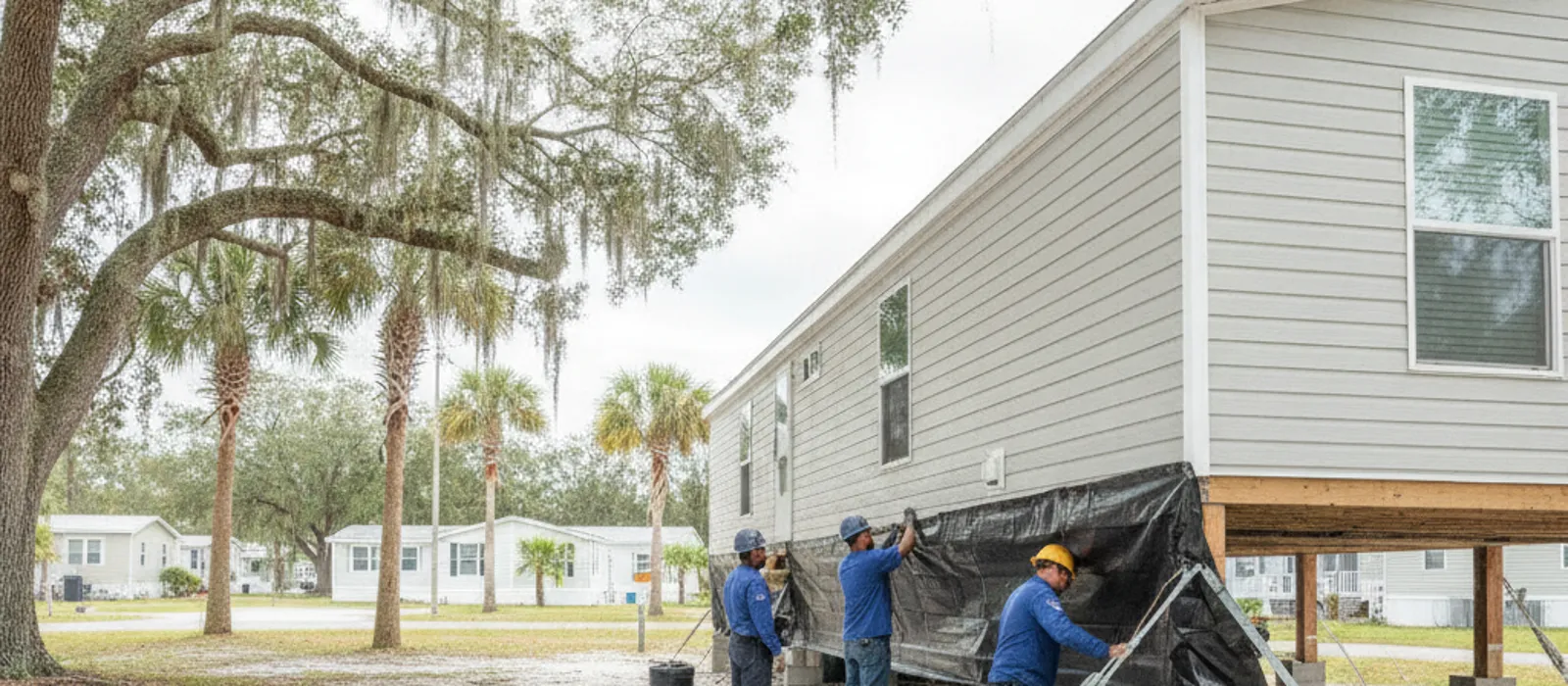
Most Ocala homeowners find out their vapor barrier is shot the same way: a musty smell that won’t quit, a power bill that jumped $60 in one month, or an inspector crawling out from under the house shaking his head two weeks before closing.
So let’s skip the runaround and talk real vapor barrier cost for a mobile home. In Marion County, most jobs land between $600 and $3,500 installed. Small patch repairs can run as little as $150. A full replacement on a big double wide with insulation work can push past $4,000. Where you land in that range depends on five things we’ll walk through below, with actual numbers from jobs around Ocala, Belleview, Summerfield, and Dunnellon.
If you’d rather just get a number for your home, call us at (352) 820-4441. We give free written estimates, and we’ll show you photos of what’s actually under your house before you spend a dime.
The Short Answer on Vapor Barrier Cost for a Mobile Home
A vapor barrier is the plastic sheeting that covers the ground or wraps the underside of your home. Its whole job is keeping ground moisture out of your insulation, subfloor, and ductwork. In Florida, where the water table sits close to the surface and summer humidity runs 90 percent, it’s not optional equipment.
Here’s what the work typically costs in our service area:
| Job Type | Typical Cost | When You Need It |
|---|---|---|
| Small patch repair (1-3 tears) | $150 - $600 | Animal damage, one sagging section |
| Partial replacement (one zone) | $500 - $1,200 | Plumbing leak soaked one area |
| Full replacement, single wide | $800 - $2,000 | Barrier is 15+ years old or shredded |
| Full replacement, double wide | $1,500 - $3,500 | Same, but twice the square footage |
| Replacement plus insulation work | $2,500 - $5,000 | Wet, fallen, or rodent-ruined insulation |
Two clarifications, because these terms get mixed up constantly.
First, some homes have a ground vapor barrier, which is 6-mil plastic laid over the dirt in the crawl space. Others have a belly wrap (also called belly board or bottom board), which is the material stapled to the underside of the home itself. Many homes need both. Ground plastic is cheaper to install. Belly wrap repair costs more because it’s overhead work in a tight space.
Second, materials are the cheap part. A roll of 6-mil polyethylene big enough for a single wide costs $80 to $150 at any supply house. You’re mostly paying for labor: someone willing to spend hours on their back in a 24-inch crawl space doing careful work. That’s fair pricing, not padding.
One tip when you’re collecting quotes: ask for the price broken out by line. A good estimate separates the barrier material, the labor, any insulation replacement, and any cleanup or animal exclusion. If a contractor hands you one lump number and won’t itemize it, you can’t compare bids and you can’t tell what you’re actually buying. Every written estimate we produce is itemized for exactly that reason.
For a deeper look at what’s actually under there and how we approach the work, see our vapor barrier service page.
What Drives Mobile Home Vapor Barrier Cost Up or Down
Five factors decide whether you’re at the bottom of those ranges or the top.
1. Square footage. A 14x70 single wide is about 980 square feet of barrier. A 28x60 double wide is 1,680. Installed pricing usually works out to $1 to $2.50 per square foot for ground barrier and more for belly wrap, so size alone can double the bill.
2. What’s already ruined underneath. If your old barrier failed years ago, the damage rarely stops at plastic. Wet insulation has to come out. Rodent nests have to be cleared. Sometimes ductwork is sitting in a puddle. On maybe a third of the full replacements we quote, the barrier itself is half the invoice and the cleanup is the rest.
3. Access and clearance. A home sitting 30 inches off grade with removable skirting panels is a straightforward job. A home sitting 16 inches off grade with skirting that’s mortared in place takes twice the labor hours. If your skirting has to come off and it’s brittle or buckling, factor that in too. Our skirting service page covers what panel replacement runs.
4. Material grade. Code minimum for ground cover is 6-mil plastic. We usually recommend string-reinforced barrier for Florida homes because it resists tearing when the ground shifts or an armadillo decides to dig. It adds maybe $150 to $300 to a typical job and roughly doubles the lifespan. We compared the options in our guide to the best vapor barrier for a mobile home.
5. Standing water. If there’s water pooling under the home, a new barrier alone won’t fix it. The grading or drainage problem has to be handled first, or you’re wrapping a wet problem in plastic. We wrote about what that means in what to do about water under your mobile home.
Repair or Replace? How to Tell Which One You’re Paying For
This is the fork in the road that swings your bill by a couple thousand dollars, so it’s worth getting right.
Repair makes sense when the barrier is under about 10 years old, the damage is localized (a few tears from a cat or a plumber who never taped his access hole shut), and the insulation behind those tears is still dry. A good patch job with the right tape and backing runs $150 to $600 and buys you years.
Replacement makes sense when the material is brittle and tears like paper, more than about a quarter of it is sagging or open, or the insulation is wet in multiple zones. Patching brittle barrier is throwing money away. Each patch holds, but the material two feet over splits next season, and you’re paying trip charges forever.
There’s also a timing issue specific to Florida. If you’re selling, a 4-point inspection or a buyer’s inspector will crawl under the home, and torn belly board with exposed insulation is one of the most common flags. Fixing it on your schedule costs a lot less than fixing it in a 10-day inspection window. Our post on 4-point inspections for mobile homes walks through what inspectors look for.
One more reason not to wait: an open belly and damp ground create exactly the conditions mold needs. The EPA’s guidance is blunt about it: control moisture and you control mold. You can read their recommendations at epa.gov/mold. If you’re already smelling mustiness inside, start with our post on mold under a mobile home, then get someone under there quickly.
Not sure which side of the line your home falls on? Request a free estimate and we’ll crawl it, photograph it, and tell you straight. If a $300 patch does the job, that’s what we’ll quote.
Real Jobs From Around Marion County
Ranges are useful, but actual jobs tell you more. Here are three from the past year, names changed but numbers real.
Ruth in Belleview had a 1998 double wide where raccoons had pulled down about a third of the belly wrap looking for a den. Another contractor quoted her $4,800 and told her the whole underside was “contaminated.” We found the insulation dry in two of three zones. Final bill: $2,350 for full belly wrap replacement, new insulation in one zone, and animal exclusion screening at two skirting gaps. She didn’t need $4,800 worth of work, and the photos proved it.
Marcus in Summerfield was two weeks from closing on the sale of his single wide when the buyer’s inspector flagged torn bottom board and “possible moisture intrusion.” He called our emergency line on a Thursday. We patched four tears, replaced one 8-foot section of barrier, taped and sealed everything to spec, and gave him dated photos for the buyer’s lender. Total: $850. The sale closed on time.
Carol in Dunnellon ignored a musty smell for two summers. By the time we got under her double wide, the ground barrier had failed completely, insulation was soaked across half the home, and one bathroom subfloor had gone soft. Her bill was $1,900 for the new reinforced barrier and insulation, plus $400 in subfloor repair. Had she called the first summer, we’d have quoted around $700. Moisture damage doesn’t stay the same price while you think about it.
The pattern in all three: the earlier the call, the smaller the check.
Where DIY Ends and a Pro Call Begins
We’re not going to tell you nobody can lay their own ground plastic. Plenty of handy homeowners can.
Reasonable DIY: laying or re-laying 6-mil ground cover in a crawl space with decent clearance, overlapping seams 12 inches, and running the plastic up the piers a few inches. Materials run $100 to $250. It’s dirty, miserable work, but it’s not complicated.
Call a pro when the job involves belly wrap (overhead stapling and sealing in a tight space, done wrong it traps moisture instead of blocking it), wet insulation removal, any sign of mold, sagging ductwork, or wiring and plumbing you’d have to work around. Also stop immediately if you see soft or dropped sections of the home’s frame area, because that’s a structural question, not a plastic question.
And here’s the one thing most homeowners miss: moisture problems and leveling problems travel together. Wet soil under a home softens, piers settle, and suddenly doors stick and floors slope. If your barrier failed a while ago, it’s worth having the level checked in the same visit. That’s one crawl instead of two, and our leveling service page explains what a check involves. HUD’s manufactured housing standards treat the bottom board and support system as parts of one system for a reason; you can see the federal construction standards at hud.gov.
Whichever route you take, a little maintenance protects the investment. Walk your skirting line twice a year and after any big storm, and close up gaps before animals find them. Keep sprinklers aimed away from the skirting. After any plumber, electrician, or cable tech works under the home, check that they taped their access cut shut, because an open flap the size of a notebook is how most belly wrap failures start. Ten minutes of looking twice a year is the cheapest moisture protection you can buy.
One honest warning about the low bid. A vapor barrier job quoted at $300 for a full double wide replacement isn’t a bargain, it’s a red flag. That price doesn’t cover the labor hours the job takes, which means corners get cut where you’ll never see them. Under-home work is the easiest place in the trades to get ripped off, because almost no homeowner crawls under to check.
If you want real numbers for your home, we’ll put them in writing for free. Call (352) 820-4441 or request your estimate online. We serve Ocala and all of Marion, Sumter, and Citrus counties, and we answer the emergency line 24/7 for inspection and insurance deadlines.
Frequently Asked Questions
How much does it cost to replace a vapor barrier under a mobile home?
In the Ocala area, full replacement typically runs $800 to $2,000 for a single wide and $1,500 to $3,500 for a double wide, installed. The price climbs if wet insulation has to come out or access is tight. Small repairs, by contrast, often land between $150 and $600.
How long does a mobile home vapor barrier last?
Standard 6-mil ground plastic usually lasts 10 to 15 years in Florida conditions. Reinforced barrier can go 20 or more. Belly wrap lasts longer if animals and plumbers leave it alone, so sealing skirting gaps and re-taping after any under-home work stretches its life considerably.
Does homeowners insurance cover vapor barrier replacement?
Usually not for age and wear, which is how most barriers fail. If the damage came from a specific covered event, like a burst pipe soaking the belly, the resulting repair may be covered. Dated photos and a written scope from your contractor make that claim conversation much easier.
Can I just patch the torn spots instead of replacing the whole barrier?
Yes, if the material is still flexible and the damage is limited to a few spots with dry insulation behind them. Patching brittle, crumbling barrier is a waste of money because new tears open every season. A quick inspection with photos tells you which situation you have, and we do that for free.