That $45,000 single wide in Silver Springs could be the best deal you make all year. Or it could come with $10,000 in hidden problems hiding twelve inches off the ground where you never thought to look.
The difference between those two outcomes usually comes down to one afternoon with a flashlight and a good used mobile home inspection checklist. Most buyers walk the kitchen, flush a toilet, check the AC, and sign. Almost nobody crawls under the home, and that’s exactly where the expensive surprises live.
We level, anchor, and repair mobile homes all over Ocala and Marion County, and a big chunk of our calls come from people who bought a used home three months ago and are just now finding out what the seller didn’t mention. This checklist is built from what we see under those homes every week.
Why You Need a Used Mobile Home Inspection Checklist Before You Sign
Here’s the thing about used mobile homes in Florida: the structure that matters most is the part you can’t see from the driveway. The steel frame, the piers holding it up, the anchors tying it down, and the vapor barrier protecting the floor system all sit under the home behind the skirting.
A site-built house gets a foundation inspection as a standard part of most sales. Mobile home sales, especially cash sales in parks, often skip any inspection at all. The seller may not even know the home has settled or that half the anchor straps rusted through years ago.
And the stakes aren’t small. A home that needs releveling, new anchors, and subfloor repair can easily rack up $5,000 to $12,000 in work. That’s money you want to know about before you negotiate, not after you close.
There’s an insurance angle too. Florida insurers routinely require a four point inspection or proof of proper tie-downs before they’ll write a policy on an older mobile home. If the home can’t pass, you can end up owning a home you can’t insure. Our guide to the four point inspection for mobile homes covers that process in detail.
If you’re already looking at a specific home and want a second set of trained eyes under it, reach out for a free written estimate. We inspect the foundation system, document what we find with photos, and put repair numbers on paper you can take straight into negotiations.
Under the Home: The First 4 Checks on the List
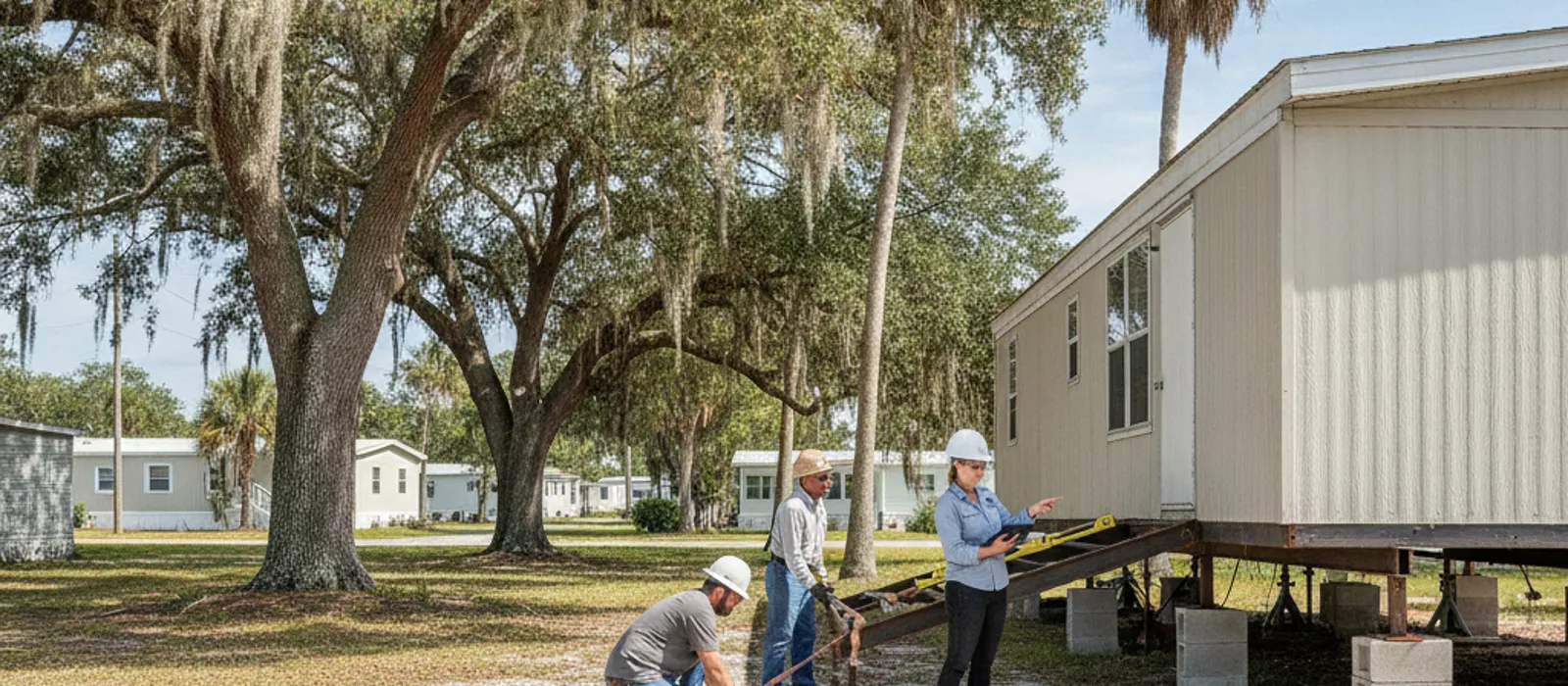
Put on old clothes, bring a flashlight and your phone camera, and open a skirting access panel. This is where most of the deal-changing problems hide.
1. Piers, blocks, and level
Look at the block piers holding up the frame. Are any leaning, cracked, or sinking into the dirt? Are there stacks of loose wood shims taller than an inch or two between the pier cap and the frame? Tall shim stacks mean the home has settled and somebody kept “fixing” it by adding wood.
Inside the home, set a marble on the kitchen floor and a few other spots. If it rolls the same direction every time, the home is off level. Sticking doors and diagonal wall cracks back that up. Our post on the signs a mobile home needs leveling walks through the full symptom list.
2. Tie-downs and anchors
Count the anchor straps and look at their condition. In Florida, tie-downs aren’t optional. The state sets minimum anchoring and installation standards for manufactured homes, and insurers care deeply about them. Rust is the enemy here: surface rust is common, but straps that flake, anchors that wobble in the soil, or straps that have snapped entirely are a real cost.
Missing or failed anchors are also a safety issue in wind, so this is not a “fix it someday” item. See what a full tie-down and anchoring job involves before you assume it’s minor.
3. Vapor barrier and belly board
Look up at the underside of the home. The black or gray sheeting (the belly board) should be intact and tight. Hanging insulation, torn sheeting, and patches of missing barrier mean moisture has been getting into the floor system. That’s how you end up with soft floors and mold.
4. Moisture, standing water, and pests
Shine the light across the ground under the home. Standing water, mud, wet spots, or a musty smell all point to drainage problems that will keep attacking the home year after year. While you’re down there, look for animal droppings, chewed insulation, and mud tubes on piers, which signal termites.
Inside the Home: Checks 5 Through 8
The inside tells you what the underside has been doing for the last ten years. You’re not looking for ugly carpet. You’re looking for structural symptoms.
5. Doors and windows
Open and close every door and window in the home. Doors that stick, latch poorly, or swing open on their own are classic settling symptoms. One sticky door is a humidity thing. Five sticky doors is a foundation thing.
6. Soft spots in the floor
Walk every room slowly, including closets and the spots in front of tubs, toilets, and the water heater. Any sponginess or flex underfoot means water has damaged the subfloor. Small soft spots run a few hundred dollars to fix. A bathroom with rot around the tub can run $1,000 to $3,000 or more once the damage is opened up. Our article on soft spots in mobile home floors explains what’s usually happening under the vinyl.
7. Cracks in walls and ceilings
Hairline cracks at drywall seams are normal in an older home. Diagonal cracks radiating from door and window corners, or gaps opening where walls meet the ceiling, suggest the frame has twisted from uneven support.
8. Roof, plumbing, and water stains
Check ceilings for brown stains, especially around vents and in corners. In the bathrooms and kitchen, look under sinks for old leak damage. Ask the seller the age of the roof, water heater, and AC. These aren’t foundation items, but they’re the other big-ticket repairs, and insurers will ask about all of them.
A quick note on real numbers: Ray and Donna were under contract on a 1998 double wide in Belleview last year. The home showed beautifully inside. Under it, an inspection found eleven piers shimmed out with scrap lumber and a low corner that had dropped almost two inches. They took the report back to the seller and negotiated $4,500 off the price. The actual releveling job cost them $1,300. That afternoon under the home paid for itself three times over.
Paperwork, Wind Zone, and Insurance: Checks 9 Through 12
Plenty of used mobile home deals fall apart after closing because of paper problems, not structural ones. Check these before you get emotionally attached.
9. The HUD data plate and the year built
Find the data plate, usually a paper sheet inside a kitchen cabinet, closet, or near the electrical panel. It tells you the year built, manufacturer, and design specs. Homes built before June 15, 1976 predate the HUD code entirely, and most Florida lenders and insurers won’t touch them. HUD’s manufactured housing program sets the construction standards every newer home must meet.
10. Wind zone rating
Florida is divided into wind zones, and Marion County requires homes rated for its zone. The wind zone is listed on the data plate. A home built for a calmer zone up north may not be legal to place here, and moving one in can create a permitting mess.
11. Tie-down certification and insurability
Ask the seller for any existing tie-down certification or a recent four point inspection report. If they don’t have one, price the home as if it needs anchor work until proven otherwise. Getting a home certified after purchase is doable, but you want to know the cost going in.
12. Title, taxes, and permits
Verify the title is clean and matches the seller’s name. In Florida, mobile home titles run through the state’s motor vehicle system, and FLHSMV’s mobile home page explains how titling works, including homes that have been converted to real property. Also ask about permits for any additions, porches, or roof-overs. Unpermitted additions are a common four point inspection failure.
Linda in Summerfield learned the insurance lesson the hard way. She paid cash for a tidy 2003 single wide, then called for insurance. The carrier wanted proof of anchoring, and the inspection found more than half her straps rusted through near the ground. The anchor and strap work came to $2,700 before she could bind a policy. Nothing about the house had changed, but her first month of ownership cost a lot more than she planned.
If you want the foundation side of this checklist handled by someone who does it every day, call us at (352) 820-4441. We work pre-purchase inspections all over Marion, Sumter, and Citrus counties, and we keep a 24/7 line open for buyers up against closing deadlines.
What Repairs Actually Cost in Marion County
Use these ranges to turn inspection findings into negotiation numbers. Every home is different, but these reflect what we commonly see locally.
| Problem found | Typical repair | Common cost range |
|---|---|---|
| Home off level, piers shimmed out | Full relevel | $500 to $2,500 |
| Cracked or sinking piers | Pier replacement | $150 to $400 per pier |
| Rusted or missing anchors | New anchors and straps | $1,500 to $4,000 |
| Torn or missing vapor barrier | New vapor barrier | $800 to $2,500 |
| Soft spots and subfloor rot | Subfloor repair | $300 to $3,000+ |
| Damaged or missing skirting | Skirting replacement | $1,000 to $3,500 |
Two things jump out from that table. First, no single item is usually a deal killer on its own. Second, they stack fast. A neglected home can need four of these at once, and now you’re looking at a five-figure problem. For a deeper breakdown of what drives the biggest line item, read our post on mobile home leveling cost factors.
Carl ran into the stacking problem in Dunnellon. The 1995 double wide he was eyeing was priced $8,000 under comparable homes, which felt like a win. Our look underneath found a shredded vapor barrier, two rotted subfloor sections, and standing water from a bad gutter setup. Total estimated repairs: about $7,800. He didn’t walk away, but he went back to the table with our written estimate and got the seller to split the cost. Without the inspection, that “discount” was no discount at all.
Mobile Home Inspection Before Buying: When to Bring In a Pro
You can handle most of this checklist yourself with a flashlight, a marble, and a free Saturday morning. So when do you stop DIY and bring in a professional?
Call in a pro when any of these show up:
- You find tall shim stacks, leaning piers, or an obvious low corner. Diagnosing how far out of level a home sits takes a water level or laser and experience reading the frame.
- The anchor straps are rusted, loose, or missing. Anchoring work involves tensioned steel straps and state standards, and it’s not a DIY category at all.
- You see widespread belly board damage or smell mold under the home. What’s visible is usually a fraction of what’s there.
- You’re not physically able to get under the home safely. Never crawl under a mobile home that looks unstable or has piers you don’t trust. A home shifting on bad piers is a genuine crush hazard.
A professional foundation inspection also gives you something a flashlight can’t: documentation. A written report with photos and repair pricing is negotiating leverage, and it’s proof for your insurer and lender that the foundation system was evaluated.
One more honest tip: don’t rely on the seller’s handyman or a general home inspector who has never worked on manufactured homes. Mobile home foundations are their own trade, with their own standards. Ask whoever inspects the home how many mobile homes they’ve been under, and see our page on mobile home leveling in Ocala for what a proper foundation evaluation covers.
Ready to look at a home this week? Request your free written estimate or call (352) 820-4441. We’re licensed and insured, we put every finding in writing, and if you’re up against a closing date or an insurance deadline, our emergency line runs 24/7.
Frequently Asked Questions
Can I use a regular home inspector for a used mobile home?
You can, and for the roof, electrical, plumbing, and HVAC, a licensed home inspector is a good idea. But many general inspectors have limited experience with piers, tie-downs, and belly boards, and some won’t go under the home at all. Pair a general inspection with a foundation-specific evaluation from a mobile home contractor so nothing under the frame gets skipped.
How much should I budget for repairs after buying a used mobile home?
For a home that inspected reasonably well, a $2,000 to $3,000 cushion covers the usual first-year surprises. If the inspection flagged foundation issues, use written repair estimates instead of guesses, because leveling, anchors, and subfloor work can range from a few hundred dollars to well over $10,000 combined. The safest move is getting firm numbers before closing and negotiating them into the price.
What year mobile home should I avoid in Florida?
Be very cautious with anything built before June 15, 1976, when the HUD construction code took effect. Most Florida lenders won’t finance pre-1976 homes and most insurers won’t cover them, which also makes them hard to resell. Homes from 1976 to 1994 can be fine but check the wind zone rating closely, since standards tightened significantly in 1994 after Hurricane Andrew.
Will insurance companies inspect the home before covering it?
For most mobile homes more than a few decades old, yes. Florida carriers commonly require a four point inspection covering the roof, electrical, plumbing, and HVAC, and many also want proof of proper tie-downs or a tie-down certification. If the home fails, you’ll have a repair deadline or a declined policy, so it’s far cheaper to find those problems during your pre-purchase inspection than after you own the home.