
Here’s a number that surprises most folks: Florida logs more reported sinkholes than any other state in the country, and Marion County sits right inside the belt geologists watch closest. If you own a mobile home here, you’ve probably wondered at least once whether that new crack or that low spot in the yard means something serious.
The good news is that most of what looks scary turns out to be ordinary settling. The trick is knowing the difference. This guide walks through the real sinkhole signs Marion County mobile home owners should watch for, how to tell them apart from normal soil movement, and what it actually costs to get answers.
We level and support mobile homes across Marion, Sumter, and Citrus counties every week, so we see both sides: homes that just need a relevel, and the rare ones that need a geologist. Let’s sort out which is which.
Why Marion County Sits in Sinkhole Country
Marion County sits on limestone. Lots of it, and fairly close to the surface. Rainwater picks up a mild acid as it moves through soil, and over thousands of years that acid slowly dissolves the limestone underneath us. That process is called karst, and it’s why Florida has springs, caverns, and yes, sinkholes.
The Florida Department of Environmental Protection keeps a whole program on this, and their maps show central Florida, including Marion County, in the zone where cover-subsidence and cover-collapse sinkholes both occur. You can read their plain-language overview at the Florida Geological Survey sinkhole page.
Two types matter for homeowners:
Cover-subsidence sinkholes form slowly. Sand filters down into voids in the limestone over years, and the ground surface settles gradually. These are the common ones around here, and they usually show up as slow, spreading depressions rather than dramatic collapses.
Cover-collapse sinkholes are the ones that make the news. A clay layer bridges over a growing void until it suddenly can’t, and the ground drops fast. These are rare, but they’re the reason you shouldn’t ignore certain warning signs.
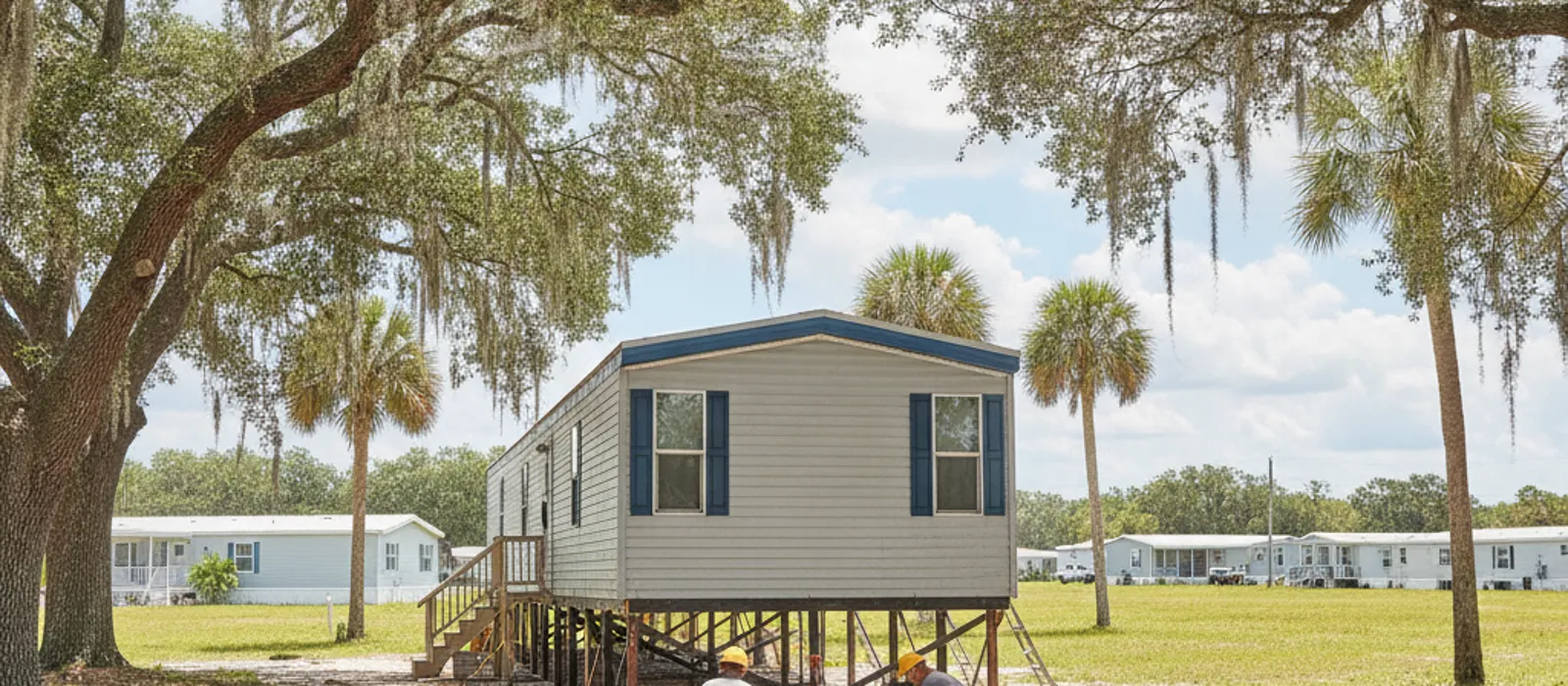
Mobile homes actually give you an advantage here that site-built homes don’t. Because your home sits on piers over a crawl space, the ground underneath is visible. You can literally look at the soil your home stands on, which means problems tend to announce themselves early if you know what to look for.
If you’re not sure your setup is even stable to begin with, our mobile home leveling service in Ocala includes a full pier and soil check. Or just call us at (352) 820-4441 and describe what you’re seeing. That first conversation is free, and we’ll tell you straight whether it sounds like settling or something worth escalating.
Sinkhole Warning Signs Marion County Homeowners Notice First
Most sinkhole activity announces itself outside before it touches the home. Here’s what to scan for on a monthly walk around your property.
Circular or oval depressions in the yard. Normal settling from fill dirt tends to be irregular. Sinkhole-related subsidence often forms a rough circle or bowl shape that deepens over weeks or months. If you can stand in the middle of a dip and see the ground sloping toward you from all sides, pay attention.
Fence posts, trees, or skirting that start leaning toward one spot. When soil moves down and inward toward a void, everything anchored in that soil tilts toward the center. One leaning fence post means a rotten post. Three posts leaning toward the same point means the ground is moving.
A new pond that shouldn’t be there. Water finds low spots. If rain suddenly starts pooling where it never did before, or a wet spot stays soggy days after everything else dries out, the ground under it may have dropped. Standing water under the home is its own problem too, and we cover that in our post on water under a mobile home, and it deserves its own fix.
Wilting vegetation in a defined patch. When soil ravels downward, plant roots lose contact with moisture. A circle of stressed grass in an otherwise green yard is a classic early sign, according to the USGS Water Science School.
Cloudy well water. If you’re on a private well and your water suddenly turns cloudy or gritty, sediment may be moving underground. That’s worth a call to a well contractor and worth noting if other signs appear.
None of these alone proves a sinkhole. All of them together, clustered in one area, is a pattern worth taking seriously.
Sinkhole Signs Under a Mobile Home: What to Check in the Crawl Space
This is where mobile home owners have the edge. Twice a year, take a flashlight and look under your skirting. Here’s what separates routine wear from a red flag.
Piers that have sunk unevenly, fast. Every mobile home in Florida settles some. Sandy soil compacts, and piers drop a quarter inch here and there over years. That’s normal, and it’s why releveling is routine maintenance. What’s not normal is one section of piers dropping an inch or more in a few months while the rest stay put. Localized, rapid drop points to localized soil loss.
A visible depression or soft cone in the crawl space soil. Get low and shine your light across the ground under the home. The soil should be roughly flat. A bowl-shaped dip, especially one with loose sand funneling toward its center, is the single most direct sinkhole sign you can spot under a mobile home.
Pier pads tilting toward a common point. Same logic as the fence posts. Pads and footings tilt toward the soil that’s leaving.
Fresh gaps between the ground and pier pads. If a pad that used to sit flush on the soil now has daylight under one edge, the ground moved. Note it, photograph it, and date the photo.
Inside the home, the signs echo what’s happening below. Doors that suddenly won’t latch, cracks that appear over doorways and windows, and floors that develop a slope all track ground movement. The catch is that every one of those symptoms is also a symptom of ordinary settling. Our guide on signs your mobile home needs leveling walks through the common, non-scary causes first, because that’s where most homes land.
Here’s a real example. Ruth in Belleview called us last spring convinced she had a sinkhole. Her back door had stopped latching, her hallway felt tilted, and a crack had opened over the kitchen window. She’d already gotten a quote for $2,500 of engineering work. We crawled the home first and found four piers on the north side had settled into soil that stayed wet from a misdirected gutter downspout. The fix was a relevel and new pier pads for $680, plus a $40 downspout extension she installed herself. No sinkhole, no engineer needed.
Sinkhole or Settling? How to Tell the Difference
The honest answer is that in Marion County, settling explains the overwhelming majority of what homeowners see. Sandy soil, heavy summer rain, and piers doing their job under a moving load will produce sticking doors and hairline cracks all on their own. We wrote up the mechanics in why mobile homes settle in Florida.
Still, there are patterns that point one way or the other. Use this table as a first filter, not a final verdict.
| What You See | Points to Normal Settling | Points to Possible Sinkhole Activity |
|---|---|---|
| Speed of change | Gradual, over years | Fast, over weeks or a few months |
| Shape on the ground | Irregular, follows fill dirt or drainage | Circular or bowl-shaped depression |
| Location | Spread across the home, worst at edges | Concentrated in one zone, inside and out |
| Cracks | Hairline, at seams and corners | Widening cracks that grow week to week |
| Yard clues | None, or general low spots after rain | Leaning posts, dying patch of grass, new pond |
| After releveling | Home stays level for years | Same section drops again within months |
That last row matters most. A properly releveled mobile home on stable soil should hold its level for three to five years or more. If we relevel a section and it sinks again in six months, we tell the homeowner plainly that the soil needs professional evaluation, and we help them find a licensed geotechnical firm. Releveling over an active void just buries the evidence.
Marcus in Dunnellon lived that sequence two years ago. His double-wide’s southwest corner dropped, got releveled by another outfit, then dropped again inside a season. When he called us, we found a two-foot-wide cone of raveling sand under that corner and a matching depression in the yard outside the skirting. We told him not to spend another dollar on leveling until the ground was tested. A geotechnical firm ran soil borings for $2,400, confirmed an active raveling zone, and his insurance carrier handled remediation from there. Total ground stabilization came in around $17,000, covered under his policy’s catastrophic ground cover collapse provision. The $2,400 test protected a claim worth many times that.
What Sinkhole Checks and Repairs Actually Cost
Money questions deserve straight answers, so here are the ranges we see homeowners in Marion, Sumter, and Citrus counties actually pay.
A visual under-home inspection from a leveling contractor runs $150 to $400, and many companies, ours included, credit it toward repair work. A full geotechnical investigation with soil borings runs $1,500 to $4,000 depending on how many borings the engineer needs. Ground stabilization for a confirmed sinkhole, usually compaction grouting, runs $10,000 to $40,000 or more, though that’s the scenario insurance most often covers.
Compare that to the routine fixes. A standard relevel runs $450 to $1,200 for most single-wides and $800 to $2,500 for double-wides, and our mobile home leveling cost guide breaks down what moves the price. Replacing a few sunken piers typically adds $150 to $300 per pier.
The math tells you the smart order of operations. Spend a couple hundred dollars on an under-home inspection first. If the evidence points to settling, you’ve solved it for four figures. If it points to the ground itself, you’ve caught it early, and early matters both for safety and for your insurance claim.
One more cost angle Florida owners should know. Standard homeowners policies here must offer coverage for catastrophic ground cover collapse by law, but full sinkhole coverage is an optional add-on with its own deductible. Pull out your policy and check which one you carry before you ever need it. If you’re buying a home, fold this into your due diligence before you sign anything.
Denise in Summerfield learned the value of checking early. She noticed her skirting buckling along one side and a soft dip in the lawn beside it. Our inspection found the piers fine but the perimeter soil eroding from roof runoff, cutting a channel that mimicked subsidence. A $520 relevel of two piers and a gutter fix ended it. She’d been quoted $3,000 by a company that wanted to “stabilize” the whole side of the home without ever crawling under it.
What to Do the Day You Spot Something
Keep this simple sequence handy.
Step 1: Photograph and date everything. Cracks, dips, leaning posts, gaps under piers. Put a tape measure or a coin in the frame for scale. A dated photo series is the cheapest diagnostic tool there is, proving whether things are changing and how fast.
Step 2: Mark crack ends with a pencil. Write the date at the tip of each crack. If the crack grows past your mark in a few weeks, you’ve turned a guess into data.
Step 3: Stay out of obvious depressions. If the ground has visibly dropped, don’t walk on it, don’t drive on it, and keep kids and pets away. Rope it off. If a hole opens suddenly near or under the home, get everyone out and call Marion County emergency management. That’s the one true drop-everything scenario, and it’s rare.
Step 4: Get an under-home inspection. For anything short of an emergency, start with a professional crawl-space evaluation. This is the stop-DIY line. Crawling under a home with actively shifting piers is dangerous, and probing suspect soil yourself can collapse a void. Let someone with jacks, experience, and insurance make the call.
Step 5: Escalate honestly. If the inspection points to settling, fix it and recheck in six months. If it points to the ground, bring in a licensed geotechnical engineer and loop in your insurance carrier early.
Watch the yard, check the crawl space twice a year, photograph changes, and act on patterns instead of single scary moments.
If something under your home doesn’t look right, don’t sit on it and don’t panic either. Request a free written estimate or call our line at (352) 820-4441, which is answered 24/7 for inspection deadlines and time-sensitive situations. We’ll tell you honestly whether you need us, an engineer, or nobody at all.
Frequently Asked Questions
How common are sinkholes in Marion County?
Marion County sits in Florida’s karst region, so subsidence reports happen every year, but confirmed damaging sinkholes under homes remain rare. The Florida Geological Survey tracks subsidence incident reports statewide, and most turn out to be ordinary settling, buried debris, or erosion. Check under your home twice a year and act on fast changes.
Will my insurance cover sinkhole damage to a mobile home?
Florida law requires insurers to offer catastrophic ground cover collapse coverage, which pays when the ground abruptly collapses, the home is condemned, and the damage is visible. Full sinkhole loss coverage, which pays for less dramatic sinkhole damage, is an optional endorsement many owners skip. Read your specific policy, because the two coverages pay in very different situations. Document everything with dated photos from the first sign onward, since claims often hinge on timelines.
Can releveling fix a home over a sinkhole?
No, and any contractor who says otherwise is selling you the wrong fix. Releveling restores a home over stable soil, and it’s the right repair for the vast majority of sunken piers in our area. If the soil itself is raveling into a void, the ground needs stabilization by a geotechnical specialist first, usually through compaction grouting. After the ground is certified stable, releveling is the finishing step, not the cure.
How do I tell sinkhole activity from normal settling after heavy rain?
Rain-related settling is broad, gradual, and worst where drainage is poor, and it usually stabilizes once the soil dries. Sinkhole activity is concentrated, often circular, and keeps progressing in dry weather. If the same spot keeps dropping after repairs, or a depression deepens without rain, treat it as a soil problem, not a leveling problem. Our post on mobile home settling after rain covers the drainage side in detail.