
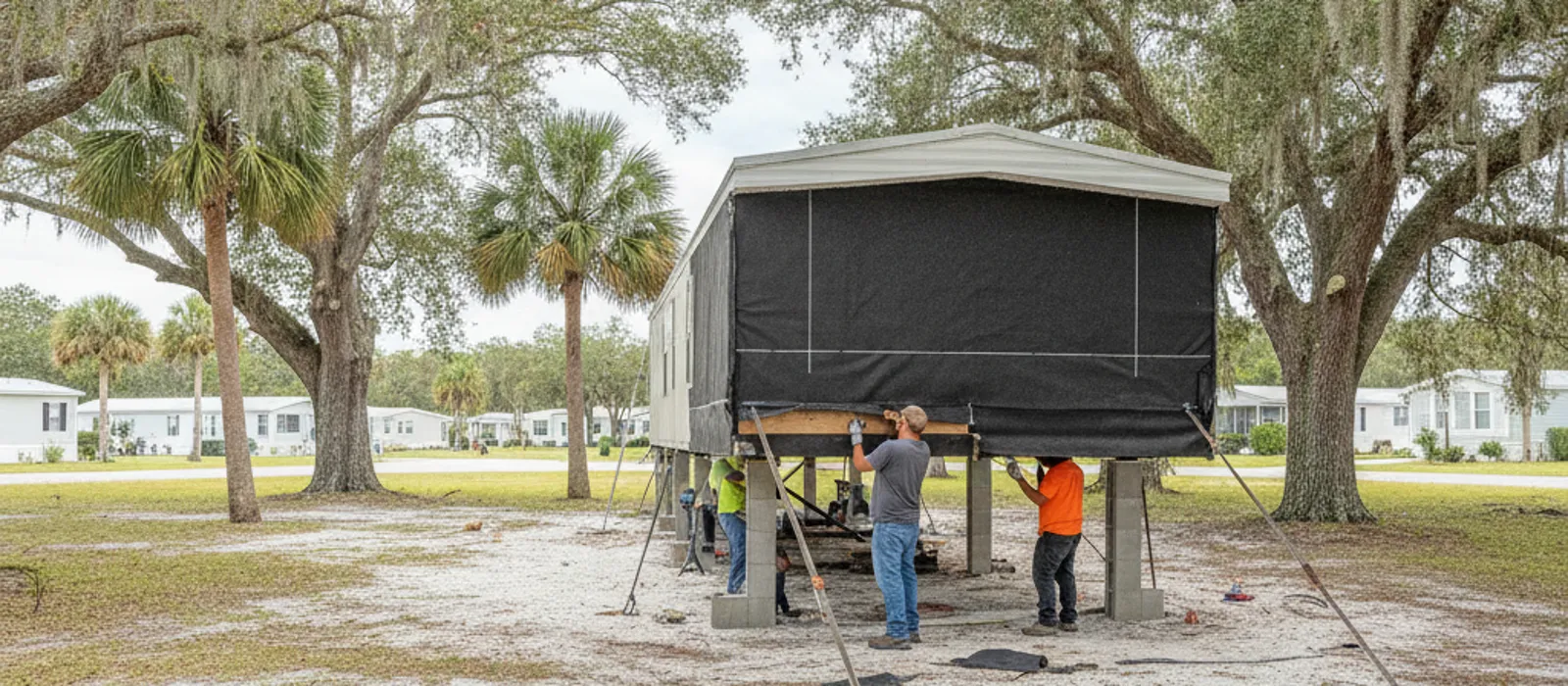
That gray fabric sagging under your mobile home isn’t just cosmetic. It’s the only barrier between your insulation, ductwork, and plumbing and every rainstorm, raccoon, and humid August night in Marion County. Once it tears, everything above it is exposed.
The good news is that mobile home belly board repair is one of the most fixable problems we see. Most jobs run a few hundred dollars, not thousands, if you catch the damage early. This guide walks through what the belly board actually does, how it gets damaged, how pros repair it step by step, and what it costs around Ocala. By the end, you’ll know whether your home needs a simple patch or a full rewrap, and how to tell the difference from your driveway.
What the Belly Board Does (and Why It Tears)
The belly board goes by a lot of names: belly wrap, bottom board, underbelly, belly paper. On older homes it was literally asphalt-impregnated fiberboard. On anything built since the 1980s, it’s usually a woven polyethylene fabric stapled or taped to the underside of the floor joists.
That fabric does four jobs at once. It holds the floor insulation up against the subfloor. It blocks ground moisture from rising into the floor cavity. It keeps rodents, snakes, and insects out of your insulation. And it’s part of the moisture control system that HUD requires on every manufactured home, which you can read about in the federal construction standards at HUD’s Manufactured Housing program.
When the belly tears, all four jobs stop getting done. Insulation slumps and falls. Humid air condenses inside the floor cavity. Critters move in and shred what’s left. And when a 4-point inspector crawls under your home before a sale or insurance renewal, a torn belly goes straight into the report.
Here’s the part most homeowners miss: belly damage rarely stays a belly problem. Wet insulation sits against your subfloor, and within a year or two you’re feeling soft spots in the floor near the bathroom or kitchen. Fixing a $300 tear now beats a $2,000 subfloor job later.
If you’re not sure what’s going on under your home, don’t guess. Request a free written estimate and we’ll crawl under there, photograph everything, and tell you exactly what you’re dealing with. No obligation, and you keep the photos.
The Three Ways Belly Board Damage Starts
Almost every torn underbelly we see in Ocala traces back to one of three causes.
Water from above. A slow leak at a supply line, a sweating AC duct, or a loose drain fitting drips into the belly. The fabric is designed to shed ground moisture from below, so water from above just pools inside it. The belly stretches into a low, heavy sag that looks like a water balloon. Manny in Summerfield found one the size of a kiddie pool under his master bath. A pinhole leak in a PEX fitting had been dripping for months. The plumber fixed the line for $185, then we drained the belly, cut out the ruined section, replaced the soaked insulation, and sealed in new fabric for $640. Total damage: under $850. If he’d waited another six months, the subfloor would’ve gone too.
Animals. Raccoons, possums, rats, and feral cats treat a warm, insulated belly like a move-in-ready apartment. They tear an opening, pull down insulation for bedding, and invite friends. Ruth in Belleview heard scratching under her floor for two weeks before she called. A raccoon had opened a three-foot gash and destroyed the insulation across two joist bays. After a wildlife trapper removed the tenant, our repair with new insulation and a sealed patch ran $1,150. Her first quote from another outfit was $4,300 for a “mandatory full replacement” she didn’t need. If you hear movement down there, start with our guide to animals under a mobile home.
Age and contact damage. Staples rust, tape adhesive gives up in Florida heat, and every plumber or cable installer who’s ever crawled under the home leaves a slice behind. These small openings grow. Wind gets under a loose edge and peels fabric like a sticker. Twenty-year-old belly wrap fails a little more every summer, and standing water under the mobile home speeds the whole process up by keeping the crawl space humid year-round.
How Pros Handle Mobile Home Belly Board Repair, Step by Step
A proper mobile home belly board repair follows the same sequence every time. If a contractor skips steps, the repair fails, usually within a year.
Step 1: Find and fix the cause. Patching over an active leak is throwing money in the trash. We check plumbing, duct connections, and drainage first. If the home has settled and pulled duct joints apart, that gets flagged too, because an unlevel frame stresses everything attached to it. Homes that need it get referred to our mobile home leveling service in Ocala before or alongside the belly work.
Step 2: Drain and open the damaged area. Sagging, water-filled sections get punctured at the low point and drained, then cut back to clean, dry fabric. You can’t tape new material to wet, stretched, dirt-caked wrap and expect it to hold.
Step 3: Remove wet insulation. Fiberglass that’s been soaked doesn’t dry out and bounce back under a floor. It stays matted and loses most of its insulating value, and it can hold enough moisture to feed mold. The Department of Energy’s guidance on insulation is blunt about this: wet fiberglass needs to be replaced, not reused.
Step 4: Inspect what’s exposed. With the belly open, this is the one chance to look at the subfloor, joists, plumbing, and duct runs without paying separately for access. A good crew photographs all of it. This is also the moment to fix small plumbing insulation gaps or re-strap a sagging duct for a few extra dollars instead of a separate service call.
Step 5: Install new insulation and fabric. New fiberglass goes up into the joist bays, then new polyethylene belly fabric gets stretched across the opening with at least a 4 to 6 inch overlap onto sound existing material. The seams get sealed with belly board tape made for the job, not duct tape, and mechanical fasteners where the framing allows. Done right, the patch is tighter than the original factory wrap.
Step 6: Address the ground moisture. If the soil under the home is bare and damp, the new belly will fight humidity every day of its life. A ground vapor barrier cuts that moisture load dramatically. Since the crew is already under the home, adding one is cheap insurance. Here’s what our vapor barrier service in Ocala includes and why inspectors love seeing one.
Most single-section repairs take two to four hours. A full rewrap of a single wide is typically a one-day job.
Belly Board Repair Cost in Ocala and Marion County
Here’s what belly work actually runs in our area. Every home is different, but these ranges cover the large majority of jobs we quote.
| Repair type | Typical cost | When it makes sense |
|---|---|---|
| Small patch, under 2 sq ft | $150 to $350 | Installer slices, single small tear, dry insulation |
| Section repair with new insulation | $400 to $900 | Animal damage or a drained leak sag in one area |
| Multi-section repair | $900 to $1,800 | Several tears, insulation down in multiple bays |
| Full belly replacement, single wide | $1,500 to $3,000 | Fabric failing everywhere, original board rotted |
| Full belly replacement, double wide | $2,500 to $4,500 | Same, larger footprint and marriage line work |
| Ground vapor barrier add-on | $600 to $1,200 | Bare damp soil, mold smell, inspection prep |
Three things move the price inside those ranges: how much insulation has to be replaced, how much working room there is under the home, and whether plumbing or duct repairs happen at the same time. Skirting that has to come off and go back on adds a little labor. If your skirting is already bowing or popping loose, that’s its own warning sign, and it’s worth reading about skirting that’s buckling because the two problems often share a cause.
One more number worth knowing: if belly damage has already soaked the subfloor, you’re into different territory. Our breakdown of mobile home subfloor repair costs shows why that bill starts around $400 per room and climbs fast. The belly is the cheap fix. The floor above it is the expensive one.
Want a real number for your home instead of a range? Call us at (352) 820-4441 and we’ll schedule a free written estimate. If you’re up against a closing date or an insurance deadline, our line answers 24/7.
Patch or Replace? How to Decide
Nobody wants to pay for a full rewrap when a $300 patch would do, and nobody wants to pay for a third patch on a belly that should’ve been replaced last year. Here’s the honest framework we use.
Patch when the damage is localized, the surrounding fabric is still strong, the insulation outside the damaged area is dry, and the belly is under about 15 years old. A tear from an animal or a plumber’s cut on an otherwise healthy belly is a patch, full stop. Anyone quoting a full replacement for one tear should have to show you photos that justify it.
Replace when the fabric tears in your hand while you’re testing it, when there are sags and staple failures across most of the footprint, when the original fiberboard bottom is crumbling, or when you’re already paying for major work underneath like pier replacement. Pre-1990s homes with original asphalt bottom board almost always land here.
The in-between case is the pre-sale home. Carl and Dena were selling their Lady Lake single wide last spring when the buyer’s 4-point inspection flagged “deteriorated underbelly with exposed insulation” ten days before closing. A patch might have technically held, but the inspector had photographed sags in four areas. We did a half-home rewrap with new insulation for $1,400 on three days’ notice, the reinspection passed, and the sale closed on time. If a sale is on the line, fix it to the standard the inspector will apply, not the minimum the fabric will tolerate. Our guide to the 4-point inspection on a mobile home covers what else those inspectors look for underneath.
DIY Belly Repair: What’s Safe and Where to Stop
Handy homeowners can do some of this, and we’ll tell you straight which parts.
Reasonable DIY: taping a small clean slice with real belly board tape (flex mend style, not duct tape), re-securing a loose edge with cap staples, and clearing debris away from the belly so it can breathe. Clean the fabric with a dry rag first, press the tape hard for a full minute, and overlap the tear by at least two inches on every side.
Stop and call a pro when the belly is holding water, when insulation is hanging down or missing, when you smell mold or see black staining, when the damage sits near electrical runs or under the marriage line of a double wide, or when any animal larger than a mouse has been living up there. Draining a water-filled belly sounds simple until forty gallons come down on top of you in a 22-inch crawl space. Wet insulation can also hide damaged wiring and rotted subfloor that need a trained eye.
And one hard rule: never crawl under a home that isn’t properly supported, and never work under one while jacking or leveling is in progress. If your floors are bouncy or doors have started sticking, the frame may already be shifting on its piers, and that’s a sign your mobile home needs leveling before anyone spends hours underneath it.
If any of that list describes your home, skip the crawl and send us a message or call (352) 820-4441. We’re licensed and insured, estimates are free and in writing, and we serve Ocala plus all of Marion, Sumter, and Citrus counties.
Frequently Asked Questions
How do I know if my belly board is damaged without crawling under the home?
Walk the perimeter with a flashlight and look through skirting vents or pull one skirting panel. Sagging fabric, hanging insulation, or daylight through tears are the obvious signs. From inside the home, cold floors in winter, a musty smell, higher power bills, and scratching noises at night all point underneath. If you spot any of these, get a professional inspection before the damage spreads.
Can I just use duct tape or a tarp to fix a belly board tear?
Not for anything you want to last. Duct tape adhesive fails fast against belly fabric in Florida heat and humidity, usually within months. Purpose-made belly board repair tape bonds to the polyethylene and holds for years, and larger openings need new fabric mechanically fastened, not just taped. A tarp stapled underneath traps moisture and makes things worse.
Does homeowners insurance cover mobile home belly board repair?
Sometimes, and it depends on the cause. Sudden events like a burst pipe or storm damage are often covered, while gradual wear, animal damage, and long-term leaks usually aren’t. Document everything with photos and dates before any repair starts. A written estimate that identifies the cause gives your adjuster something concrete to work with, and we provide that with every quote.
How long does a belly board repair last?
A properly sealed patch on healthy fabric should last 10 years or more, often the remaining life of the original wrap. A full rewrap with new polyethylene fabric commonly lasts 20 to 30 years if the ground stays reasonably dry and animals stay out. Pairing the repair with a ground vapor barrier and intact skirting is the best way to protect that lifespan.