
Does your coffee cup rattle when someone walks through the living room? That little jiggle feels harmless, maybe even funny, right up until you realize your floor is trying to tell you something.
Bouncy floors in a mobile home are one of the most common calls we get here in Marion County, and they’re almost never about the flooring you can see. The carpet, the laminate, the vinyl planks, they’re just passengers. The real story is happening underneath, in the piers, the frame, the subfloor, and the moisture barrier that most homeowners never look at.
The good news? Most of the causes are fixable for a few hundred to a couple thousand dollars, and catching them early is the whole game. Let’s walk through what’s actually going on under your feet.
Why Bouncy Floors in a Mobile Home Are Worth Taking Seriously
A little squeak in a 30-year-old single wide isn’t a five-alarm emergency. But bounce and squeak are early symptoms, and the conditions that cause them tend to get worse on their own, never better.
Here’s the chain reaction we see over and over in Ocala:
- A few piers settle or a shim works loose after a wet summer.
- The frame drops slightly in that spot, and the floor above loses support.
- The floor starts to flex when you walk on it. That’s the bounce.
- Flexing works fasteners loose and opens gaps. That’s the squeak.
- If moisture is involved, the particleboard subfloor softens, and bounce turns into soft spots and eventually holes.
Every step in that chain costs more to fix than the one before it. A relevel might run $450 to $900. Replacing rotted subfloor in three rooms can run several thousand. That’s why we tell folks not to ignore the bounce, even when it seems minor.
Not sure how bad yours is? Call us at (352) 820-4441 and describe what you’re feeling underfoot. We’ll tell you straight whether it sounds like a quick fix or something that needs eyes under the home. Estimates are free and in writing.
The Usual Suspects Under Your Floor
When we crawl under a home in Silver Springs or Belleview with bouncy floors, we’re looking at five things in a specific order.
1. Settled or leaning piers
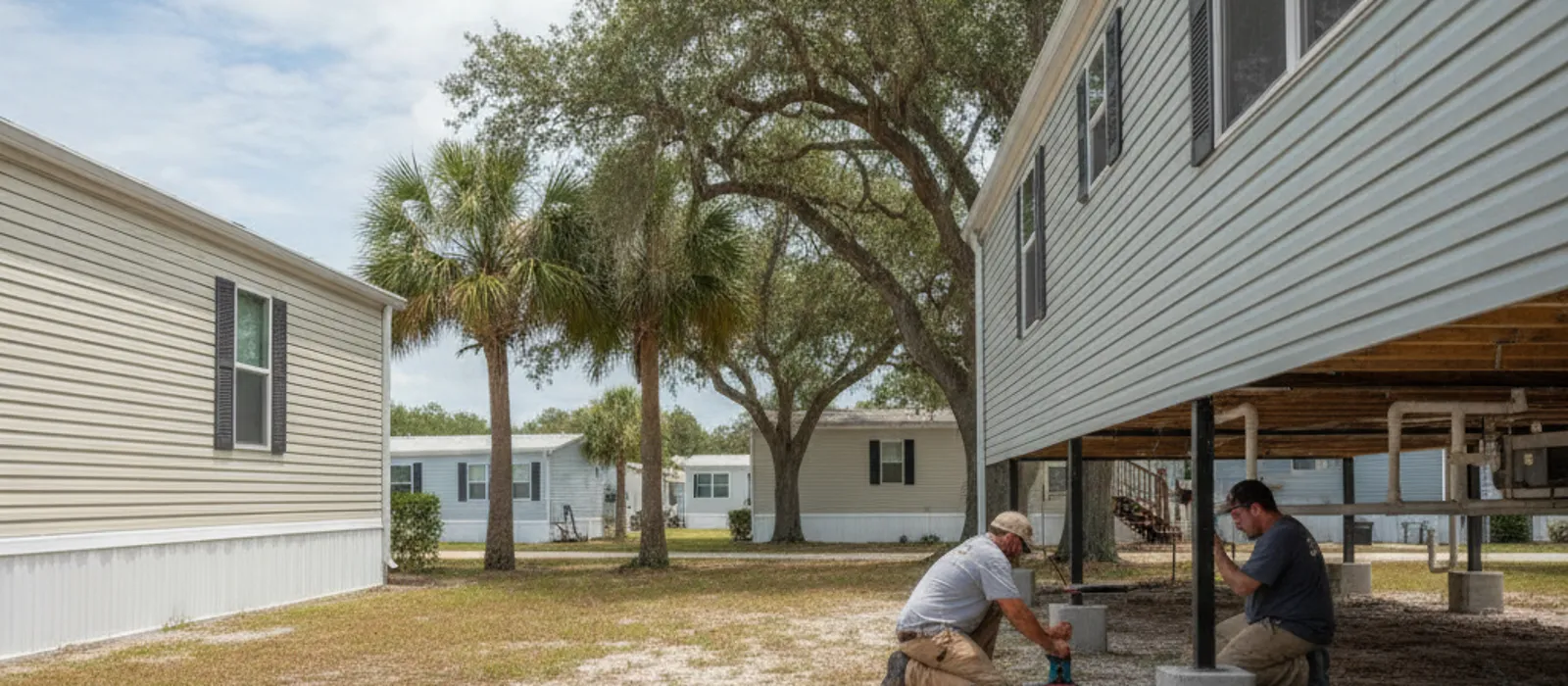
Your mobile home sits on piers, usually concrete blocks on pads, spaced every 6 to 8 feet along the steel frame. Central Florida’s sandy soil shifts, especially after heavy rain. When a pier settles even half an inch, the frame above it sags and the floor loses its stiffness in that zone.
This is the number one cause of bounce we find. It’s also the most affordable to fix, because the pier itself is usually fine. It just needs to be reset and re-shimmed as part of a professional releveling.
2. Loose or crushed shims
Shims are the small wedges between the pier cap and the frame. Over time they compress, split, or vibrate loose. A loose shim means the frame can move up and down slightly with every footstep. That movement is exactly what you feel as bounce and hear as squeaking where the frame meets the floor joists.
3. Moisture-damaged subfloor
Most older mobile homes used particleboard subfloor, which handles moisture about as well as a saltine cracker. A plumbing drip, a torn belly board, or humid air rising from bare ground will soften it over a few seasons. Softened subfloor flexes, squeaks, and eventually crumbles.
If your bounce comes with a spongy feeling near tubs, toilets, or exterior doors, read our guide on soft spots in a mobile home floor, because you’re likely dealing with both problems at once.
4. Torn belly board and missing vapor barrier
The belly board (also called belly wrap) is the black fabric layer under your home that keeps moisture out of the insulation and subfloor. When it’s torn, ground moisture rises straight into the wood. A ground vapor barrier is your second line of defense, and a lot of older homes in Marion County never had one installed at all.
The EPA notes that controlling moisture is the key to preventing mold growth in any home, and that’s doubly true in a crawl space over Florida sand. You can read their guidance at epa.gov/mold.
5. Damaged joists or frame issues
Least common, but most serious. If a joist has cracked or rotted, or the steel frame has rust damage, the floor above it will bounce no matter how good the piers look. This is a stop-and-call-a-pro situation every time.
A Tale of Two Floors: Real Fixes, Real Numbers
Two quick stories from our service area show how different the same symptom can turn out to be.
Carol in Belleview called about a bouncy hallway in her 1998 double wide. Her coffee table wobbled when her grandkids ran through. Under the home, we found four piers that had settled after last summer’s rains and a dozen loose shims. No water damage at all. A full relevel with new shims came to $680, done in one morning. Her floor firmed up the same day.
Mike in Summerfield had what sounded like the same problem, a bouncy, squeaky kitchen floor in his single wide. Underneath, the story was different. A slow drain leak had soaked through a torn section of belly board, and about 40 square feet of particleboard subfloor had gone soft. His fix ran $1,850: subfloor replacement in the kitchen, belly board patching, and fixing the leak source. He told us later the squeak had been there for two years. If he’d called at year one, the subfloor might have survived.
Same symptom. One fix cost $680, the other $1,850. The difference was mostly time and moisture.
What It Costs to Fix Bouncy and Squeaky Mobile Home Floors
Here’s the honest range of what these repairs run in the Ocala area. Every home is different, but this table will keep anyone from quoting you fantasy numbers.
| Underlying cause | Typical fix | Typical cost range |
|---|---|---|
| Settled piers, loose shims | Full relevel with new shims | $450 to $900 |
| A few crushed or failed piers | Pier replacement plus relevel | $700 to $1,500 |
| Small soft spot (one area) | Subfloor patch, 10 to 30 sq ft | $300 to $800 |
| Widespread subfloor damage | Subfloor replacement, multiple rooms | $1,500 to $4,500+ |
| Torn belly board | Belly wrap patch or reseal | $200 to $600 |
| No ground moisture control | Vapor barrier installation | $1,200 to $3,000 |
| Cracked or rotted joist | Joist sistering or replacement | $400 to $1,200 |
Costs stack when problems overlap, which they often do. But notice the pattern: everything on the top half of that table is a few hundred dollars, and everything on the bottom half is what the top half turns into when it’s ignored. For a deeper breakdown of the wood repair side, see our post on mobile home subfloor repair costs.
How to Check It Yourself Without Crawling Under the Home
You can learn a lot from inside the house, no crawling required.
Do the bounce map. Walk every room slowly and mark where the floor flexes. Bounce concentrated along the center line of a double wide often points to marriage line pier issues. Bounce near exterior walls points to perimeter piers or moisture coming in at the edges.
Check doors and windows nearby. If doors near the bouncy area stick or won’t latch, that’s a strong sign the frame has moved, not just the floor. Sticking doors plus bounce almost always means the home needs leveling. Our article on signs your mobile home needs leveling covers the full checklist.
Press test suspicious spots. Push down hard with your heel near tubs, toilets, the water heater closet, and under windows. Firm flex that springs back is usually a support issue. A dead, mushy feeling is water damage.
Look at your skirting. Skirting that’s buckling, bowing, or pulling away can indicate the home has shifted on its piers.
Peek through a skirting vent with a flashlight. You’re looking for hanging or torn black fabric (belly board damage), standing water, or piers that look tilted. Don’t go under the home. Just look.
Now, here’s where we draw the DIY line. Checking is fine. Crawling under a home to adjust piers or add shims yourself is not. A mobile home can weigh 15,000 to 40,000 pounds, and a pier that shifts while you’re under there is a genuinely life-threatening situation. Jacking and shimming needs proper equipment, cribbing, and someone who knows the frame points that can take the load. HUD’s manufactured housing program sets the standards these homes are built and installed to, and you can find their resources at hud.gov. Leave the under-home work to people with insurance and hydraulic jacks.
If your inspection turns up anything from the list above, request a free written estimate and we’ll get eyes underneath safely.
What a Professional Fix Actually Looks Like
When we come out for bouncy or squeaky floors, here’s the process, so you know what you’re paying for.
First, we run a water level or laser level across the frame to map exactly which sections have dropped and by how much. Guessing isn’t good enough. A floor can feel bouncy in the living room because of a pier 12 feet away.
Second, we inspect every pier, cap, and shim, plus the belly board, for moisture staining, torn wrap, and pest damage. If we see rust on your anchors or straps while we’re down there, we’ll flag it, since that matters for your insurance and your 4-point inspection.
Third, we jack the low sections in small, even lifts, reset or replace piers as needed, and install new hardwood or steel shims tight to the frame. Then we re-check level across the whole home, because lifting one section changes the load on its neighbors.
Most relevels take two to four hours. You’ll usually feel the difference the moment you walk back inside: the bounce is gone, and half the squeaks go with it. Squeaks that remain after leveling are usually fastener or subfloor issues, which we can quote separately.
One more story worth telling. Ray and Diane in Lady Lake were selling their 2004 double wide when the buyer’s inspector flagged floor bounce and an out-of-level frame. The sale had 10 days left on the inspection window. We releveled the home for $720 two days after their call, the inspector re-checked and passed it, and the sale closed on time. That’s exactly why we keep a 24/7 line for pre-closing deadlines.
Whether you’re selling, buying, or just tired of the rattle, call (352) 820-4441. If water shows up anywhere in your inspection, mention it when you call, because moisture problems move to the top of the list every time.
Frequently Asked Questions
Are bouncy floors in a mobile home dangerous?
Usually not immediately, but they’re a warning. Bounce from settled piers means your home is losing support in that area, and bounce from wet subfloor can progress to a foot going through the floor. The risk isn’t today, it’s the direction things are heading. Get it diagnosed within a few weeks, not a few years.
Can I fix squeaky mobile home floors from above without going underneath?
Sometimes. Squeaks caused by flooring rubbing on loose fasteners can be fixed by screwing the subfloor down tight to the joists from above. But if the squeak comes with bounce, sticking doors, or soft spots, the cause is under the home, and surface fixes will only quiet it temporarily.
How much does it cost to fix bouncy floors in a mobile home?
In the Ocala area, a relevel with new shims typically runs $450 to $900 and solves bounce caused by settling, which is the most common cause. If moisture has damaged the subfloor, add $300 to $800 for a small patch or $1,500 and up for larger replacement. A free under-home inspection will tell you which situation you have before you spend anything.
Why did my floors get bouncy after a rainy summer?
Central Florida’s sandy soil compacts and shifts when it’s saturated, and the piers under your home sit on that soil. A wet season can settle several piers at once, which is why we see a wave of leveling calls every fall. A properly releveled home with good pads and a ground vapor barrier handles wet seasons far better.